

An Odd Food Law May Make Eating Watermelon In Parks Illegal In One Midwest State

When was the last time you enjoyed a picnic in the park on a warm summer day? Maybe it was recently, or maybe you've only ever imagined the experience. But when you picture a picnic in the park, watermelon is there, isn't it? It's the seminal summer picnic food. It's even one of the best picnic foods to pack to prevent food poisoning. Sweet, juicy, and refreshing, watermelon belongs at cookouts, parties, and beach outings. Unless, of course, you live in Beech Grove, Indiana. Word is there is a law on the books that makes it illegal to eat watermelon in the town's parks.
Beech Grove, so named for the abundance of beech trees, has a population of less than 15,000. The town has five major parks and a trail system. It comes across like the perfect place for summer picnics. But a law against eating watermelon in the park certainly seems out of place. It's also impossible to find on the town's website. There's simply no mention of it in the bylaws.
The lack of an official ruling might make this seem like it came from one of those quirky lists of laws that circulate online without verification. It seems made-up, and silly, yet plausible enough that no one would check the source. However, even though documentation was hard to find, local news affiliate WRTV asked city officials who confirmed that this was a real law.
Why would it be illegal to eat watermelon?
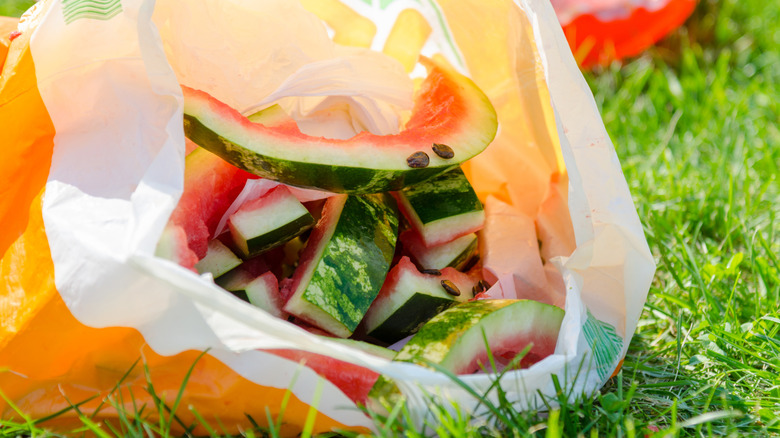
The reason for the ban has been speculated upon but never confirmed, which makes sense since the ban itself can barely be confirmed. In 2015, Indiana Monthly's Hoosierist column, which explores reader questions about Indiana history and lore, tackled the issue. According to the writer, the law was brought about because the rinds were stiff and tended to puncture the trash bags in city parks. So instead of asking visitors to stop throwing out the watermelon rinds, the law was enacted as a way to prevent city workers from having to clean up extra trash in the parks.
The column notes that the law was not widely enforced. It is easy to imagine that being true. Local police patrolling parks to confiscate watermelons doesn't seem like a reasonable use of city resources. Given that city officials confirmed the law was real but could not specify when it came into effect or when it was removed, it suggests the law was not highly regarded by anyone in town.
Plastic trash bags have been used in municipal settings only since the late 1960s and early 1970s. That means the watermelon law could only be about 55 years old at most. People likely were also discarding bottles, cans, and other sharp objects, so singling out watermelon makes little sense. That means there are several reasons the law may have been disregarded shortly after it was enacted. In any event, since it's no longer on the books, if you ever find yourself in Beech Grove, enjoy some watermelon, but maybe candy the rinds instead.