

The Budget-Friendly Beef Cut You Need For Poor Man's Burnt Ends
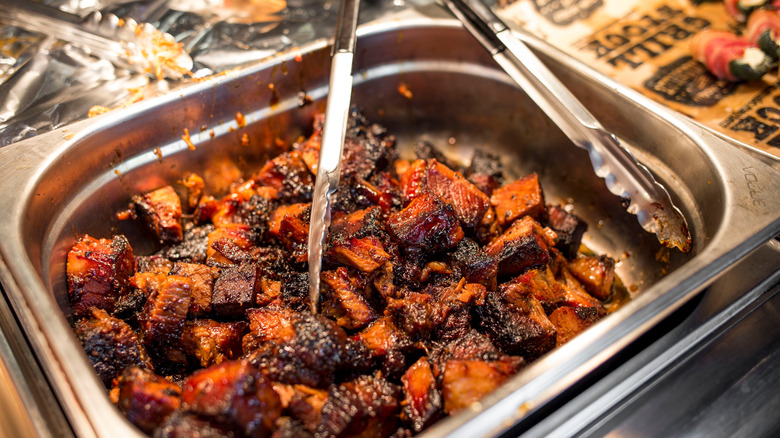
Burnt ends weren't always the coveted barbecue staple they are today. In fact, they were once undesired debris that pitmasters would slash off of brisket before serving the tender meat to patrons. Now, they're on menus in barbecue regions across the U.S., not to mention the pork belly burnt ends you'll find at American and Asian barbecue restaurants. If you want to make burnt ends at home, Scott Thomas, owner of The Grillin' Fools, has some tips on how to make them on a budget.
Burnt ends are traditionally from brisket, but chuck roast is the beef cut you need to make poor man's burnt ends without sacrificing flavor. "Chuck roast is very similar to brisket in that it is a large cut of beef (not nearly as big as a brisket), along with great marbling," Thomas explains. "It is also more tender than brisket to start." Chuck roast is from the shoulder of the cow, while brisket comes from the pectoral muscles. Both are heavily used muscles, resulting in a tougher consistency with connective tissues that need to be broken down.
The brisket you get at your local barbecue joint has likely been slow-cooked in a smoker for hours, effectively breaking down the connective tissues, rendering the fat, and creating that incredible bark. "Due to size and marbling," Thomas elaborates, "it is quite easy to use the same method with a chuck roast to make brisket burnt ends at a lower cost and get pretty similar results."
Tips for poor man's burnt ends

Chuck roast is a great and cheaper alternative to brisket, but there are key differences between the two that will affect the way you prepare your poor man's burnt ends. "The biggest consideration is that the cooking time is a lot shorter for a chuck roast," Thomas tells us. "A whole brisket packer, which consists of the flat and the point, can be twice as large (or more) than a chuck roast." While a large brisket will take up to 16 hours to smoke, a chuck roast will take up to 6 hours in the smoker at around 250 degrees Fahrenheit.
Another reason Thomas gives for brisket's longer cooking time is that "there's more connective tissue with the brisket than the chuck." A longer smoking time also results in better bark, he adds. "Scientifically, it's the combination of the seasoning, liquid fat rendered while cooking, heat, and smoke that forms a black outer layer to the meat," Thomas explains. "Unscientifically, bark is the best part of barbecue."
Don't worry, you can still get a scrumptious bark on a chuck roast using the same techniques as a brisket. Smother your roast in a thick coating of spice rub and smoke between 225 and 275 degrees Fahrenheit uncovered, spraying it with beef stock every so often to prevent drying out. When the bark has set, you can wrap the chuck roast in foil to cook until tender. From there, you can enjoy your delicious poor man's burnt ends.