

Check The Color Of Your Cinnamon, It Might Actually Be Inferior
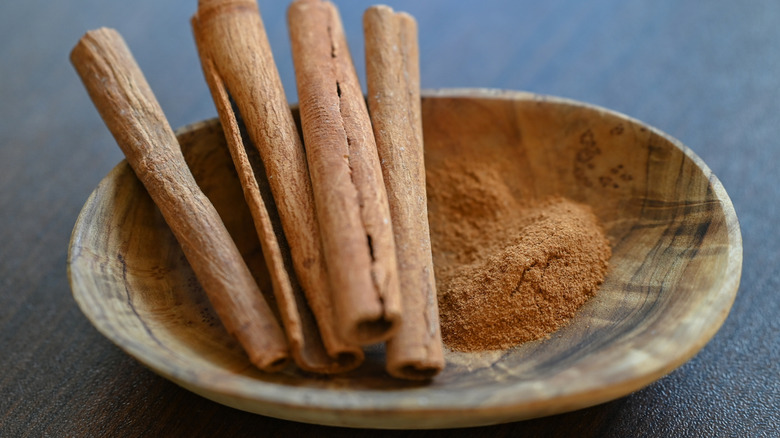
Foodies have been trading in cinnamon for at least 3,000 years.Ceylon and Cassia are the two most common types of cinnamon. Both are widely available and relatively affordable, but Ceylon's quality is prized over Cassia's for its unique taste and aroma. The explanation partly boils down to the fact that these products come from different parts of Asia. Just as terroir impacts the nuanced profiles of specific coffee beans, wine, and cacao beans, geographic origin also influences the profile (and subsequent quality) of cinnamon crop. To identify authentic Ceylon cinnamon, check the color.
High-quality Ceylon cinnamon is pale brown on the surface, and when it's ground into a powder, it has an almost yellowish tone. The inferior Cassia cinnamon, by comparison, has a darker red color that's richer and deeper. A few visual cues can help discerning shoppers extrapolate that cinny-grade. But, if you're purchasing affordable cinnamon from your regular local grocery store, it's probably Cassia. Foodies are more likely to find Ceylon cinnamon in specialty gourmet grocery stores, accompanied by a higher price.
What's behind the quality distinction? Ceylon is packed with over 80 different chemical compounds (chiefly Cinnamaldehyde), all of which contribute to the spice's unique flavor and heightened status. These compounds are linked to beneficial health properties as well, making Ceylon cinnamon a prized choice for certain medicinal practices. It also has 250 times less of the chemical coumarin than Cassia cinnamon, which can be harmful to the body in large doses.
Superior Ceylon cinnamon has multilayered inner quills and a yellowish hue when ground
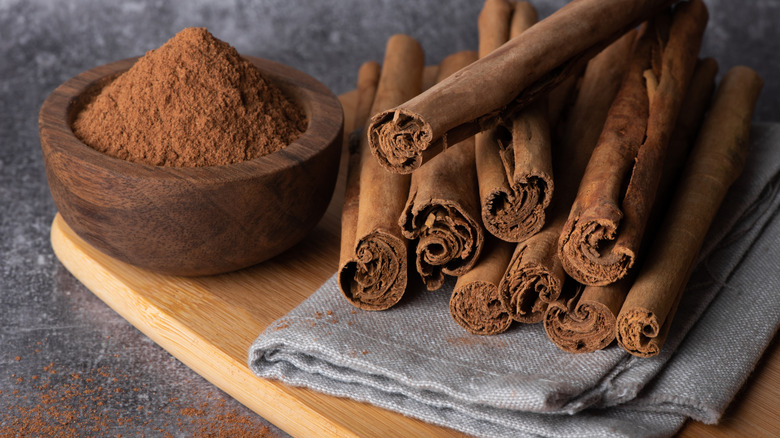
Ceylon cinnamon (aka "true cinnamon") is an agricultural product of Sri Lanka, derived from the inner bark of the South Asian country's indigenous Cinnamomum Zeylanicum tree. In fact, under British colonization, Sri Lanka's national name was "Ceylon" for a time (which is also where the country's prized Ceylon tea export gets its name). That bark is dried until it curls into rolled, cigar-like sticks. Today, the tree is also grown in Madagascar, Seychelles, and Northwestern India, but Sri Lanka alone accounts for roughly 80% of global Ceylon cinnamon exports.
On the palate, Ceylon cinnamon arrives subtle, mild, and a tad citrusy due to its blend of essential oils. It's less bitter and more herbal and savory than its robustly spiced counterpart (Cassia), visually distinguishable by a lighter, almost yellowish hue when ground. Ceylon cinnamon is also slightly pricier than Cassia due to less abundant supply. It's also produced through a labor-intensive harvesting process, which is completed by hand and followed by sun-drying. Often, cultivation follows traditional Sri Lankan techniques that are typically performed by smaller-scale manufacturers, further contributing to the spice's status as a specialty gourmet food product. According to the Sri Lanka Export Development Board, Ceylon cinnamon's largest consumer base is in the European Union, Western Asia, and Oceania.
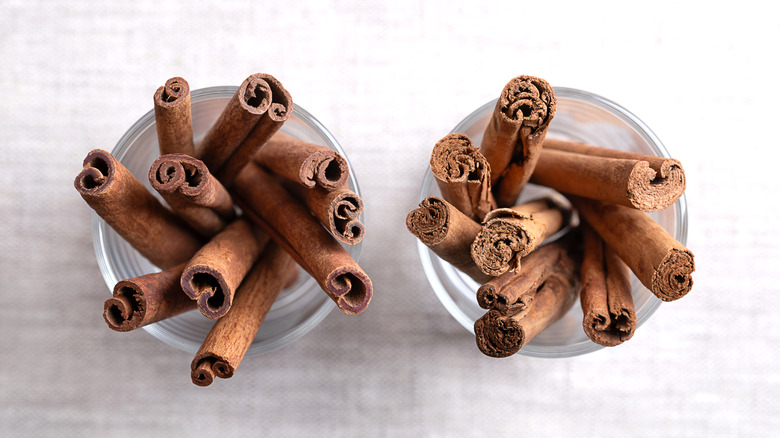
Inferior Cassia cinnamon is thicker, harder, redder, and more robustly spicy
Unlike the limited-regionally-grown Ceylon cinnamon crop, Cassia cinnamon (aka Chinese cinnamon or Saigon cinnamon) comes from the bark of the Cinnamomum Cassia. It can be grown in multiple countries, namely China, Indonesia, and Vietnam. This wider availability also comes with a lower price tag. Notably, while Cassia has historically been traded in Saigon, the city itself isn't home to any cinnamon-bark-producing trees.
The primary visual distinction between the cinnamon types is Cassia's reddish brown hue when ground, as well as its bolder, pungent, more robust spiced taste. In the kitchen, Cassia cinnamon is commonly used in savory applications, such as curries.
Working with whole stick cinnamon? Flip that stick on its side. If the inner coils appear thin (less than 0.08 millimeters thick), tightly-packed, and multilayered, it's Ceylon. This type of cinnamon is structurally fragile and paper-like. Alternatively, if the inner coils appear thicker (about 1.5 millimeters) and less-tightly packed inside the cavity, it's Cassia. Think of the former as more cigar-like in appearance and the latter as a hollow tube.