

What Actually Is A Traditional Country Breakfast?
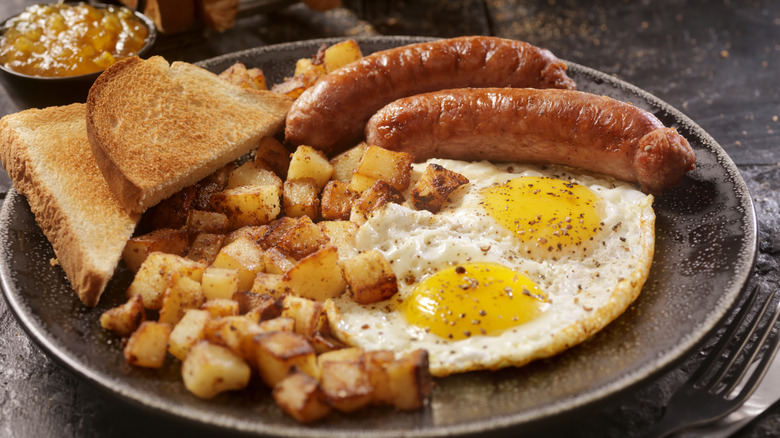
The idea of a big, hearty breakfast started in England, where the full English breakfast — dating back to the Victorian era – is the stuff of legends. The American equivalent is the country breakfast, born of the South. It was influenced by multinational settlers who brought their lofty breakfast traditions, but it has fewer rules and is still packed with protein and carbs to start your day.
A country breakfast, or farmer's breakfast, is meant to be big and filling. It's a high-calorie meal that can include eggs, hash browns, steak, sausage, ham, bacon, pancakes, grits, gravy, or more. It's traditionally meant to fill you up and give you the energy you need for an early start to the day on a farm. Even during the Depression, farmers got a jump on the day with these hearty meals. They might only have one more meal later, so they needed the calories to get through.
The British are very particular about their full English breakfast and the definition of it. For instance, there's a difference between a full English and a full Irish, and a full Scottish is something else again, though all three are very similar. A country breakfast in America has no such restrictions and is much more adaptable to whatever you have handy.
The many iterations of the country breakfast and their origins
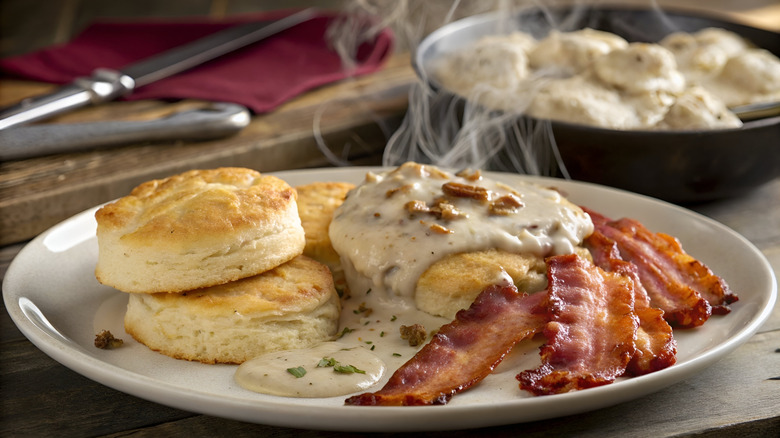
Eggs have a long history as a breakfast food dating back to Roman times. Though they fell out of favor for many years, they have been a cornerstone of many hearty country-style breakfasts thanks to their convenience and nutrition. While bacon and sausage were also a part of the full English breakfast, bacon became even more popular on American breakfast plates during the 1920s, due to an advertising campaign encouraging people to eat more of it. Potatoes were similarly used in European breakfasts — but hash browns are specifically an American innovation. The term first appeared in print in 1888.
Biscuits and gravy are a Southern classic, dating back to the Revolutionary War or in the Appalachian sawmills — its origins are debated. It's believed that biscuits, an easy-to-make and filling staple, were paired with a simple gravy made from leftover pork fat to add calories, and regional versions of the gravy developed from there. As these dishes grew in popularity, it was in the 1800s that country breakfasts began to become the norm for American farmers. Simple, hearty food to fuel people who were working hard and needed the energy — it's a common thread through all tales of the origins of these large breakfast traditions.
As people began to move away from rural environments, the country breakfast became less popular. People living in cities with more hectic lives and different schedules, not to mention the marketing push for things like cereal, began choosing lighter breakfast options. Still, the country breakfast lives on today in diners and on farms across America for those who have the time and appetite.