

Martha Stewart's Must-Follow Steps For Successfully Shipping Holiday Cookies

Martha Stewart has been called the "Queen" of many things, including entertaining, Instagram, and even Halloween, but if she can lay claim to one title for sure, it's the "Queen of all things Christmas." Ever since her book "Martha Stewart's Christmas" became a massive bestseller in the late '80s, the cookbook author has been a go-to source of ideas and tips about holiday hosting. But not every seasonal gesture happens in the home. We caught up with Stewart at Foxwoods Resort in Connecticut for a preview of her restaurant, The Bedford, opening in spring 2026, with an "immersive" Christmas experience as part of Foxwoods' Season Like No Other. When asked about the most important steps for successfully shipping holiday cookies, she offered a simple solution. "Christmas cookies have to be strong for shipping," she reveals, "so I have a sugar cookie recipe that I swear by."
Stewart has given many tips about shipping cookies over the years through her massive publishing empire, but she tells us the number one thing concerns their strength. Her suggestion was found in the sugar cookie recipe on her website, which she says "incorporates the regular flour and butter [for a] very nice, buttery, hard cookie, but it has a little cognac in it, which makes it even stronger." And luckily, some popular, classic cookie recipes fit that requirement, as gingerbread, snickerdoodles, and oatmeal cookies can all be made strong enough to survive a few days of cross-country travel in a shipping box.
Making strong cookies and protecting each layer are Martha Stewart's keys for shipping holiday cookies
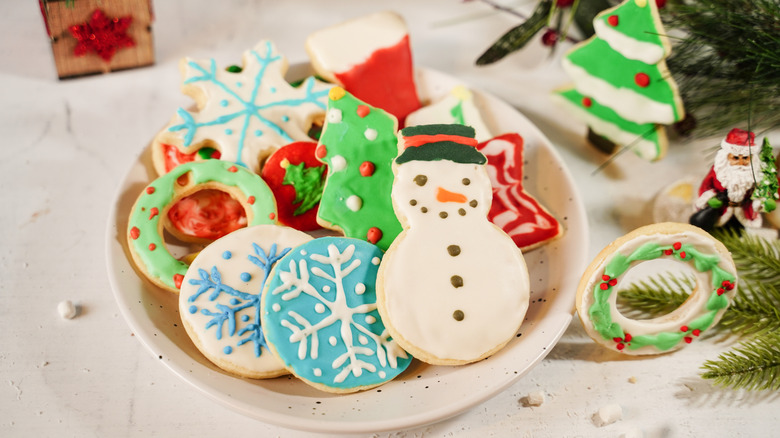
While strong cookies are most important, cracking isn't the only thing that can happen in transit. If you are decorating cookies, Stewart recommends something that will dry and stay set, like an easy royal icing, as opposed to using buttercream or anything that could get smooshed. And no matter what you are sending, padding is essential. "I layer it with a little bit of bubble wrap in between every layer of cookies," Stewart explains.
If you don't want to go out of your way to get bubble wrap, Stewart has also previously suggested buffering the outside of cookie containers with tissue paper or even corrugated paper tubes wrapped in paper. If your cookies are soft enough that you are less worried about breakage, parchment paper or wax paper layers for protection are still a good idea. And all cookies should be left to fully cool before you start packing, lest the residual heat create steam that can soften them.
Outside of the cookies themselves, the box you use will also have an effect. Metal tins will help cookies stay firmer than cardboard. If you are using cardboard, that's fine, but just make sure you fully line them in wax or parchment paper, as this will help the cookies stay fresh. Stewart's suggestions are all small steps, but as she knows, when it comes to the holidays, it's the little touches that make all the difference.