

The Biggest Mistake People Make When Reheating Creamy Soup

It's an easy shortcut you'll quickly regret. One quick spin in the microwave and your creamy bisque turns into a broken, grainy mess. The soup didn't "go bad," per se; the issue is the distribution of heat. Microwaves work fast but not evenly, and cream hates that kind of chaos. Hot spots form, proteins seize, and the equilibrium that made your once-smooth soup serene, collapses into chunky cacophony.
Cream-based soups — like chowders, or butternut bisque – are built on a fine balance of chemistry, called an emulsion. Fat, protein, and water are suspended in cooperation; wherein the cream or milk disperses tiny droplets of fat through liquid and the milk proteins hold everything together. The uneven heating comes from how microwaves interact with the ingredients themselves. They excite polar molecules, so different parts of the soup heat at different rates. Fat warms quickly because it has a lower heat capacity, even though it absorbs fewer microwaves overall. Those temperature disparities create pockets of heat where the proteins seize and the emulsion collapses, leaving oily broth flecked with curdled milk. What was once integrated becomes fractured.
Instead, apply patience and reheat the soup on the stovetop over low heat, stirring gently and often. The gentle movement redistributes heat before it can concentrate in one spot. Give the soup time to come back to life slowly, the same way you would reheat a custard or sauce. By keeping the temperature below boiling, you allow the proteins to relax while the fat melts back in. If the soup is very thick, you can slowly add more milk or cream to thin it out.
Molecular mayem in a mug
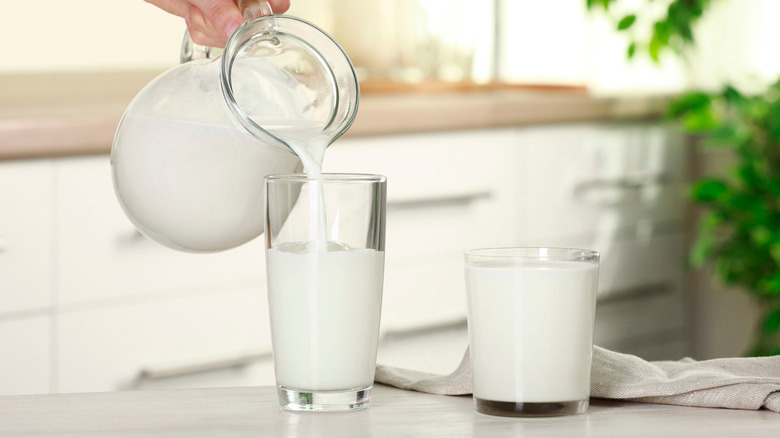
Cream likes to be coddled and courted, not shocked. That's because cream (and milk) is an emulsion. Just like the composition of the bisque, it's a mixture of fat suspended in water, stabilized by milk proteins. Those proteins — casein and whey, along with free polar lipids — are natural emulsifiers, but they're fragile under stress. When heated beyond 140 degrees Fahrenheit they begin to denature, meaning they unravel and clump; the water they were holding back escapes, and the fat separates.
Essentially, the texture of cream is only a temporary balance, not a solid structure. Temperature, acidity, and agitation all test its limits. Add acid — like from the tomatoes in a bisque or the wine in a chowder base — and the reaction is accelerated. This is because the lowered pH strips charge from the proteins, making them less able to repel one another. Stir too vigorously and the phospholipid membrane becomes disturbed, causing the fat droplets to collide and merge, forming larger pools instead of a fine, cohesive dispersion. Even salt can tip the scales by tightening the protein network too soon. In cream soups, every ingredient and technique affects whether the mixture holds or breaks once heat is applied.
The goal is to manage the thresholds. Keeping the temperature moderate allows proteins to unfold slowly and reform into a smooth matrix instead of clumps. Fat helps buffer those changes, which is why soups made with heavy cream are less likely to curdle than those with milk. Gentle stirring keeps the particles moving without forcing separation; and a small starch addition adds another layer of insurance by thickening the liquid phase and stabilizing the emulsion.
Keep cream copacetic
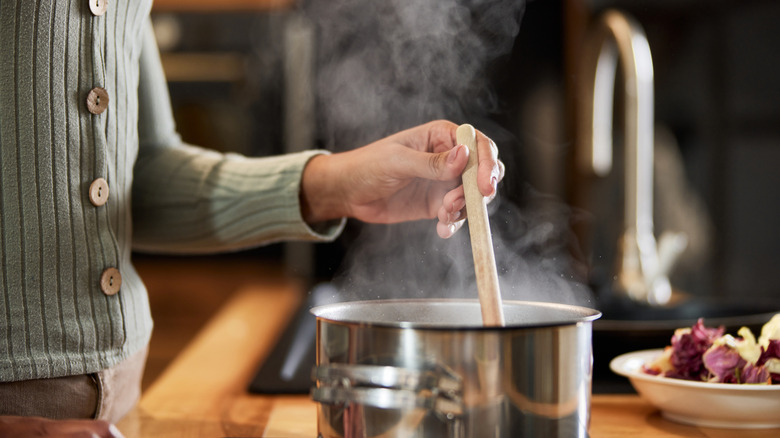
Creamy soups show how much of food's texture depends on the pace of heat. Foods with depth — like breads, slow-roasted vegetables, and long-simmered stews — all develop because their structure changes gradually as moisture moves and proteins shift. Microwaves interrupt that rhythm rather violently, at least on a molecular level. They push energy through too quickly, jolting fragile emulsions before they have time to adapt. They damage the food by flattening both the flavor and texture.
The microwave can handle some leftovers, but not carefully-balanced cream soups. Low heat gives proteins space to realign, starches to swell and gelatinize, and fats to melt silkily back into the liquid. The same rules apply to tempering chocolate; steady warmth builds control. Precision equipment, like candy thermometers, can monitor the exact details, but low and slow with patience and a wooden spoon work just as well. Any cream-based dish depends on this negotiation between temperature and texture. It turns out that reheating leftovers is both an art and a science. Treating your cream carefully means understanding the chemistry of your ingredients and knowing when to slow the application of heat, which guards against curdling. It also means you'll end up with the best bowl, and the best bite.