

The Once-Famous Cut Of Steak That Vanished From Menus
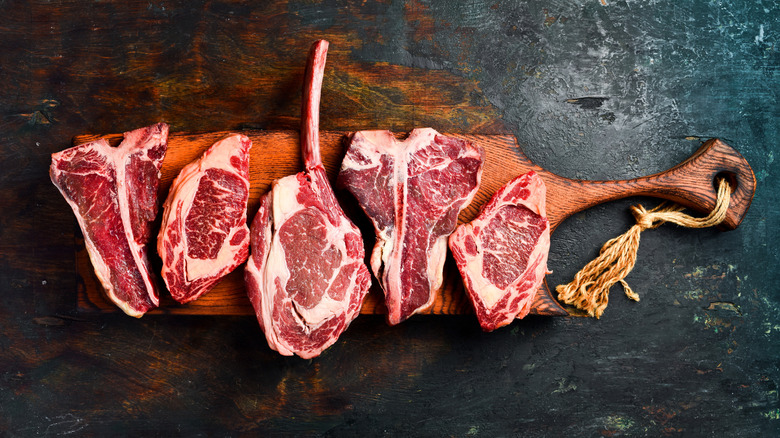
The anatomy of cows hasn't changed over the past hundred years, but if you sat down at a fancy steakhouse in the 1920s and ordered the best steak on the menu, it would likely be a cut that you almost never see anymore. That's because names and popular cuts of steak change over time, and definitions weren't always as specific as they are now, in an age where we like to know everything about our meat. One of the victims of this newfound love of transparency was a steak named not after the beef, but after a restaurant: the Delmonico.
Delmonico's is a steakhouse in New York City that is one of the oldest restaurants in the city, and has long had a reputation for its high-end beef. It's been around since 1837 and has been serving "Delmonico steaks" for just as long — but nobody really knows what cut of beef it originally was. Instead, because of the restaurant's reputation, Delmonico was used as a more ambiguous term to describe a high-quality steak with a few common characteristics. Most importantly a Delmonico steak was large, often around two inches thick. It was also a well-marbled and a tender cut. It also usually came from somewhere in the rib or short loin area, where most steaks with those characteristics are found. Essentially, it was the platonic ideal of a thick, juicy steak. However, the rise of more specific cut-based names like ribeye (which the Delmonico is often compared to) led to a decline in the steak.
The Delmonico steak is a thick and well-marbled cut of beef

Currently at Delmonico's, the steak is known as a boneless ribeye, but some other cuts are referred to as a Delmonico, too. One from the short loin area is also known by the name "club steak" or "shell steak," and is similar to a New York Strip steak. It is a bone-in steak that comes from the part of the short rib directly bordering the rib, which makes it tender and well marbled. Or you could simply make a Delmonico steak from a thick-cut, bone-in New York Strip, as well.
Another cut is also increasingly being called a Delmonico steak because it shares those tender and well-marbled traits, but isn't as well known as a ribeye or New York Strip. It's called a "chuck eye steak," and comes from the chuck primal, which is the shoulder area known for its high levels of marbling, but also tougher cuts with lots of connective tissue. It wasn't normally a source of Delmonico steaks, but the chuck eye comes from near the rib, much like New York Strip on the other side, so it is a more tender steak. In fact, chuck eye is sometimes referred to as the "poor man's ribeye," and this is the cut some butchers are starting to label Delmonico. It may not be historically accurate, but the steak boasts all it needs to be just as delicious.