

How Bankruptcy Led To The Downfall Of A Once-Popular Pancake Chain From The '50s
In 1957, Southern Californians Sam Battistone, Sr., and Newhall "Bo" Bohnett opened a diner in Santa Barbara, California, that offered a bottomless cup of coffee for a dime and a full breakfast for a little more than a dollar. When trying to dream up a name for their restaurant, they wound up combining their names to create Sambo's Pancake House (often just called Sambo's). Battistone, a former diner owner, was in the kitchen every morning with his 17-year-old son flipping diner-style pancakes, while Battistone's wife worked as the waitress.
From the beginning, they all wanted Sambo's to be a cozy place for families to enjoy breakfast and lunch — and the homey atmosphere and good, cheap eats helped Sambo's flourish. Throughout the 1960s and '70s, Sambo's opened hundreds of restaurants across the U.S. in 47 states, eventually burgeoning to over 1,100 locations. Part of Sambo's success was its unique "fraction-of-the-action" program that gave 20% of profits to each restaurant manager. With the incentive of managers being able to purchase an additional percentage of the profits in other Sambo's restaurants, the program engendered a vibrant entrepreneurial spirit.
But in 1977, due to actions by the U.S. Securities and Exchange Commission, Sambo's discontinued the "fraction-of-the-action" program. Without the financial bonus, restaurant managers left in droves, leaving behind people who had no experience in running a restaurant. The following year, profits declined precipitously, and the losses were so steep that, in 1981, Sambo's filed for bankruptcy. While other retro restaurant chains went bankrupt in the '80s, Sambo's was unique because its name and image were tied to racist stereotypes.
Sambo's controversial name
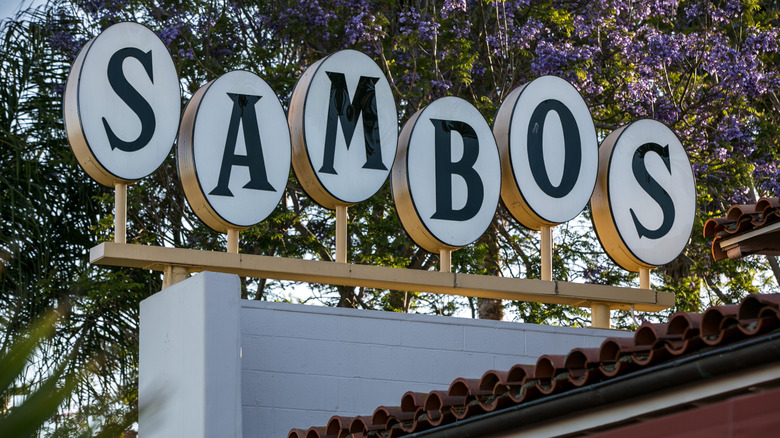
Battistone and Bohnett decorated the restaurant's walls with murals that depicted scenes from the popular children's book "Little Black Sambo." Published in 1899, the illustrated book told the tale of a dark-skinned boy escaping fearsome tigers who were turned into butter, which his father, Black Jumbo, gathered up, and his mother, Black Mumbo, used to cook a huge batch of pancakes. The book takes place in India, but its illustrations depict caricatures of the 19th-century American racist stereotype of a "picaninny," an enslaved or impoverished Black child, prone to thievery and greedy hunger.
It's possible that author Helen Bannerman was unaware that "Sambo" had long been an offensive epithet for a lazy, childlike slave, but when later reprints relocated Sambo from India to a Southern plantation or Africa, for Black readers, Sambo's association with the "picaninny" stereotype was clear. Though Sambo's restaurant patrons were predominantly white, Battistone and Bohnett ignored protests and lawsuits by activists in the 1970s and refused to change the Sambo's name. However, once active campaigns against the restaurant by the NAACP, as well as some northern states, took a precipitous toll on Sambo's sales, management finally got the message. Eventually, the restaurant was rebranded from Sambo's to "No Place Like Sam's" and "Jolly Tiger."
But it was too late. When a restaurant declares bankruptcy, it often sheds unprofitable sectors of the business. In 1981, the Sambo's corporation shut down 447 restaurants and laid off 10,000 employees. Sambo's, however, still couldn't pay its debts. By 1984, all of its restaurants were sold, all except for the original Santa Barbara location, still called Sambo's. However, that changed in 2020, in response to the George Floyd riots, when Battistone's grandson, Chad Stevens, renamed Sambo's to "Chad's."