

Russian Dressing Isn't Actually From Russia. So Where Did It Originate?
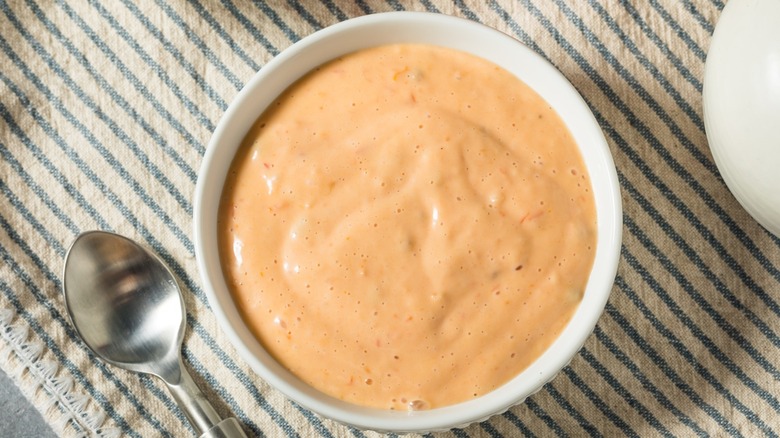
The names given to foods are sometimes baffling, even downright misleading. German chocolate cake was created in Dallas, Texas. Hawaiian pizza? Ontario, Canada was its birthplace. These are just two of many foods named after places that they didn't actually originate from. Another is Russian dressing. Occasionally used on salads, Russian dressing is best known for what it brings to classic grilled Reuben sandwiches. This lightly spicy, creamy vinaigrette was most likely to have been originally dreamed up by a regular Joe or ... er, James, a New England grocer by the name of James E. Colburn of Nashua, New Hampshire.
Colburn started in the meat industry before opening his own grocery in 1906 and then a catering business. Somewhere between 1906 and 1914 (Colburn retired in 1924), he created a successful mayonnaise, as well as the now-famous dressing, which he called Colburn's Russian Salad Dressing.
Some say that he named it this as it was created to top a Russian Olivier Salad. Others suggest that Colburn put caviar (an expensive ingredient exclusively associated with Russia at the time) in the original ingredients. Another theory is that the Russian moniker came simply because of the inclusion of pickles — a Russian favorite. And a few point to the French "Sauce Russe," too, as the stem of the name, as it's similar in color and texture and also contained caviar.
More tales of Russian dressing
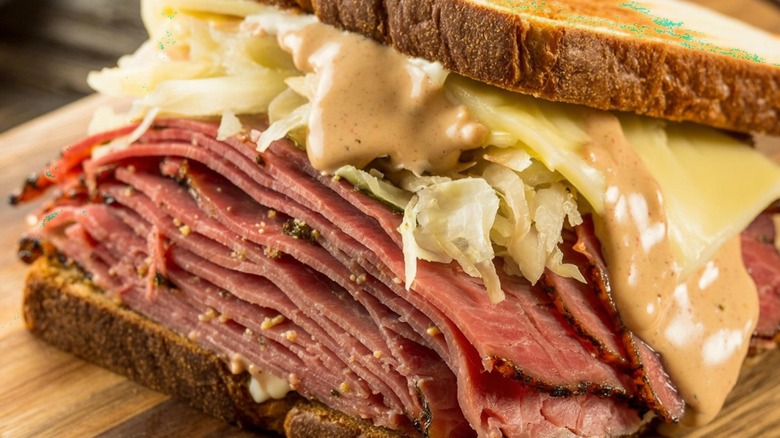
Theories also go further back to possible origins linking it to caviar-laden recipes in Russia, or those that meander into the gastronomic history of French mayonnaise-based sauces. The truth is that Russian dressing as we know it today (minced onion, mayonnaise, ketchup, horseradish, dill pickle relish, Worcestershire sauce, sweet paprika, and salt) has very little in common with those musings. As is often the case with food history, go back far enough, and it's as muddled as this mayo and ketchup-based dressing itself.
Perhaps the earliest mention of Colburn's infamous sauce of indeterminate origins is in a five-volume history from 1927 by Hobart Pillsbury, which credits him as "the originator and first producer of that delectable condiment known as Russian salad dressing." But because Pillsbury didn't include Colburn's exact ingredients, we're left to speculate about his inspirations and exact ingredients.
What we do know is that Colburn's dressing was such a hit, he was able to retire off its nationwide sales. Russian dresssing's muted popularity has endured to this day. Despite the fierce competition of the similar but sweeter and less spicy Thousand Island dressing, many of us are still enjoying grilled Reuben sandwiches slathered with the requisite Russian dressing.