

What Was Mahatma Gandhi's Actual Last Meal?

We may receive a commission on purchases made from links.
Mahatma Gandhi was a key figure in India's fight for independence. A firm believer in non-violence, he led India to independence through a path based on truth, non-violence, and non-cooperation — principles which blossomed into a philosophy known as Satyagraha. Gandhi's political ideology of non-violence also translated to his personal beliefs as he was a staunch vegetarian. In his book "The Moral Basis of Vegetarianism," Gandhi famously said that "a man was not born carnivorous animal, but born to live on the fruits and herbs that the earth grows" (via the Mahatma Gandhi organization). Needless to say, his last meal was entirely vegetarian.
On January 30, 1948, Mahatma Gandhi had premonitions that he would not live much longer. However, nobody around him had any inkling that he would meet his end on that day itself. At around 4.30 p.m., during a meeting, Gandhi consumed a light meal of vegetables both raw and cooked (possibly in the form of vegetable soup), precisely four tomatoes, as well as oranges. He washed the meal down with a 12-ounce glass of goat's milk (which comes as no surprise, since most of the world's goat milk comes from India), along with some carrot juice and a ginger-lemon-aloe drink. Minutes after finishing his meal, Gandhi was en route to a prayer meeting where he was greeted by a sea of followers. Hidden amongst them was Nathuram Godse, the assassin, who shot Gandhi thrice, leading to his demise.
Mahatma Gandhi's relationship with food
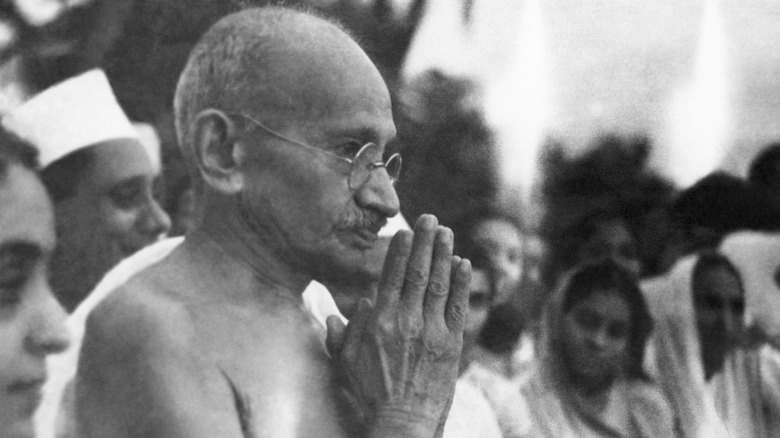
Mahatma Gandhi was a vocal practitioner of vegetarianism, but he wasn't vegan and did consume animal byproducts such as ghee, butter, and curd. To him, food was imperative in shaping and maintaining not only the physicality of man, but it also played an important part in maintaining the equilibrium of the mind and soul. To this degree, Gandhi viewed food through the lens of sustenance and medicine, consuming items that he found ideal to fuel the body rather than satisfy the pleasures of the tongue.
Gandhi followed a balanced diet that featured a mix of various Indian foods. He believed that cereals (wheat in particular) were an important food group, and considered milk, pulses, and lentils to be vital sources of protein in a vegetarian diet. In terms of fats, ghee was his preferred choice, though he thought that groundnut, coconut, or even linseed oils were acceptable replacements for those who couldn't afford the high-priced ghee. He also encouraged the consumption of seasonal fruits, leafy vegetables, nuts, and seeds.
Along with being a vegetarian, Gandhi also was a lifelong teetotaler and discouraged the consumption of alcohol vociferously. He even campaigned against the consumption of alcohol , seeing it as a societal evil. His disapproval for stimulants also seeped into tea and coffee. He believed that neither were necessary for the human body and could cause it more harm than good. Throughout his life, Mahatma Gandhi had a strict and disciplined relationship with food, often experimenting and tweaking his diet to just raw or boiled vegetables. To him, food was fuel, energy, and medicine, which was best consumed mindfully.