

Here's What Really Makes Orange Lobsters So Rare
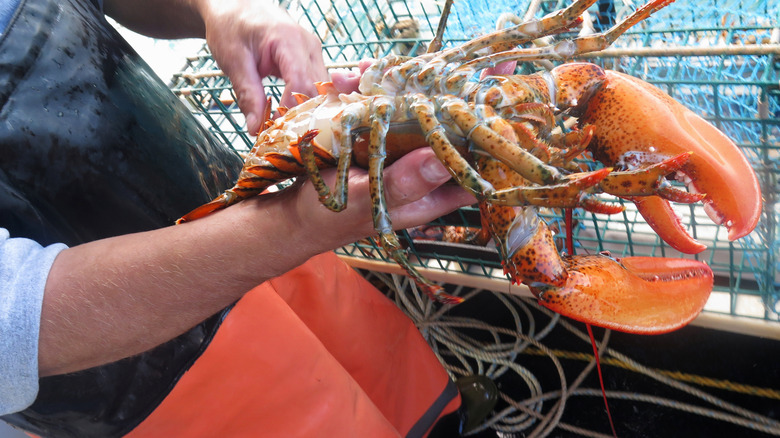
"Consider the lobster," wrote David Foster Wallace. Now, consider the orange lobster. If you haven't before, you aren't alone. Orange lobsters are a rare 1 in 30 million sight, according to the New York Aquarium, the product of a genetic mutation that affects shell pigmentation.
Typically, the lobster's signature crimson hue is the result of specific proteins in its shell. When a certain genetic mutation occurs that causes a lack of proteins, fewer of these pigment-producing agents bond, and the result is an orange-hued shell. This bright orange color is even more remarkable considering that, in the wild, lobsters are typically a dark blue-yellow-brown hue, not turning scarlet red until after they are cooked. Further compounding their rarity is the fact that lobsters are an aggressive, territorial, and cannibalistic species. While ruddier hues allow most lobsters to blend in with their undersea environment, orange-shelled "sea bugs" stand out and might be the subject of increased targeting.
In 2024, an orange lobster named "Peaches" donated to the University of New England gave birth to 100 baby lobsters, half of which shared the rare orange-shelled trait — but scientists aren't sure exactly why. Researchers are working to identify the cause of this mutation, as well as whether it might be hereditary. "Each larvae stage is a new opportunity to look at the gene expression in that stage, making it easier to identify which genes cause this coloration," marine sciences professor Markus Frederich told News Center Maine of Peaches' orange babies.
Orange-shelled lobsters are a genetic anomaly
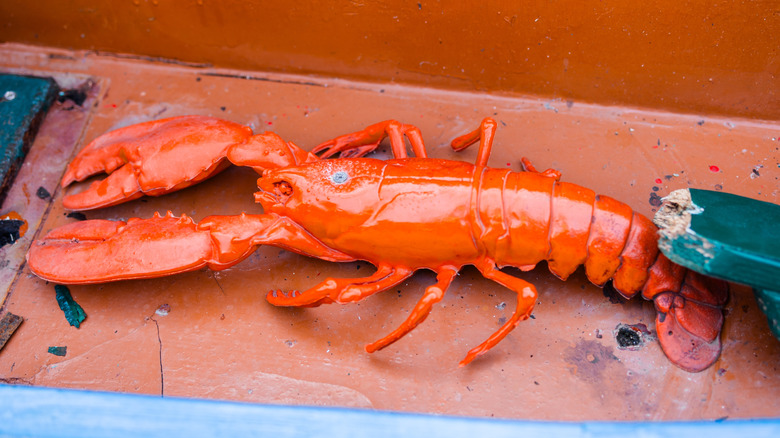
When a fish market happens upon a rare orange lobster in the wild, it is often kept and displayed for public enjoyment for a short period, then released back into the wild or given to a local aquarium. All in all, the public reaction to finding orange lobsters has been impressively endearing. Earlier this year, Canadian news outlet CBC reported a story in which a career fishmonger of forty years saw his first-ever orange lobster in the wild off the coast of Gaspé, Quebec. As Yvon Jalbert (the fishmonger) told the outlet, "It's pretty rare. We've had yellow, we've had blue, but never orange." Blue lobsters are also the result of a similar cellular mutation, the overproduction of crustacyanin.
Last year, a rare orange lobster was discovered at a Stop & Shop on Long Island and affectionately given the name "Clementine." When the nearby Long Island Aquarium declined the store's request to adopt the crustacean, the Southampton Animal Shelter made moves to return Clementine back into the wild. "We got ourselves a big saltwater tank to rehab her in, we brought her down to the ocean, and she immediately began foraging," John Di Leonardo, president of Humane Long Island, told NBC. "She was ready to go as soon as she saw the ocean." More recently, another orange-shelled lobster made headlines after being rescued from a Tops grocery store in upstate New York. His nickname? Jean-Clawed Van Damme.