

Bread Vs Tortillas: The Nutrition Facts That Bust The Wrap Myth
We may receive a commission on purchases made from links.
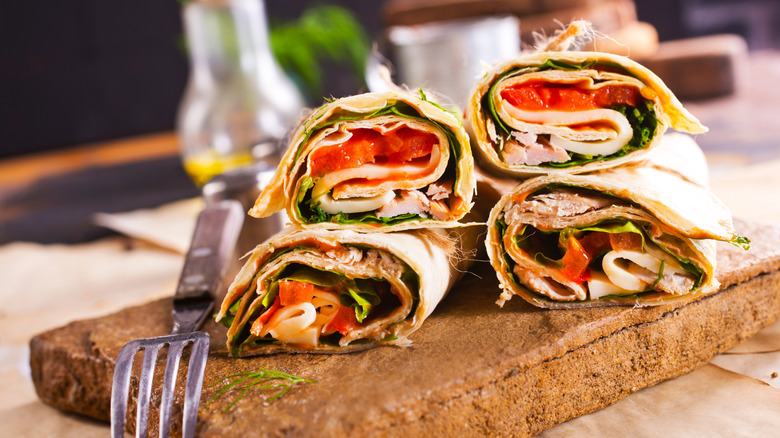
When faced with the choice between a wrap and a sandwich, most health-conscious diners instinctively pick the wrap. It seems like the obvious choice — that thin tortilla shell has to be better than two slices of bread, right? Well — let's take a look and see what the numbers and data are saying.
Per Nutritionix, a traditional corn tortilla weighing 24 grams will tally about 52 calories, while white bread hits nearly double that at 98 calories per 32-gram slice (so 2.1 calories per gram for tortilla versus 3.0 calories for every gram of white bread that you eat). The differences are even more dramatic when you take a look at things like sodium — white bread loads up with 180 milligrams compared to just 11 in a tortilla, for instance. Throw in higher carbs and protein, and white bread comes out swinging heavier than a tortilla in every nutritional category, both good and bad, especially if you account for the fact that there are two slices.
This is one of the main reasons why lots of health enthusiasts have been migrating over to wraps when they need a portable lunch. In fact, many restaurants and delis are promoting wraps as a supposedly "healthier option" than traditional sandwiches. However, what if we move off of nutritional databases and take a look at the numbers printed on the back of bread and tortilla packaging? The figures may surprise you (as they did us!)
Brand-by-brand, the numbers are very different
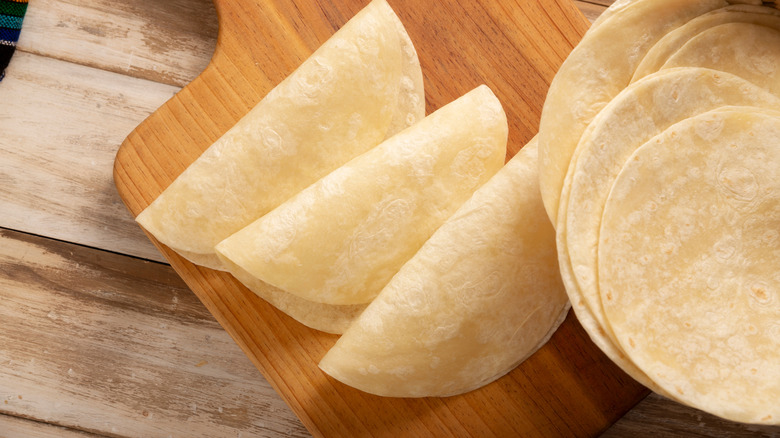
Let's take Mission Soft Taco Flour Tortillas — since it's currently Amazon's best-seller, it's likely what you're getting in most restaurant wraps. According to the nutritional facts printed on the back, each tortilla packs 140 calories. That's already way more than our Nutritionix data suggested. Compare that to Nature's Own Perfectly Crafted White Bread at 110 calories per slice — or 220 calories for a typical two-slice sandwich. So far, the numbers seem to check out in favor of wraps.
However, that's assuming we're doing something like a BLT, but what about something like a loaf-style sandwich, such as a homemade Philly Cheesesteak? Things take a pretty dramatic turn. A loaf of Whole Foods Market French Demi Baguette, for instance, carries 140 calories, so about the same as a tortilla wrap, while containing less sodium and more protein. So, in this case, your caloric intake won't differ either way. You even get more minerals and protein if you pick the demi-baguette.
So the takeaway is this: don't take the "tortillas are healthier than bread" thing you've been hearing as fact. If you're genuinely concerned about nutrition, skip the assumptions and actually read those labels — the "healthier" choice might not be so healthy after all.
What's the best bread for a healthy sandwich, then?

While "the whiter the bread, the quicker you're dead" might be a bit of an old-timer exaggeration, there's a sliver of truth in there. The super-common white bread that you see acting as a sandwich base everywhere is made from enriched white flour. You get white flour after the bran and germ of the wheat kernel are milled away, but since this is also the most nutritious part of the wheat, manufacturers need to add back the nutrients lost using a process called "enrichment." However, not every nutrient can be reintroduced, plus you miss out on a lot of fiber.
That's why, if healthiness is what you're after, anything whole-grain will be your best bet. It's the mirror opposite of white flour: every part of the wheat kernel is used (just make sure to note the difference between whole-grain and whole-wheat). Any type is fine — baguette for a Banh Mi sandwich, or soft bread for a sweet and savory club sandwich. Pick the one that works best for what you're making.
If you're still drawn to wraps, you've got better options than regular tortillas: look for whole-grain or whole-wheat tortillas like Mission Soft Taco Whole Wheat Tortillas. While they won't necessarily offer fewer calories per serving, you're guaranteed to get far more nutrition out of each bite than with their white flour counterpart. The same logic applies whether you choose the wrap or stick with a whole-grain sandwich.