

Here's How Many Cloves You'll Find In A Typical Head Of White Garlic
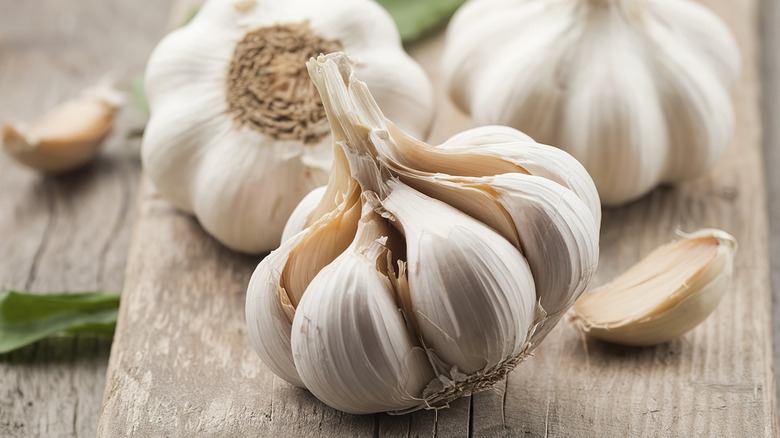
It doesn't take a scientist to know that adding garlic to a dish can lend tremendous flavor. One of the single biggest ways to increase garlic's very specific flavor profile is to add more to your dish. Simply put, the sheer number of cloves you use in a recipe can make or break a dish. Which is why it's important to know just how many cloves you can expect to have on hand in a typical head of white garlic (garlic with white outer skin layers). While there are many varieties of white garlic, meaning that each bulb can technically yield somewhere in the range of 2 to 40 cloves, the average supermarket bulb generally gives you around 10-12 cloves.
But just how much of that sharply pungent, savory flavor you get depends on a myriad of things like what variety you're using, its size (small vs. big), if you're using it raw or cooked, how it's cut (Ina Garten has a method for mincing garlic super fine), and how you cook it — for example, whole roasted garlic bulbs or simply chopped and cooked with onions as the base of a dish.
While most grocery stores carry only white-skinned, softneck garlic, due to its mild flavor, long storage life, and ease of transport, there are also hardneck white garlic varieties available. Porcelain garlic is one of these and contains the fewest number of cloves at around 4-6 per bulb. The softneck bulbs at your local grocer typically belong either to silverskin (smaller and more garlicky with more cloves, these run mild to sharp in flavor) or artichoke (larger bulbs with a milder flavor) categories. But with a bunch of sub-varieties, maybe turning to science isn't such a bad idea.
The science of garlic cloves
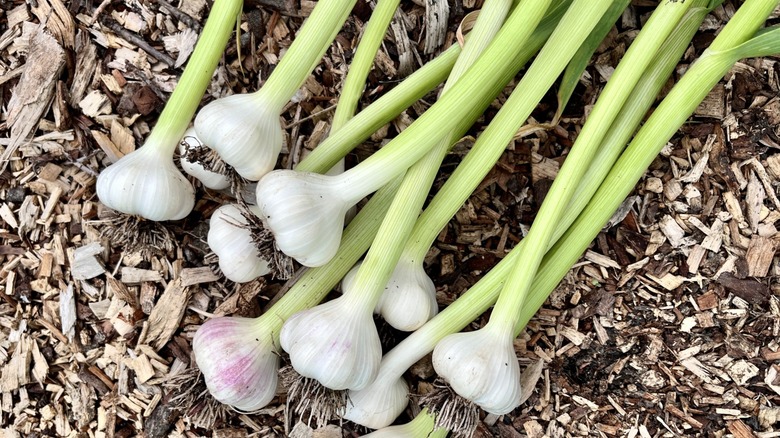
While most of us are happy with the white bulbs containing 10-12 cloves that we find at the store, there are other types to consider. Garlic (aka allium sativum) comes in two subspecies (hardneck and softneck), ten major groups, and hundreds of varieties. In 2003 two independent genetic analyses (one by USDA researcher, Dr. Gayle Volk and another by German researcher, Dr. Joachim Keller) classified hundreds of garlic varieties using DNA testing. They found ten distinct groupings: Those two softneck varieties in your grocery store, and eight hardnecks (glazed purple stripe, marbled purple stripe, porcelain, purple stripe, rocambole, Asiatic, creole and turban). By the way, sneaky elephant garlic actually belongs to the leek family.
Chefs particularly love the more deeply flavored hardnecks, partly for their large easy-peel cloves. They are recognised by a firm stem growing in the center of the bulb. Rocambole, with around 7-11 cloves per bulb is thought to be the most delicious garlic variety, with a sweeter taste than others.
While you don't have to be a botanist to appreciate garlic's unique flavor, you may want to experiment a bit with it, letting it sit for 10 minutes after chopping, adding it to oil, or mixing it in some lemon juice. See which works best for your favorite recipes and how each preparation influences the garlic's flavor and pungency. Just be careful not to make one of these 14 common garlic mistakes.