

What Those Bumps At The Bottom Of Your Salt Shaker Are Really For
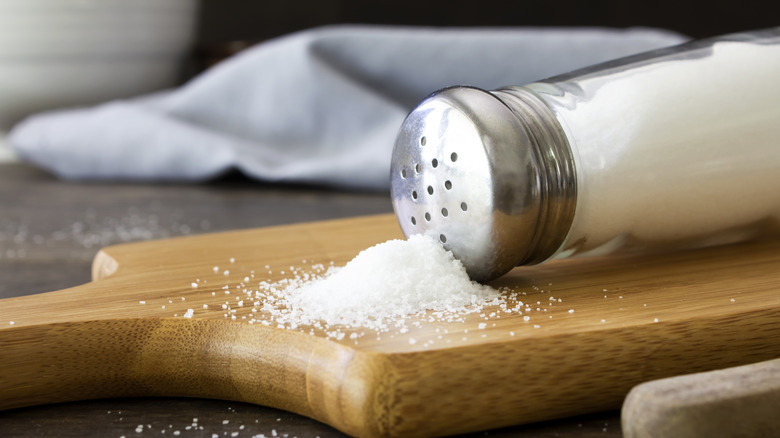
Our world is full of intentional design choices you have to look closely for to notice. The hole in a pen cap that makes it safer if swallowed, the tiny gas gauge arrow that tells you which side your fuel door is on. Even the humble, ordinary salt shaker holds traces of decisions made by engineers long before it hit a restaurant table. Flip one over and you'll see a ring of small bumps circling the base. They look decorative, maybe even accidental, but they're actually called "knurls," and they are there for a purpose.
The bottom of the vessel endures constant sliding, so the ridged knurling acts like armor, lifting the smooth glass just enough so scuffs land on those high points instead. Over time, the ring collects tiny scratches that would otherwise spread across the bottom, where they could weaken the vessel or make it look cloudy. Knurls also play a role in stress distribution, changing how the vessel experiences pressure. Glass breaks when tension concentrates at a flaw, and the tirelessly supportive base is a prime candidate for that kind of failure. By adding raised points around the ring, engineers redirect the pressure away from vulnerable seams. In testing, stippled bases consistently outperform smooth ones, especially when bottles are jostled on production lines or filled under pressure.
The bumps are unassuming, but they're the result of centuries of refinement in glassmaking. Pickle jars, soda bottles, and lab beakers all have the same belt of bumps because the principle works so well. It's a clever solution to a universal problem: glass is brittle, and contact points are vulnerable. By shaping the bottom to absorb wear in a controlled way, manufacturers extend both strength and appearance.
Bumpy is better
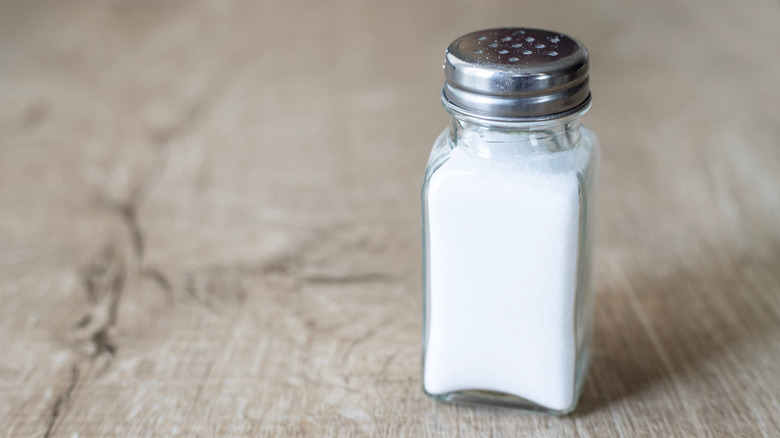
Not every ring of bumps looks the same. Some are arranged as neat dots; others form bars or chain-like links. These patterns come straight from the mold in factories that choose styles to suit their machinery and performance needs. Dotted stipples tend to disguise scuffs, while bar-shaped ridges handle heavier conveyor wear. Chain knurls occasionally appear on liquor bottles, but they're less common since the design can introduce small weaknesses. Each option changes how the base interacts with equipment and how well it endures over time, and the shape of glassware can even change how a beverage tastes.
Taken with the rest of the base anatomy, the salt shaker reveals a surprisingly complex system. The push-up dome in the middle adds strength and stability. The heel is where the sidewall meets the floor. The bearing surface is the outer ring, where knurls concentrate contact. Every part plays a role in extending the life of glass through filling, shipping, and repeated use. Even condensation has been considered: ridged bases give airflow a path when moisture pools underneath a cold container, helping prevent bottles from sticking to tables or slipping in their own puddles.
Over time, those bumps have taken on a life outside the factory. Diners discovered that dragging a spoon across the ridges could unclog salt holes, shaking loose stubborn grains. It's satisfying, effective, and repeatable, which made it a natural candidate for viral videos and word-of-mouth tricks. That double life says something about design; once an object leaves the factory, folks find their own uses, bending hidden engineering choices toward new uses. And while you're scrutinizing salt shakers, check your old mason jars, because some can be worth real money.