

It's Hard To Believe This Everyday Food Was Still A Novelty In The 1970s
The United States is a land of ever-changing food trends, and the way we eat today would be unrecognizable even as recently as the 1970s. We have hamburgers and hot dogs, and we still eat our roast turkey on Thanksgiving, but every decade has its food trends that add to the American canon — some invented, many brought over by immigrants. The average American family wasn't ordering pizza until after World War II, and outside Mexican-immigrant hubs, many people in the country thought of ground beef and hard shell tacos as Mexican food until the last few decades. However, few foods have gone from curiosity to ubiquity the way that sushi has.
Even with the diversity of American cities, food made from raw fish in the 1970s was still mysterious and suspect. The origins of sushi in Japan go back to at least the 9th century, but Japanese culture had barely penetrated into normal people's lives in the United States. There was some sushi in the U.S., centered around Japanese immigrant enclaves on the West Coast, and there were mentions of sushi in news articles of the time as food that was trendy with high-class socialites. This overlapped with a general craze for Asian culture in the upper classes. However, a diplomatic agreement in 1907 cut off Japanese immigration, and the outbreak of World War 2 saw a backlash to all things Japanese. It wouldn't be until the 1960s that sushi started to make inroads again.
Sushi first gained a foothold as a trendy urban food in the early 70s in Los Angeles
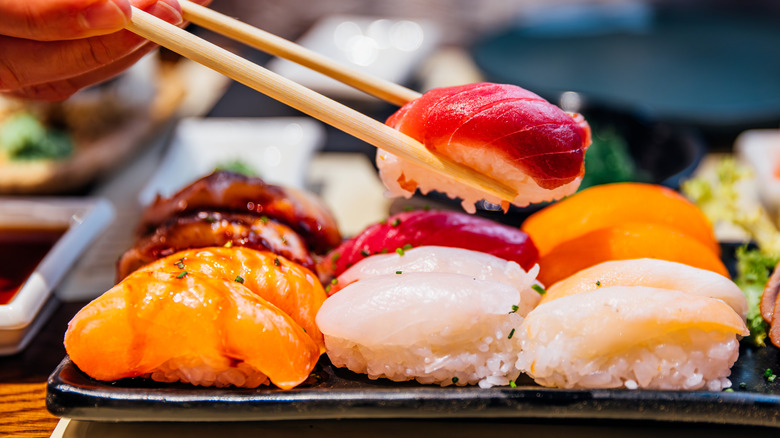
Sushi was still being served in Japanese restaurants in the U.S. into the '50s and '60s, but the beginning of the American sushi craze is often credited to the restaurant Kawafuku in Los Angeles' Little Tokyo neighborhood. This was the first popular spot to sell traditional nigiri sushi to American patrons. Opened by Noritoshi Kanai and a business partner, Harry Wolff, it mainly served Japanese businessmen, but as they brought their American coworkers, the restaurant grew in popularity. The success of Kawafuku got back to Japan, and it inspired many sushi cooks there to immigrate to America to try opening their own sushi bars.
Two more essential developments followed. The successful Little Tokyo restaurants led to the opening of the first sushi spot outside the neighborhood called Osho in 1970. Situated next to the 20th Century Fox Studio Lot, it became a fashionable spot for celebrities, and the healthy raw fish was tailor-made to appeal to the tastes and concerns of glitzy L.A. residents. This notoriety was the push that started sushi's expansion into other cities like New York and Chicago.
The other big change was the creation of sushi that appealed more to American palates. Around this time, the California roll was first invented. There are competing claims, but it's commonly attributed to Tokyo Kaikan, another Little Tokyo spot. The crab and avocado mixture became an easy entry point for skeptical American diners.
The rise of Japan as an economic power finally pushed sushi into the mainstream
While sushi had found its foothold in the U.S. it still wasn't everywhere, but Japan was undergoing an economic boom in the 1980s. Japanese business began expanding in the U.S., which brought a new wave of immigrants hungry for the food of their home country. This exchange also led to a growing interest in Japanese culture in the U.S., which introduced more everyday Americans to sushi. It was still unusual enough to be commented on in movies like "Valley Girl" and "The Breakfast Club," but sushi had finally broken through to the mainstream.
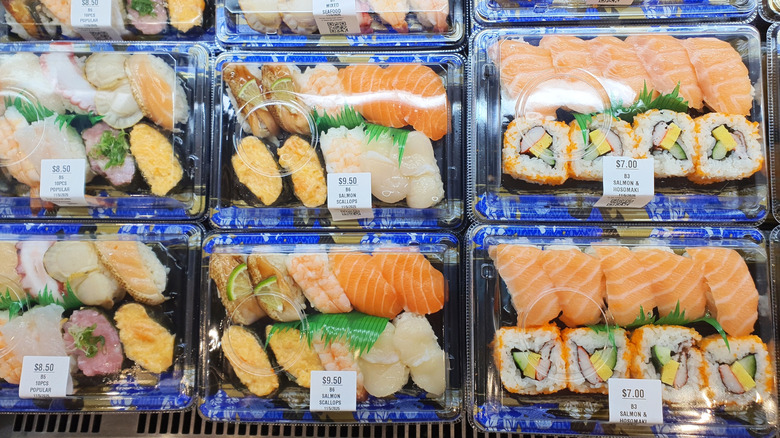
Since then, sushi has grown from a trendy food for city dwellers into an everyday staple for millions of Americans. Far from just a luxury, it's now sold as an affordable to-go food at grocery stores and takeout lunch spots. By some reports, the largest sushi seller in the U.S. is Kroger, which sells more than 40 million sushi rolls per year at its deli counter. As a food that is both healthy and delicious, it's popular across demographics and state lines, and its convenience is the perfect fit for Americans on-the-go eating habits. None of that would have happened without the Japanese immigrants that took the risk to come over and sell a food that many Americans saw as weird or a punchline. It's because of them that we can eat so many amazing types of sushi in this country today.