

Which Country Eats The Most Salt?
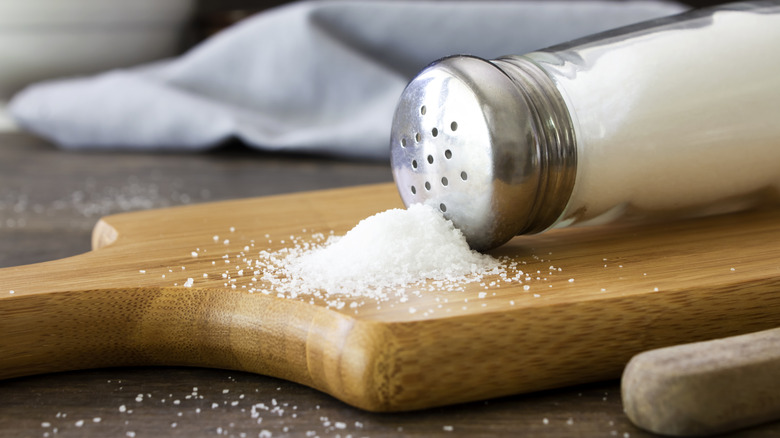
Salt is more than just the finely-ground grains we season our food with. In the past, wars were fought for salt, and it was so valuable it was used as a currency — the word salary traces its roots to the allowance given to Roman soldiers to buy salt. Today, in the U.S., we eat about 8.9 grams (0.3 ounces) of the stuff a day, per person, according to the World Population Review. But when it comes to global salt consumption, Americans don't even come close to taking the crown. That goes to China. The Chinese eat more than twice the amount of salt per capita than Americans, at 17.7 grams (0.6 ounces) a day. China outpaces the runner-up by more than 3 grams (Hungary at 14.3 grams per person a day).
Part of the reason the Chinese eat so much salt is historic cooking methods deeply embedded in the cuisine. To demonstrate, a portion of Tasting Table-approved spicy Chinese eggplant stir fry contains about 1,153.3 milligrams of sodium (equivalent of almost 3 grams of salt), or nearly 50% of the maximum daily intake of 2,300 milligrams of sodium (6 grams of salt), per the Mayo Clinic. And that's us trying to be conservative with the soy sauce, which contains about 1000 milligrams of sodium per tablespoon. What's particularly interesting is that an assessment in the Risk Management and Healthcare Policy journal noted that about 80% of the salt consumed by Chinese people is from home cooking — the mirror opposite of the situation in the rest of the world, where most people's salt intake is from processed food. This means traditional cooking techniques like stir-frying at high heat, ingredients like soy sauce and fermented black beans (a staple in Sichuan cooking), and the practice of seasoning dishes throughout the cooking process all contribute to far higher sodium levels than the global average.
Being a big consumer of salt is bad for health
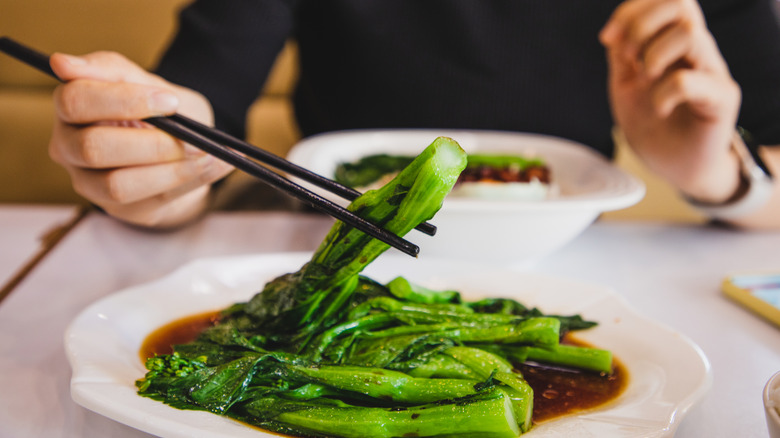
Although sodium is an essential ingredient for life, too much of anything is never good — and China's love affair with salt comes with serious health implications. A study in the Kidney International Supplement journal noted that salt consumption is the leading cause for "high blood pressure and increased cardiovascular risk worldwide". The numbers in China are particularly stark: According to a study in the China CDC Weekly looking at the incidence of cardiovascular diseases (CVD), two out of five people in China died from CVD in 2019.
Obviously, salt consumption isn't the sole factor responsible for this figure. There are other things like smoking, genetics, and obesity that contribute, as well, but it's quite clear that sodium is a very big part of the problem. If it wasn't, the World Health Organization wouldn't have coordinated with the government to get people to eat less salt. After all, being the world's biggest salt consumer isn't an accolade that any country would like to lay claim to, and they're trying very hard to pass on the title.
How China is trying to reduce its inhabitants' salt intake
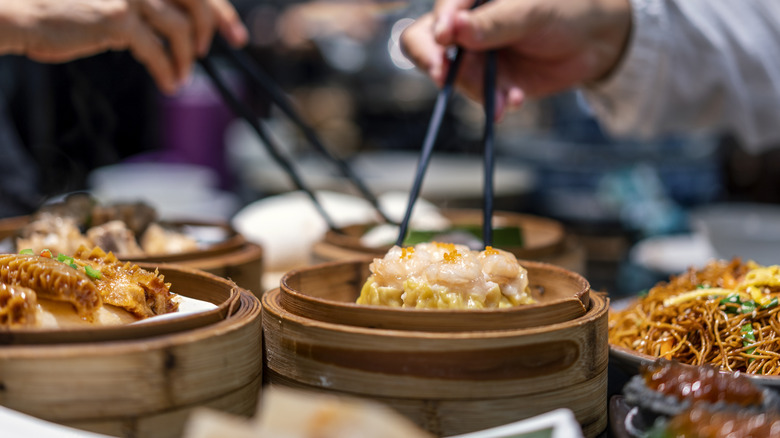
The Chinese government has been running programs to try and cut down on the populace's sodium consumption for decades. A popular idea is replacing sodium-based salt with potassium salt (yes, there's actually sodium-free salt). In addition to lowering sodium intake, making the switch will also boost people's potassium intake which, coincidentally, is low in China according to the Journal of Nutrition.
But really, swapping out standard salt with yet another kind is a temporary fix at best. That's why broader initiatives have been created to change dietary habits at their source. WHO China started a program in 2022 to encourage people to use less salt while cooking at home. The Chinese government has launched campaigns dating back to 2007, like the China Healthy Lifestyle for All (CHLA) and the China Salt Reduction Initiative, with a goal of reducing salt intake to just 6 grams per person a day by 2020. These programs are quite creative, including distributing free salt restriction spoons (measuring spoons to help people visualize portions). As we now know, these initiatives are still a work-in-progress.
What makes this particularly tricky is that Chinese cuisine has been defined over centuries by bold, savory depth. Soy sauce, fermented bean pastes, spices and sauces — these essential ingredients form the flavor foundation for countless recipes across China and its diasporas. That's why reducing sodium without losing the soul of the food is no small feat — even the most flavorful traditions, as it turns out, need a little recalibrating from time to time.