

The 1970s Crepe Restaurant You Likely Went To At The Mall
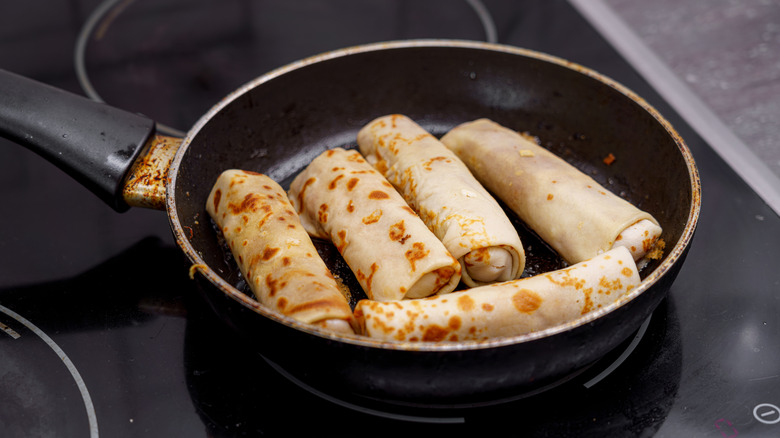
Julia Child rocked the culinary world with the publication of "Mastering the Art of French Cooking" in 1961. Two years later, on her seminal television show "The French Chef," Child taught the public how to easily make the French-style pancake known as crepes using a key ingredient. At the time, crepes Suzette was the most well-known crepe recipe to Americans, but Child chose to make savory crepes. Suddenly, in the 1960s, crepes were considered an elegant alternative — but they weren't really mainstream until Hungarian immigrants Laszlo and Paulette Fano opened The Magic Pan restaurant in San Francisco.
Both Lazlo and Paulette were working in banking and had no prior restaurant experience prior to opening The Magic Pan in 1966, but Paulette was encouraged by friends who loved her palacsintas — the Hungarian equivalent of crepes. The restaurant was small, and with people queuing out the door, the Fanos would have to churn out crepes very quickly. To meet the demand, Lazlo hammered out a large iron wheel affixed with eight crepe pans that rotated over an open flame — cooking eight perfect crepes in a matter of minutes. In homage to Lazlo's magical invention, the Fanos' restaurant was named The Magic Pan.
The Fanos opened two more locations before selling to Quaker Oats in 1969. The company went on to open more than 100 The Magic Pan locations in malls across the U.S. — capitalizing on the country's booming mall culture and crepe craze.
The rise and fall of The Magic Pan
As more malls were built in the 1970s, it was likely that you would find The Magic Pan as a place to dine after shopping. Patrons were charmed by the decor, the excellent service, and the show of watching the chef cook crepes on the spinning magic pan. Crepes were the rage in the 1970s, offering Americans a taste of France, and The Magic Pan became a place for high school French students to hang out and soak up a bit of European ambiance. The restaurant served both sweet and savory crepes, which, by all accounts, were delicious and cheap, and because the restaurants served until midnight, The Magic Pan was a late-night spot to grab a crepe and a coffee.
But by 1980, crepes were deemed passé. The dining public wanted big meals, and restaurants began shifting to menus with heartier American food. With declining sales, Quaker Oats sold off all its The Magic Pan restaurants in 1982. The new owners changed the menu to offer meats and pastas, but The Magic Pan couldn't keep up with the competition. Like other mall food court restaurants that quietly disappeared, The Magic Pan eventually closed all of its doors, and it was no more. The Fanos opened four other European-style restaurants, which were all successful. But none are as iconic, nor fondly remembered, as The Magic Pan.