

How 'Free' Is Your Fat-Free, Sugar-Free, Or Salt-Free Food, Really?

By now, most American consumers realize that food labels can be ambiguous, but terms like "fat-free," "sugar-free," and "salt-free" should, in theory, be more straightforward. Being free of something, you might think, means that the product in question doesn't contain any of the ingredient in question at all. But, perhaps unsurprisingly, nothing in the world of food labeling is ever that straightforward.
A recent example you've probably heard about is the growing popularity of "non-alcoholic" beer, which actually does have some small amount of alcohol in it, and is legally allowed to contain up to 0.5% alcohol by volume. And it turns out that labels like fat-free, sugar-free, and salt-free all contain similar loopholes.
These labeling terms are regulated by the Food and Drug Administration (FDA), and the government agency does allow trace amounts of sugar, fat, or salt in products labeled "free" of these substances. The amounts allowed are measured by serving, and for sugar and fat, a product can still contain up to 0.5 grams of either and still be labeled sugar-free or fat-free. This amount applies to both naturally occurring sugar and added sugar. Serving sizes that allow up to 0.5 grams of fat or sugar are determined by what the FDA calls "reference amounts customarily consumed." For example, one serving of bread is 50 grams, while one serving of a carbonated beverage is 12 fluid ounces. So one 12-ounce can of soda could technically contain 0.5 grams of sugar and still be labeled "sugar-free."
How sugar-free, salt-free, and fat-free food affects your diet
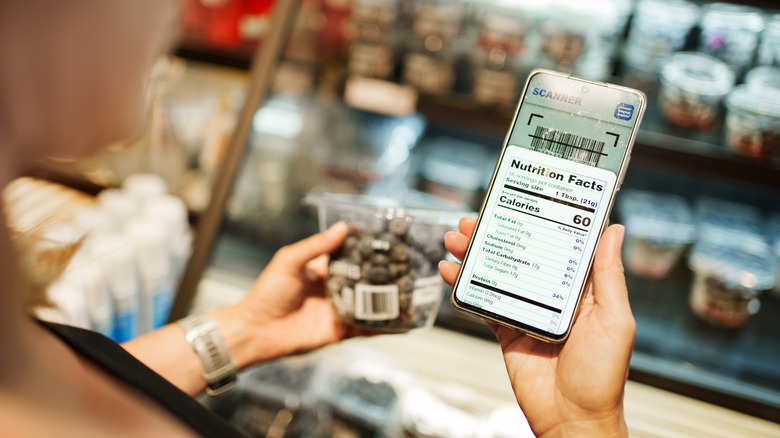
So, how much is 0.5 grams of fat or sugar? Relatively, it's a very small amount, but not nothing. Going by measuring spoons, one gram of granulated sugar is about a quarter-teaspoon, with 0.5 grams equating to roughly one-eighth of a teaspoon. While that is a measurable amount and might frustrate someone who understandably thinks sugar-free means no sugar at all, it's just 1% of the daily recommended amount of added sugar, according to the Food and Drug Administration.
Dietary fat is a little harder to measure, as plenty of foods combine fat with other macronutrients, but 0.5 grams of fat is about five calories worth. The recommendation for a 2,000-calorie diet is 400 to 700 calories from fat, so 0.5 grams isn't likely to ruin your diet.
For foods labeled salt-free, the amount of sodium in products must be under 5 milligrams per serving, and that really is basically nothing. A quarter-teaspoon of salt contains between 480 and 590 milligrams of sodium, depending on whether it's kosher, table, or sea salt. And with the recommended daily level of sodium intake being around 1,500 milligrams, you pretty much can take salt-free food labels at face value. Fat-free, sugar-free, or salt-free might not mean what you think, but don't fret about these labels too much, as the allowed amounts involved really are quite small.