

Deep Clean Your Kitchen Sink Drain With Pantry Staples (Don't Buy Expensive Cleaners)
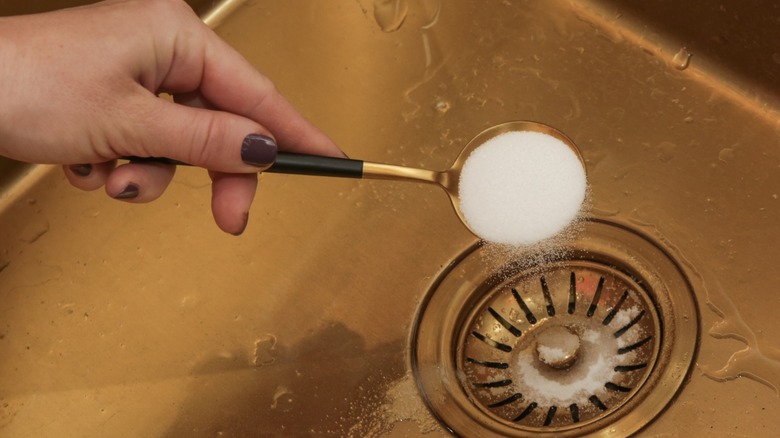
Your kitchen sink drain can get absolutely disgusting. Bacteria, standing water, and chunks of old food sit around, get warm, and stink up the place. Fortunately, there are countless cleaning products you can buy to ensure that isn't a problem. However, stocking up on these products can take time and money that might be better spent elsewhere. As it turns out, you can clean your sink drain with affordable everyday staples like baking soda, vinegar, and dish soap just as well.
To be clear, you don't want to mix all these ingredients together in your sink. That's how you make a science fair volcano — which would be cool, but that's not necessarily the best cleaning approach. You want to use the ingredients here one at a time.
For basic cleaning, just use warm water and dish soap. A sponge or microfiber cloth is all you need to wash the sink's surfaces, faucet, and handle. Then, rinse the sink with warm water. If you have some stubborn, stuck-on stains, that's where cleaning with baking soda comes in. Baking soda has a high pH that allows it to cut through grease stains, and its gritty texture provides a gentle abrasive for scrubbing stubborn spots. Lastly, vinegar is acidic and can help clean mineral deposits like calcium buildup and limescale — here are some vinegar cleaning hacks that may help.
Why you shouldn't mix baking soda and vinegar
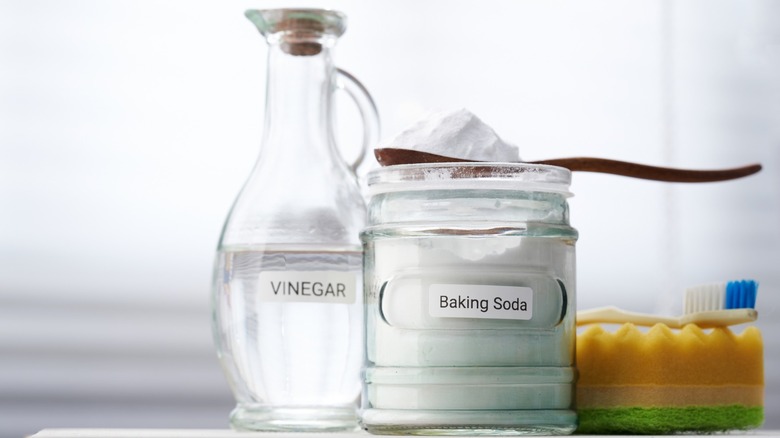
Contrary to what you might have heard, vinegar and baking soda together are not a good cleaning solution for surfaces. In reality, they don't really clean anything. The bubbling is simply carbon dioxide being released, and it does not clean your kitchen sink. In the drain, however, the reaction may help loosen buildup if used correctly. Vinegar and baking soda together create carbonic acid, which dissipates very quickly. Vinegar weakens baking soda's effectiveness, and baking soda reduces vinegar's, which is why it's best to use them separately.
If you have a clogged or greasy sink, start with hot water and then add baking soda to help break it up. You may have heard that boiling water works in this situation, but be warned, it can damage PVC pipes, which are usually rated for only 140 degrees Fahrenheit. So, stick to hot water, not boiling. After the baking soda has had a chance to penetrate the clog for several minutes, add vinegar. The release of CO₂ gas creates a mechanical action in the form of bubbling that helps loosen chunks, which you can rinse away with hot water. Once it stops bubbling, it is no longer effective, so letting it sit won't improve its cleaning power.
If you're looking for a more effective solution with pantry staples, replace the baking soda with cream of tartar and mix that with equal parts vinegar. Together, this forms tartaric acid, which is effective at cleaning sinks made of porcelain, copper, and aluminum. It's also less abrasive than a baking soda paste, making it safe for a wider range of surfaces and providing effective cleaning.