

Here's What The Imitation Label Actually Means In Grocery Store Code
You've surely seen them at the grocery store, products that look like, say, blueberry muffin mix, but in big letters to the side it specifically says, "imitation blueberries." Reading the ingredients, you can determine that the seemingly fruity component of the mix is actually made from a weird amalgamation of sugars, starches, dyes, and artificial flavors. But does this mean that all imitation products are made with such artificial ingredients? Not necessarily. In the U.S., the FDA requires products to be labeled as "imitation" if they resemble another food and are deemed to be nutritionally inferior by comparison.
While this does often apply to situations where things like real fruit are replaced by chemically-derived flavoring agents in little balls of colored starch, the true meaning is not quite so simple as the artificial-versus-real divide. In order to be considered nutritionally inferior, the substitute must contain lower quantities of a measurable essential nutrient when compared to the actual food. The term "measurable quantity," when used in these regulations, means 2% or more of the recommended daily intake, and "essential nutrient" refers to things like protein, vitamins, and minerals. Differences in caloric content and fat content are not subject to these same regulations.
But clearly this is not the whole story. When you look at the nutrition facts of vanilla extract and imitation vanilla extract side-by-side, neither contains measurable essential nutrients, according to FDA rules. So, what's the explanation for the other "imitation" products in the grocery store?
Other reasons a product might be labeled imitation
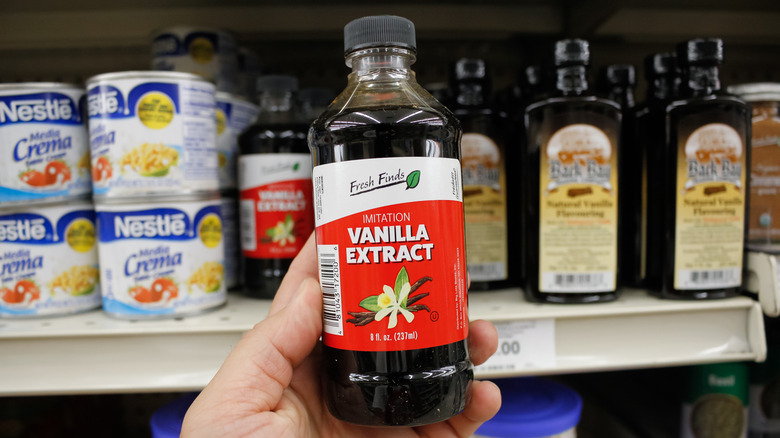
Vanilla extract is actually something of a unique case in the "imitation" food regulations. Per FDA regulations, to qualify as vanilla extract, a product can contain only an ethyl alcohol solution of one of the types of real vanilla beans. Vanilla extract is the most-sold flavor extract in the U.S., and has also been prone to adulteration over the years. To keep vanilla extracts from being supplemented with additions like tonka beans or vanillin — a chemically-derived artificial vanilla flavor — the product is closely regulated.
Seafood products are another interesting case in the imitation food landscape. Unlike with many other meats, it is common in the seafood department for several species to be ground up and either sold together or sold as an imitation of another meat. If you are a sushi-lover, you have probably eaten imitation crab, whether you know it or not. Don't worry, it is a delicious product that is the star of many a sushi roll, like this spicy crab salad sushi recipe. This knock-off crab meat is made with fish protein, starches, oils, and sugars, which does technically make it nutritionally inferior to plain crab meat, necessitating the "imitation" label. But there is a little bit of additional protection out there. The FDA does also require that products labeled as crab actually contain primarily crab. For example, packaged crab cakes that contain other fish protein must mention the other fish, and must contain more crab than other fish protein. It's a complicated world, trying to determine which imitation product to eat and which to skip, but now you are armed with a little bit more knowledge.