

If You Love Lychee, Rambutan Deserves Your Attention
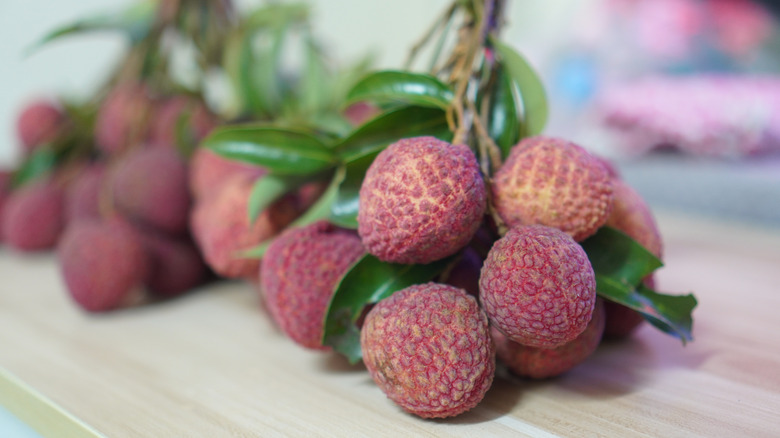
Easily one of boba's most notable flavors, lychee has experienced a surge in popularity on social media for its unique flavor and visual aesthetic, but this little fruit has a history stretching back thousands of years. While native to Southeast Asia, lychee trees also thrive in South Africa and certain American states (like Florida), where the weather is hot. You might be familiar with lychees, might even overload your pantry in the months when lychees are harvested. If that's the case, you should turn your eye to the rambutan fruit, too.
The rambutan is another tropical fruit with a small shape, a red exterior, white flesh, and an inedible pit, just like a lychee. Both fruits are members of the Sapindaceae family, or soapberry family, hence why the two appear so visually similar, and both make it on our list of 14 fruits uncommon in the U.S. you need to try once. Eating either a rambutan or a lychee begins with peeling back the red skin (which is way easier with this simple method) and either biting directly into the white flesh or using your fingers to pop the inedible pit out of the center before plopping the whole thing in your mouth. Many people who consume rambutan regularly describe the flavor as grape-like. It grows in clustered bunches from the branches of trees.
Rambutans are similar to lychees, but not exactly the same
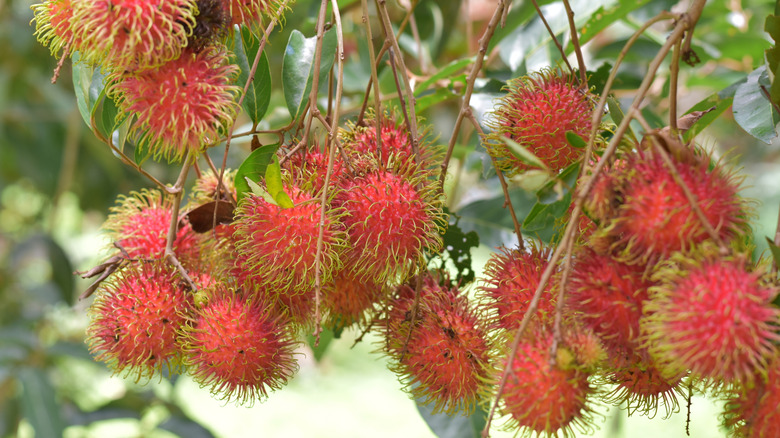
Both the lychee and the rambutan have red-ish coloring, but while the lychee's skin is bumpy, the rambutan's skin is covered in tiny bristles that make the fruit look like it's growing a head of hair. These dull and flexible spines give the rambutan its name, since "rambut" means "hair" in the Malaysian region where rambutans are most commonly cultivated. Compared to lychees, rambutans are slightly bigger, with a sweet flavor and less juice, but a taste that's still enjoyable in desserts, cocktails, smoothies, and fruit salads, and various other ways to prepare and eat rambutan.
The rambutan tree thrives in tropical environments, such as Malaysia and Vietnam, though it also does well in the jungles of Central America and even Hawaii. It can't withstand cold at all, so unless you own a greenhouse or live in USDA hardiness zones 10, 11, or 12, you're better off buying rambutans from your local farmers' market than growing them from seeds. These fruits might be easier to find than you'd think, with supermarkets like H-E-B and Trader Joe's often stocking them. If you can't find the fresh fruit, canned rambutans in syrup are also popular. Similar to lychees, the darker the color of the rambutan, the better it tastes!