

Here's What Goat Milk Really Tastes Like
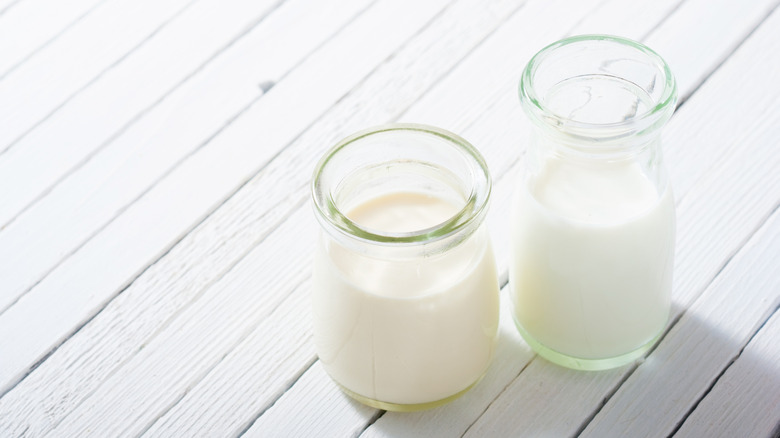
Goat milk tends to divide people. Some swear it tastes fresh and mild; others dismiss it as funky or outright bad. It mostly comes down to personal preference, plus some biology and some handling. Goat milk has higher levels of certain medium-chain fatty acids than cow's milk, which is partially why some label it "goaty," especially if the milk isn't chilled quickly. Pasteurization can smooth out some of that edge, which is why the cartons you find in grocery stores taste different than milk from a farm. But even pasteurized, it certainly has its own strong character, much like goats themselves.
Goat milk has smaller fat globules than cow's milk, which means it feels smoother on the tongue (no wonder it's more expensive), so there's a textural distinction too. It's also naturally homogenized, so the cream doesn't quickly separate and float to the top. That makes it silky, though the flavor is carried in those fat globules, so the higher the fat, the more pronounced the taste. Skim milk of any animal tastes like almost nothing, while whole milk is fuller, richer, and tastes more overtly of where (or what) it comes from.
And that's the thing: milk always tastes like what it came from. We've convinced ourselves that cow milk is neutral, but it's just cow-flavored milk. Likewise, goat milk tastes like, well, milk from a goat. Both are necessarily influenced by what the animals eat. If goats are feeding on fresh alfalfa and orchard grass, the milk leans sweet and mild. If they get into stronger flavors, like onion tops or brassica stems, you'll notice that sharpness. Milk is chemistry filtered through a body, carrying a kind of animal terroir that changes with species, season, and diet.
Growing up with goat milk
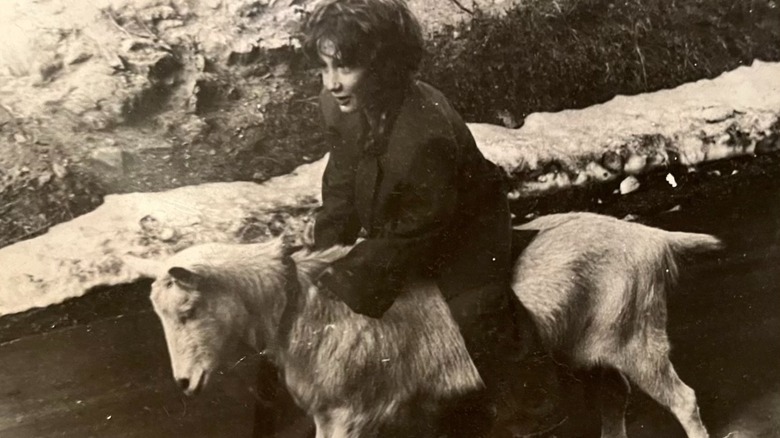
But I didn't learn about goat milk from a carton in the grocery store; I learned it from our family goat Belle, who stood patiently in our shed each morning as we milked her. She was a champion milker who grazed on wildflowers and clover in our pasture at the top of the Rocky Mountains, so the milk she produced was rich, clean, and sweet. It never carried the "barnyard" flavor that many complain about. For me, that's just what milk was: alive, immediate, and unmistakably part of the place we lived.
We made yogurt, strained it into yogurt cheese, and experimented with recipes. Goat milk just became the baseline for how dairy tasted. I discovered my own strange treat: raw goat milk mixed with Rumple Minze schnapps. Creamy, minty, maybe a little weird, but sue me, it was delicious. Goat milk was good for my body; it made my skin soft and plump, and I still joke that it's the fountain of youth. Science actually backs that up, because goat milk is high in vitamin A and fatty acids, like caprylic acid, compounds the body can metabolize easily into healthy skin lipids.
Belle nourished my family, and, in many ways, shaped how I still experience both milk and animal products broadly. She taught me early that flavor is context. Goats eating lush grass in summer make different milk than goats eating hay in winter. It has to be chilled fast so it stays sweet (and to prevent bacterial growth); leave it warm and the fatty acids assert themselves gamily, much like Belle playfully butting her head against us as we walked through the field after collecting milk.
Easy to digest, hard to miss
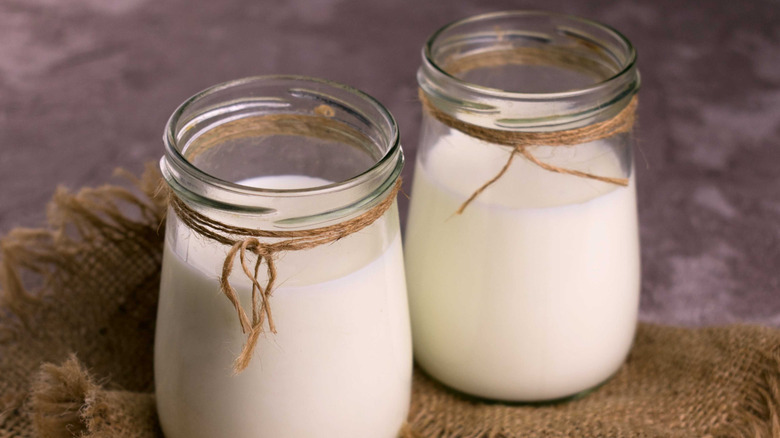
For some, the smaller fat globules and different protein structure make goat milk easier on the stomach than cow's milk. Conventional cow's milk mostly contains A1 beta-casein, a form that can be harder for the human digestive system to process. Goat milk, by contrast, is richer in A2 beta-casein, which resembles the protein in human breast milk, and is why some whose digestive systems can't tolerate cow's milk find goat milk gentler. Nutritionally, goat milk is high in calcium and phosphorus for bones, potassium for circulation, and vitamin A for vision and skin. It's also a good source of selenium, a mineral linked to immune function.
Outside of my own childhood, goat milk has a long history in cooking. In Mexico, it becomes cajeta, a slow-cooked caramel that rivals dulce de leche. In France, soft chèvre cheese ranges from soft and spreadable to aged and sharp. Chèvre can even be used in cheesecake, pairing beautifully with honey or apricots (try this no-bake apricot goat cheese recipe), the characteristic tanginess of the cheese playing impishly against the sweetness. In India and parts of the Middle East, goat milk is used in sweets, curries, and yogurt.
Globally, goat milk is the most widely consumed milk, precisely because goats thrive where cows don't, needing less land and water. For billions, goat milk is everyday nourishment, but for those trying goat milk for the first time, it can be intense on its own. However, in cooking and baking, its differences soften or become assets. It is a funky curiosity, but if you lean into those flavors instead of hiding them, goat milk shows why it's been cherished around the world for centuries as a versatile, nourishing staple.