

How Ketchup And Mustard Became The Ultimate Duo
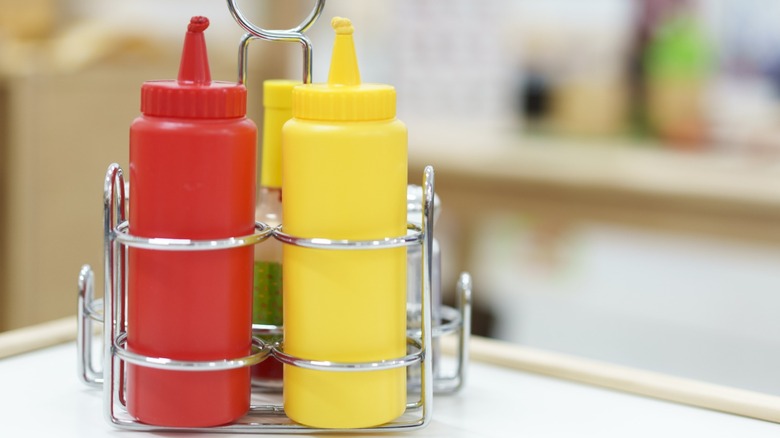
From backyard barbecues to diner counters, ketchup and mustard have long been the tag team of condiments. Seeing the familiar red and yellow squeezy bottles forever standing next to each other, it's hard to imagine their origin stories were so far apart: one rooted in ancient Rome, the other in 17th-century Asia. Still, these two condiments, each with its own storied past, came together to become quintessential symbols of American fast food.
Ketchup's journey to becoming the sweet, tangy tomato-based staple we know today is long and winding. Ketchup was originally made with a surprising ingredient, fermented fish, and was popular across Southeast Asia. Early Western adaptations included wildly different ingredients like mushrooms, walnuts, and even elderberries. Tomatoes only entered the picture in 18th-century America, and because fermented tomatoes didn't store as well as fish or mushrooms, the vinegar, salt, and sugar-heavy recipe we recognize today was developed. Today, Grub Americana estimates that a bottle of ketchup can be found in 97% of American households.
Meanwhile, mustard's story stretches back to ancient Greece and Rome, where mustard seeds were ground and mixed with wine, vinegar, and olive oil to create early versions of the condiment. The Romans took their mustard mix to France in the 4th century, and later, French settlers brought mustard to North America in the 16th century, but large-scale production didn't take off until the early 1900s, when brands like French's and Gulden's transformed it from a regional specialty into an American pantry essential. By the mid-20th century, both ketchup and mustard had found their way into American homes and kitchens, setting the stage for a legendary pairing.
Match made in flavor heaven
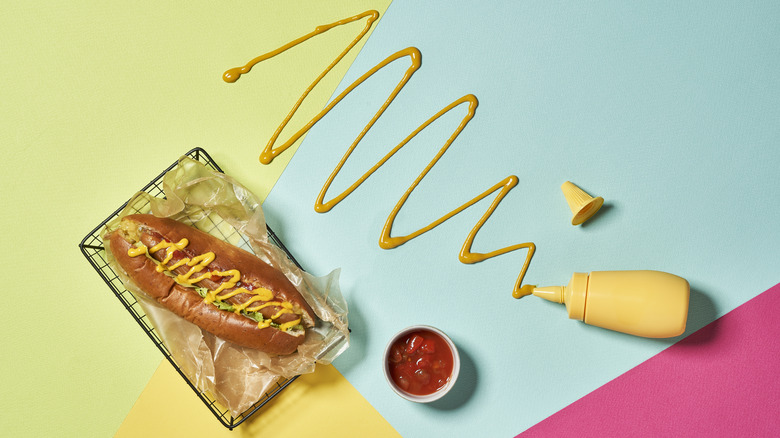
While it's hard to track down a clear moment that saw ketchup and mustard become yin and yang, if you had to pick one defining phenomenon that brought them together, it's the rise of American fast food and the explosion of roadside diners and drive-ins in the 1950s. As burgers, hot dogs, and fries became the nation's go-to comfort foods, ketchup and mustard emerged as their perfect, complementary condiments.
Ketchup and mustard might be on opposite ends of the flavor-profile spectrum, but together they work like a dream. Ketchup is sweet, tangy, and mildly acidic, while mustard brings a sharp, pungent hit to the table. Ketchup's sweetness softens mustard's boldness, while mustard adds a complex edge to ketchup's sweet tanginess. They're both extremely versatile, too. Ketchup lends itself well to marinades, glazes, and can also be used to add thickness and flavor to stews. Mustard, with its sharp and piquant flavor, works wonders in salad dressings, vinaigrettes, and as a flavor booster in sauces, sandwiches, and roasted meats.
There's one more reason why ketchup and mustard have had such lasting popularity: they both have really long shelf lives. Mayonnaise might be the world's favorite condiment, but it lasts for only a couple of months in the fridge once opened. Ketchup, on the other hand, keeps for three times longer. Mustard has the longest shelf life among popular condiments and can be refrigerated for a year after it's opened. Add this long shelf life to the versatility and flavor compatibility, and it's no wonder ketchup and mustard have remained the go-to condiments for generations.