

The Cold Pan Technique Bobby Flay Uses For Soft, Creamy Scrambled Eggs

When it comes to scrambling eggs, every celebrity chef worth their salt and pepper has a signature approach. Alton Brown turns up the heat and relies on precise timing. Emeril Lagasse swears by his Baby Bam spice mix. Heston Blumenthal uses a heat-proof bowl set over boiling water. And Gordon Ramsay constantly moves his pan on and off the flame. Bobby Flay takes a notably different route: He starts with a cold pan. That's right. His first step is to add cold butter, crème fraîche, beaten eggs, and a dash of pepper to the skillet — all before turning on the heat.
Why the cold start? Because, despite the many dramatically different techniques, nearly every recipe for perfect scrambled eggs shares one key principle: careful temperature control. Even Alton Brown, who starts scrambling on a high heat, lets the eggs rest on a pre-warmed plate for a minute before serving them.
Flay's cold-pan technique, featured on The Food Network, ensures the eggs cook slowly and evenly, preventing overcooking and resulting in a luxuriously smooth, creamy finish. As the pan gradually warms, Flay begins stirring, carefully watching for the moment the egg mixture starts to form soft curds. The transition from liquid to cooked happens quickly, and because the pan retains heat, it's easy to overshoot the perfect texture if you don't remove the eggs promptly.
The science behind slow-cooked eggs
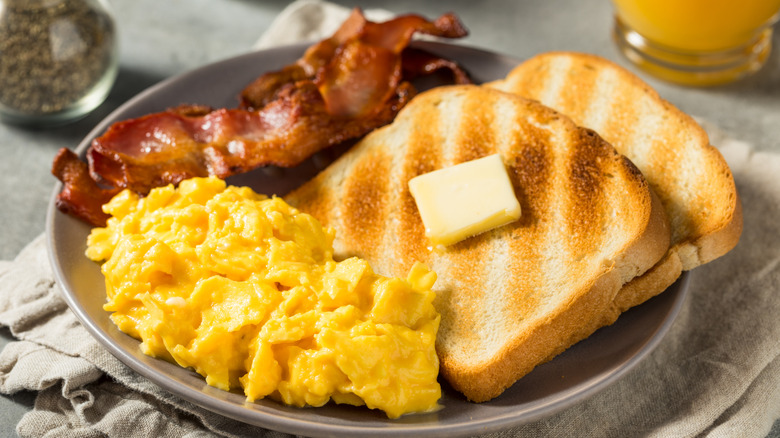
You'll come across plenty of tips for making perfectly fluffy scrambled eggs. Most recipes focus on three particularly important aspects: heat, liquid, and salt. When you apply heat to eggs, it agitates the proteins. As the temperature rises, these protein bonds tighten, squeezing out water and transforming the mixture from liquid to the semi-solid curds we recognize as scrambled eggs. Cooking on high heat causes the proteins to tighten too much and squeeze out moisture. The result? Rubbery whites and chalky yolks. While there are ways to rescue overcooked eggs, prevention is definitely better.
The next important aspect is liquid. The traditional reason to use milk, water, or cream is to dilute the egg proteins. The extra liquid creates steam as it heats, helping lift the mixture and resulting in a lighter, fluffier texture. However, Gordon Ramsay adds a spoonful of crème fraîche right at the end to cool the eggs down and prevent them from overcooking in the residual heat.
At what point of the process you add salt makes a difference too. Adding it early helps the eggs thicken and coagulate at a lower temperature, producing a more tender texture — but adding salt early also increases the risk of overcooking. With his cold-pan technique, Bobby Flay is clear: hold off on adding salt (as well as goat's cheese and romesco sauce) until the eggs are fully cooked, ensuring the perfect creamy consistency.