

The Best Type Of Wine To Order When Everyone's Eating Something Different
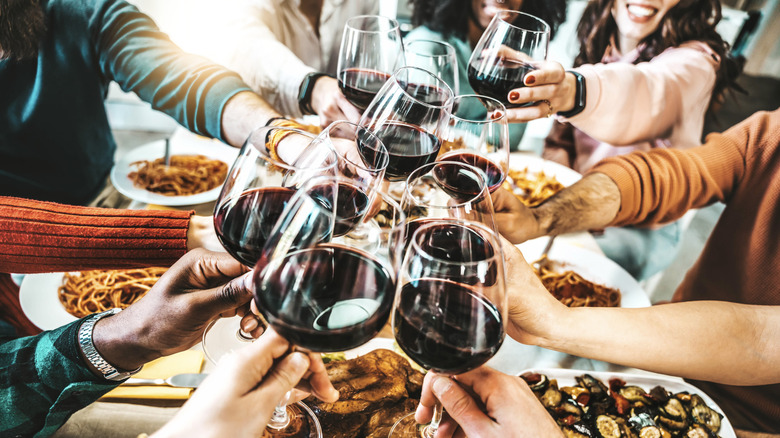
Dining out with a group of family, friends, or coworkers can be fun and relaxing — but only if you think ahead, especially when it comes to wine. Ordering wine by the bottle is typically the way to go, but it requires choosing wines that pair well with a wide array of menu items. For some insight on this potential conundrum, we reached out to an expert in the field: James Ruggiero, Beverage Manager, Washington Street Hospitality, the company behind Charleston's Legami restaurant.
Ruggiero offers some suggestions for keeping the wine-peace among folks with varying palates, starting with a list of priorities. "It's hard to get a group of people to agree on anything, but typically, people can always agree on value," he says. "You want to order something that overdelivers for the value and approachability." There are two go-to varietals in his own personal repertoire: viognier and barbera.
Barbera is an Italian red wine featuring low tannins but high acidity, a solid choice for tomato-based dishes and seafood, explains Ruggiero. "It's one of my favorite glasses to drink alongside our chefs' "tagliolini pecatora" lobster, mussels, shrimp, scallops, garlic, EVOO, Calabrian chili flakes, and pomodoro." Then there's its French counterpart, the versatile white viognier from the Rhone Valley, which pairs well with many meats and seafoods. "It's a fuller-bodied white, often with lots of fruit, citrus, and floral notes, and it stands up really well to savory dishes," he says. However, viognier and barbera aren't the only wines getting some group love from Ruggiero.
Consider bubbly or a sangiovese red

Choosing bottles for communal wine-sharing can be a nuanced endeavor, especially with bubblies. "For an outlier like sparkling, rose, and orange wine, I think sparkling is a great way to set the tone for the meal," notes Ruggiero, who goes on to explain a dual purpose. "The high-acidity and refreshing bubbles not only have that symbolic celebratory mood that can capture everyone's attention, but they also serve as a pragmatic approach to scrub everyone's palates as a 'clean slate' for everyone heading into their dishes."
Then there's a well-loved Tuscan wine, the sangiovese red. Noting the difficulty of exclusively pairing single wine varieties with specific dishes, Ruggiero explains sangiovese in the broad context of Italian-focused cooking. He calls sangiovese a go-to for these tomato-based dishes because there's a harmonious balance between high acidity in both the wine and the tomatoes — while the medium body and moderate tannins complement umami flavors and rich ingredients. The prominent acidity also makes sangiovese an ideal pairing partner for hard italian cheeses such as Pecorino Romano and Parmigiano Reggiano, and by extension, our cheesy, tomato-based lasagna Napoletana recipe.
As for other foods, Ruggiero feels sangiovese works except in rare circumstances — such as very spicy or rich dishes overpowering the wine. "But generally, culinary teams are striving to create a harmonious balance of flavors," he points out. "So it's unlikely that a restaurant would be offering an item with such a polarizing flavor profile, which increases the probability that sangiovese would work well for everyone."
Steer clear of certain wine characteristics

When everyone at the table is eating something different, a few categories of wine get the snub from Ruggiero. That's for a couple of valid reasons: either the potential lack of broad appeal, or a specific wine being at odds with certain food pairings. On their own, these wines could well be excellent choices — but with sharing in mind, problems could arise.
"I personally would stay away from orange wines or natural wines," says Ruggiero, due to minimal intervention during the wine-making process — which creates a wider range of flavors and aromas. As a wine lover, he personally loves "the unexpected discovery" of these wines, but recognizes the drawbacks. For multiple diners sharing varied meals at communal tables, he suggests sticking with something predictable: "It's not about you, it's about the group."
On another level, some excellent wines for sipping could be very tricky in a food pairing situation, especially with an array of menu items arriving at a communal restaurant table. Some of the hardest wines to pair with food include high-tannin reds or high-alcohol wines, so they're best avoided in this situation, according to Ruggiero. That includes sagrantino, a cherished Italian red wine from Umbria. Ruggiero notes that it "requires fatty or rich foods to balance the wine's astringency and prevent the pairing from tasting bitter. The wine's intense structure and high alcohol can easily overpower less robust dishes."