

Slimy Okra? Chef Priyanka Naik Says Your Cleaning Technique May Be To Blame

There's nothing more disappointing than the anticipation of satisfyingly crispy roasted okra, only to realize the texture is far from what you aspired for once you take a bite. Rather, it's a little soggy... slimy even. According to esteemed chef Priyanka Naik, this textural mishap could stem from the way you're cleaning your okra.
"Do you hate okra? I gotchu," Naik teased in the caption of her Instagram post. Her animated recommendation is simple: avoid washing the vegetable with water, and gently wipe with a moist towel instead. Minimizing that initial exposure to water is one of the most effective tips you need to know when cooking with okra; it's a strategy rooted in food science.
"I've never had slimy okra in our house," Naik promised in her Instagram post — and she might be onto something. Okra contains a soluble fiber that actually dissolves in water, formally referred to as mucilage. Without the correct cleaning approach, the fiber can quickly dissolve into goo, turning your plate of okra into a limp-looking affair. Naik's technique reduces the amount of water the okra is exposed to, and in turn, reduces the chances of the mucilage dissolving.
Is Naik's strategy effective in cleaning the okra?
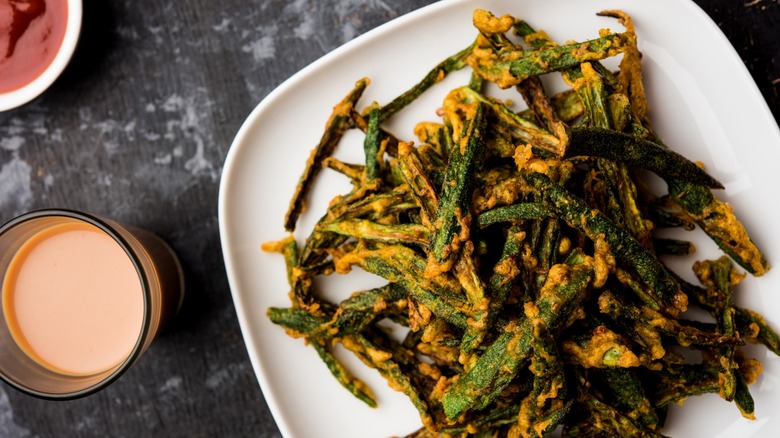
In the video posted on Instagram, Naik's okra is left gleaming — look closely and you'll see the buffed-up shine on each vegetable. That said, many tout the importance of using more abrasive strategies for cleaning them. But, according to the Federal Drug Administration and the Centers for Disease Control and Prevention, the consensus is clear: water-only washing is sufficient for produce, and sticking to trusty H20 is the best approach.
This gives Naik's strategy the green flag for properly cleaning okra. The physical action of rubbing the okra with a towel is a tried-and-tested method of removing grime, and likely even more effective than a trickling tap — all while helping to reduce sliminess. While vinegar is the other go-to, a 2006 study suggests its cleaning capacity is no greater than water. It does, however, carry some additional slime-busting benefits.
Many chefs suggest that a vinegar soak is all you need to combat slimy okra, as the acetic acid adjusts its pH levels. So, if your okra is still emerging slippery and soggy even after trialing Naik's hack, a tub of vinegar might be the optimal next step.