

Cool Whip Used To Be Dairy-Free, But Now It's Not. Here's What Changed

Cool Whip was a non-dairy alternative to whipped cream when it hit the market in 1966. But in the years since, milk ingredients have been added to its recipe. The blue tub currently contains sodium caseinate, a milk protein derivative, as well as skim milk and light cream elements. The byproduct is used as a thickening agent that is added to foods to help emulsify textures.
The product was created by George Lorant and William Mitchell, the latter of whom previously worked as a food chemist for Pop Rocks. The two hoped to create a substance that could be manufactured easily and stored for long periods of time. At the time, it was frozen and needed to be defrosted before use.
After making its debut as a non-dairy product, Cool Whip, which can be used in many creative ways, now contains several other ingredients, in addition to its dairy components. Among them? Water, hydrogenated vegetable oils, corn syrup, high fructose corn syrup, beta carotene, and xanthan gum.
Is Cool Whip the same as whipped cream?
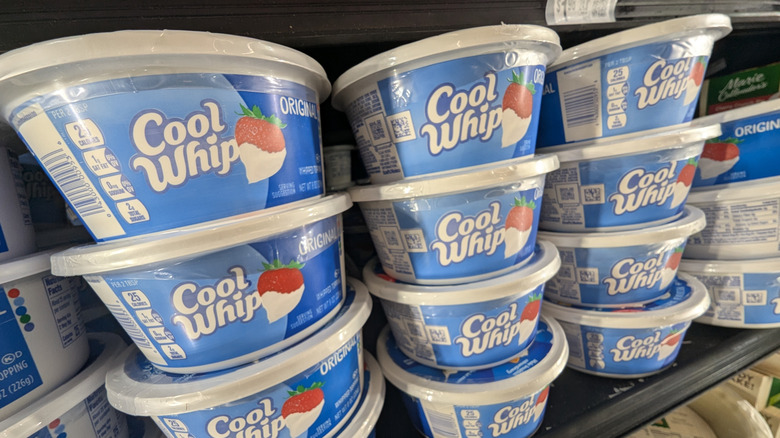
Sorry to disappoint whipped cream fans out there, but Cool Whip is not identical to its fluffy cousin. While both commodities serve similar purposes and are colored white, they each have major differences in terms of textures, caloric means, and additives. The whip substitute is labeled as "whipped topping" rather than cream, as it holds more oil constituents than dairy liquids. Cool Whip is also thicker, and the texture is more reminiscent of a pillowy-type density over normal whipped cream.
Whipped cream has a higher fat content than its faux relative, and its consistency is lighter and silkier. Authentic whip also just has simple ingredients such as heavy cream, vanilla, and sugar, while Cool Whip has many more substances added. Whether you prefer whipped cream or Cool Whip is up to your personal preference, and can be decided upon based on the dish on which it will be used, as well.