

This Unconventional Flour Is Richer In Protein Than Meat Or Eggs
We may receive a commission on purchases made from links.
With an ever-expanding population worldwide and factors like climate change affecting our ability to produce enough food to feed the world, it's no surprise that people are seeking alternative ways to provide sustenance for a global population. Some scientists look to the future with advances like lab-grown meat, while other researchers seek alternatives inspired by ancient cultures around the world, specifically in insects. Cricket flour, also known as cricket powder and acheta powder, is a wonderful source of protein.
Cricket flour is made up of finely ground crickets, using the entire insect. Cricket bodies are made up of roughly 65% protein, and their exoskeletons contain an insoluble fiber that can aid in digestion, compared to whey proteins, which some people have a difficult time digesting. If you're worried about texture or taste, don't be: The crickets are finely ground and have a neutral taste with slight notes of nuttiness.
A 10-gram serving of Thailand Unique's Cricket Powder, which is made of 100% cricket, has 7 grams of protein. Meanwhile, the same serving size of chicken breast has about 3 grams of protein. Similarly, 10 grams of ground beef contains 3 grams of protein and 10 grams of eggs have about 1.5 grams of protein, far less than the cricket flour. Cricket flour also contains B vitamins and other micronutrients, as well as healthy fats.
It's easy to incorporate cricket flour into your recipes
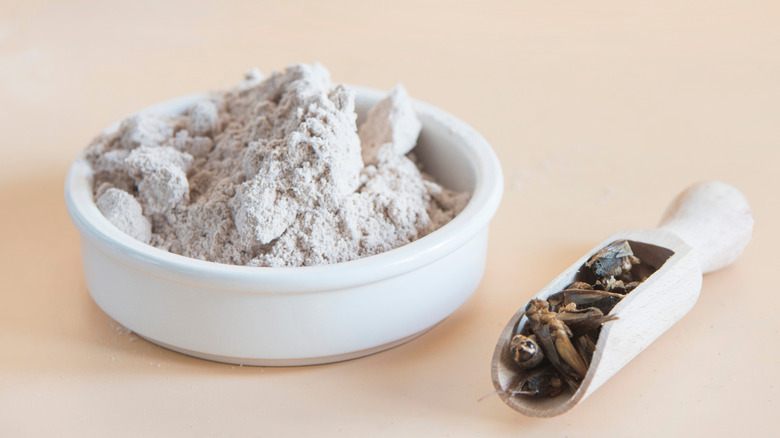
In terms of using the cricket powder, it's an easy swap for other protein powders in smoothies. Since it's ground to a fine flour, you can also substitute it for a small portion of regular flour when baking, like pancakes, waffles, or banana bread. Cricket flour doesn't have the same gluten structure as all-purpose flour due to the lack of wheat, so we don't recommend it as a complete swap for baking projects that require that stability from gluten. However, you can easily experiment by swapping it for a few tablespoons of plain flour when making bread, tortillas, pasta, or even cookies, as the taste is fairly neutral and is a great way to sneak in a little added protein to baked goods.
While our modern American palates may be squeamish at the thought of consuming insects, it's a common practice around the globe that's been popular for thousands of years. Insects like crickets, grasshoppers, and ants are plentiful, and they are an amazingly sustainable source of protein compared to traditional animal proteins, especially when compared to the greenhouse emissions and land use of raising proteins like cattle and pigs. If you've ever visited Mexico City, you've likely seen or even eaten "chapulines," seasoned and roasted grasshoppers, which are commonly served as a bar snack, folded into guacamole, or used as a crunchy garnish. Grasshoppers and crickets can be seen as a gateway for eating insects for many travelers. Insect flours are a great way to try out a new source of protein.