

What Even Is Huitlacoche And Can You Safely Eat It?

We may receive a commission on purchases made from links.
Mexican cuisine encompasses a vast array of native ingredients, farming practices, and preparation methods that vary throughout the country and are deeply rooted in its history. Many of its dishes have migrated north in one way or another and become popular in the U.S., however, there are plenty of traditional recipes that remain scarce outside their regions of origin. One food that has been part of Mexican cooking for centuries but which is only just starting to gain notoriety further afield is huitlacoche, a dark fungus that grows on corn.
Native to Central Mexico, huitlacoche has been a part of the local cuisine since the Aztecs first discovered that they could cook with it. At first, they ate it out of necessity. In the 14th century, the Aztec empire was growing rapidly, and in order to grow enough crops to feed their growing population, they developed sophisticated agricultural systems that are still being used today. Nothing could stop a particular silvery-blue fungus from growing on their all-important corn crops, especially during the rainy season. Although it might have seemed like a catastrophe at first, the Aztecs soon discovered that this fungus could be treated as a valuable crop in its own right. 700 years later and huitlacoche is still served in Central Mexican cuisine, and today, you can even find it on the menus of some of the U.S.'s most exclusive restaurants.
It's a fungus that is safe to eat
The word "fungus" has a pretty bad reputation, largely due to the vast number of things that it encompasses. It's a broad term that describes a group of organisms that produce spores, and it can be used to refer to anything from an unpleasant skin condition to an umami-rich ingredient found in everything from pizza to soup. Some types of fungus are safe to eat (shiitake mushrooms and truffles, to name a few), and some can be deadly. When it comes to huitlacoche, it makes sense to be wary. There are many types of fungi that grow on corn, and most of them are bad news.
There's Fusarium, which produces pink-tinged white mold on ears of corn that contains a mycotoxin that should be kept far away from the kitchen. There's Diplodia ear rot, which creates a white mold over the corn and is not particularly appetizing either. Then, there's Gibberella ear rot, which produces a reddish mold that can also contain mycotoxins.
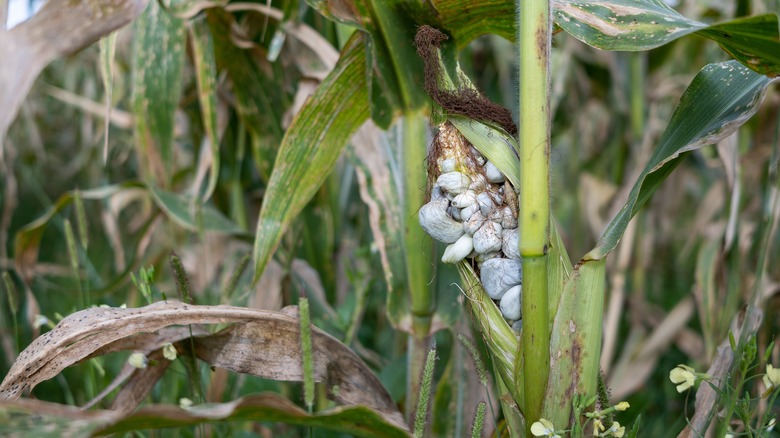
In this light, viewing any type of irregular growth on corn as a potential health hazard is wise, but huitlacoche presents a rare exception. It is the result of a fungus called Ustilago maydis, which infects corn and surrounds the kernels in light, blue-grey growths that look like shiny pebbles. Unlike other types of corn fungus, huitlacoche is safe to eat and, as we'll see, has many advantages over corn, both for farmers and cooks.
It is considered a delicacy in Mexican cuisine
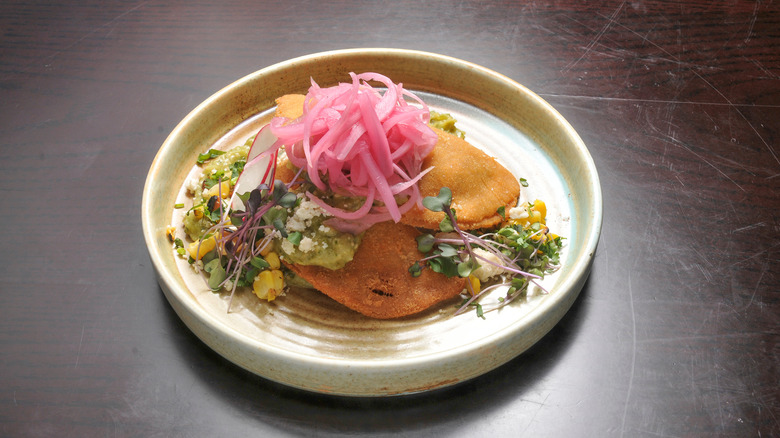
Ever since the Aztecs discovered that huitlacoche was safe to eat, it has been a part of Mexican cuisine. Recently, it has gone from being viewed as a humble regional ingredient to a coveted delicacy, prized by chefs across the country. You can find it in everything from street food to Michelin-starred restaurants, and this rise in demand has forced farmers to innovate.
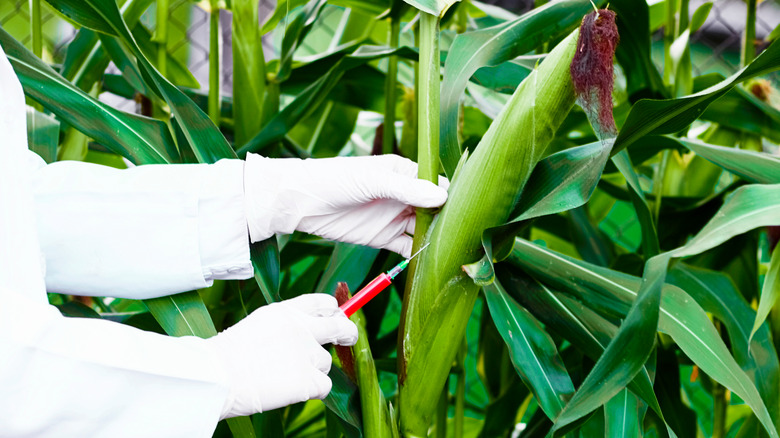
Although many corn farmers would likely despair at discovering a fungus running rampant over their crops, many are now growing huitlacoche intentionally. Until a couple of decades ago, this was no easy feat, largely because the fungus was seasonal. Huitlacoche appears when corn kernels are damaged, and that usually happens during the rainy season, when wet weather and wind inflict small injuries to the corn. Now, however, farmers often inoculate their crops with a syringe in order to produce the fungus year-round. They even grow particular types of corn that have been deemed to produce tastier results. Like many other types of flavorful edible mushrooms, huitlacoche is highly versatile, giving chefs from all parts of the culinary spectrum plenty to work with and farmers plenty of incentive to keep growing it as consistently as possible.
Its taste is often compared to another luxury ingredient
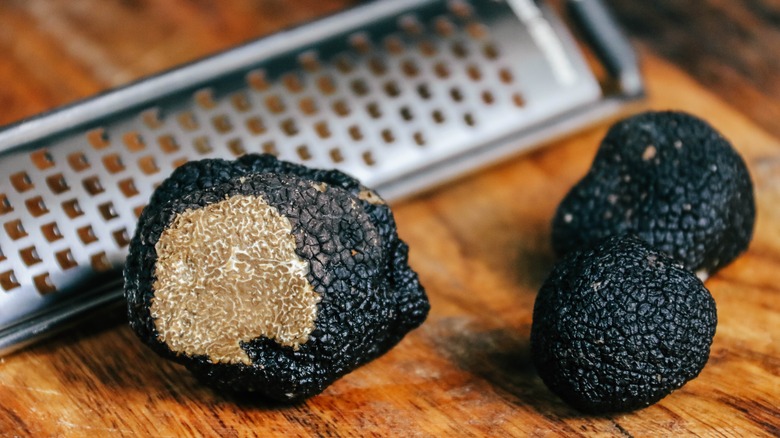
What's so special about huitlacoche as an ingredient? Let's start with the flavor. It's always a challenge to describe the flavor of something that is truly unique, but many people have drawn comparisons between huitlacoche and another gourmet fungus, the truffle. The association is so prevalent, in fact, that it is sometimes referred to as "Mexican truffle." Confining it to this one-to-one comparison would be a disservice, however, because the reason huitlacoche is in such high demand is that it has a distinctive flavor that no other ingredient can substitute.
In addition to the earthy umami flavor that you'd find from truffles and other mushrooms, huitlacoche is often described as having a smoky taste. There are even those who identify notes of chocolate and vanilla. Although you might need a hyper-sensitive palate to zero in on those two ingredients, there is a touch of sweetness that distinguishes it from other fungi. You might even catch a hint of sweet corn. Ultimately, though, like any novel ingredient, you'll need to taste it yourself to find out its precise blend of singular attributes.
You can use it to add flavor and color to dishes
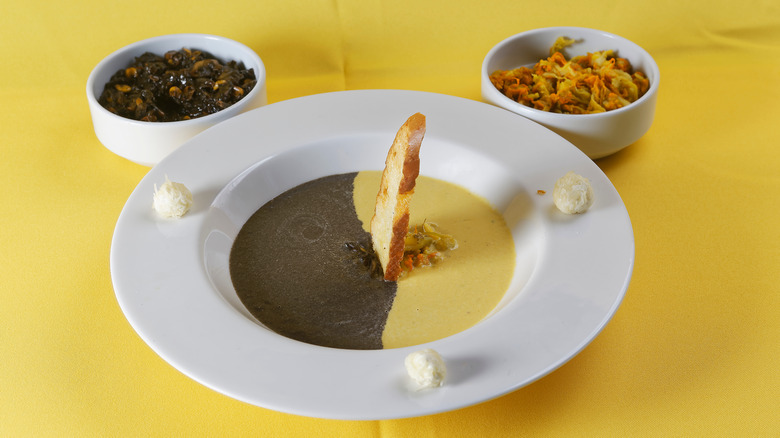
Given its uniqueness of flavor, perhaps a better way to describe the possibilities and merits of huitlacoche is to explore some of the ways it is frequently used in cooking. One of its most common uses is in quesadillas, where it is often paired with soft, stretchy Oaxaca cheese, known as quesillo. Its flavor is also a welcome addition to sauteed veggies, soups, and sauces. Like other types of fungi, it can be used as a meat substitute thanks to its soft, chewy texture. That said, it has such a distinctive flavor that it's best not to make it the main ingredient in a quesadilla or taco filling. You probably wouldn't enjoy pure black truffle in a filling, no matter how much you like the flavor, and the same goes for huitlacoche. Pairing it with veggies and cheese is an easy and delicious option.
You can also use huitlacoche to add color, though unlike other plant-based food dyes such as beet powder and spinach, its flavor will stand out just as strongly as its color. It is also worth keeping in mind that, although it is silvery blue on the outside when fresh, cooked and canned huitlacoche turns black, and when you add it to food, it will add an inky dark color.
It can also be used to make a cozy drink

If you're looking for a truly novel way to use this special ingredient, you can opt for making a cozy Mexican drink called atole. This is a traditional holiday beverage that is usually made with masa harina (nixtamalized corn flour), a type of unrefined sugar called piloncillo, cinnamon, vanilla, and milk. If you ever get tired of hot chocolate or simply want to switch things up a bit, atole will hit the spot. It is also infinitely adaptable. We even have a delicious recipe that adds peanuts to the mix.
However, you can also use huitlacoche. This may come as a surprise given how often this ingredient is used in savory dishes and how frequently it is compared to truffles (it's safe to say that a few dashes of truffle oil in a mug of atole would yield questionable and even downright unpalatable results). And yet, the fact that it pairs so well with this sweet drink illustrates just how versatile and distinctive huitlacoche truly is. The simplest way to add the ingredient is to simmer it in the milk and then blend the mixture into a smooth texture. It will turn the drink a grayish hue, but don't worry — it tastes delicious.
More farmers in the US are starting to grow it

Even after chefs throughout Mexico began to embrace huitlacoche as a gourmet ingredient and farmers began to grow it intentionally to meet the demand, farmers in the U.S. were slow to catch on. As with any other fungus, huitlacoche was a costly pest, something that would render the corn it infected unusable. For this reason, the American term for the fungus is corn smut, a derogatory name for an unwelcome visitor. Even the U.S. government has spent a significant amount of money to find ways to eradicate it for good.
However, in recent years, more and more farmers north of U.S.-Mexico border are embracing their former enemy, and are either cultivating it intentionally or selling effected ears of corn when they find it. Even growers as far north as Canada are experimenting with inoculating their plants and hoping that the now-coveted fungus will grace them with its magic. In 2016, researchers from the University of Texas — Rio Grande Valley concluded that huitlacoche could be a lucrative crop for Texas farmers, but for the time being at least, it remains a niche crop prized in some circles but still vilified by others.
It's full of nutrients
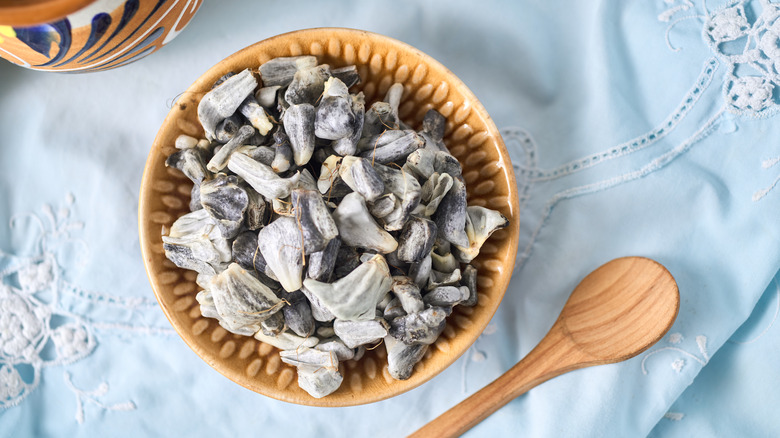
Huitlacoche is primarily celebrated for its flavor, but it turns out that there is even more to appreciate about this unassuming ingredient than pure deliciousness. It also happens to be packed with nutrients. Not only is it healthy, but it exceeds the nutritional value of corn in multiple respects. While corn is primarily a source of carbohydrates and fiber, huitlacoche is rich in protein. Where cooked corn is around 4 or 5% protein, cooked huitlacoche can be anywhere between 9 and 19% protein. It also contains high amounts of the amino acid lysine, a nutritional compound in which corn is extremely low. You might have seen the word lysine emblazoned on supplement bottles and tubs of drink mix. It is an essential amino acid that the body uses to produce hormones and energy, and the fitness crowd have glommed onto it. Unlike other amino acids, lysine is not produced naturally by the body, so people have to get it through their diets.
Huitlacoche is also high in beta-glucan, a type of fiber with a laundry list of health benefits, including being anti-inflammatory, anti-obesity, and anti-allergic. Foods highest in beta-glucan include oats, barley, and certain types of fungi, but a 2010 study published in Food Chemistry found that huitlacoche has even higher amounts of this vital fiber than many types of edible mushrooms. As if all that weren't enough, the corn fungus is also high in nutrients such as phosphorus, magnesium, calcium, and flavonoids.
It's a lucrative but fussy crop
Now that huitlacoche is considered a gourmet ingredient rather than a scourge on corn farming, its price in the U.S. has skyrocketed. In fact, it can sell for as much as 40 times the price of regular corn. This was not always the case. As recently as 2020, it only cost $15 per pound for American importers. By 2023, that price had risen to over $40. In 2025, huitlacoche can cost upwards of $40 per pound, and that's frozen, not fresh.
The reason for the price isn't just about scarcity and demand; it's a reflection of how challenging the crop is to grow. Even now, when farmers can inoculate the corn with the fungus rather than simply having to wait until the rainy season and cross their fingers, there are many things that can go wrong. For one thing, the inoculation doesn't always work. If pesticide residue from neighboring farms comes into contact with the corn, the fungus will be killed off. Even temperature changes can kill it. For another thing, huitlacoche has to be harvested at just the right time. If it's harvested late, it can develop excessive liquid and lose its firmness. Eventually, it turns black and bursts to release an inky powder. Even when it's been picked at just the right moment, huitlacoche is only good for five to seven days, further complicating the lives of the farmers, who have to move it on to buyers as quickly as possible.
It goes by several names
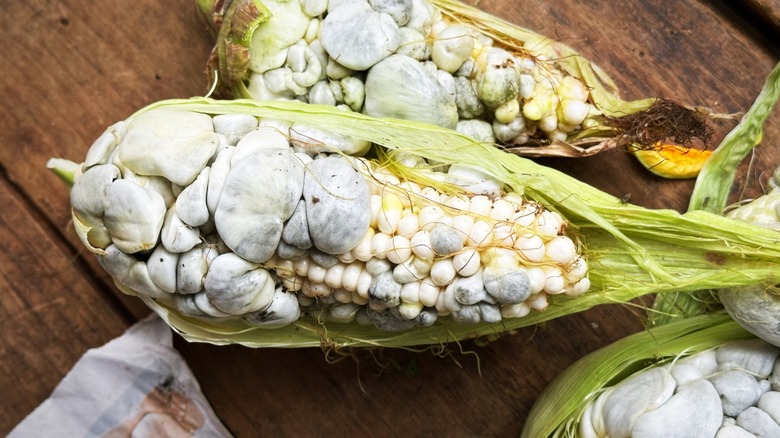
Over the years, huitlacoche has gone by many names, most of which offer a glimpse into how the speaker viewed it. The origins of the word huitlacoche (sometimes spelled cuitlacoche) are disputed, though they lie in the Aztecs' Nahuatl language. The most common translation is "sleeping excrescence," referring to the way the fungus prevents the corn kernels from growing, or puts them to sleep. Though not a common word, excrescence means a growth on an animal or plant and is therefore a pretty literal description of the fungus.
In the U.S., however, huitlacoche has been demonized (literally in the case of one particular term), which is evident in its American names. "Corn smut" is the most common, reframing the fungus as spoiled corn rather than as an ingredient in its own right. An American name that gets the point across even more bluntly is "devil's corn," suggesting that it is the product of evil rather than a rare and potentially lucrative blessing.
South of the border, huitlacoche has earned opposite monikers. Thanks to its hefty price tag, it is often called "black gold," a name that gets a completely different point across. Another common term that you'll frequently see instead of huitlacoche is Mexican truffle, though anyone who's tasted this pricy fungus will know that it can't be easily compared to any other ingredient, even the truffle.
There are a few things to consider when buying it
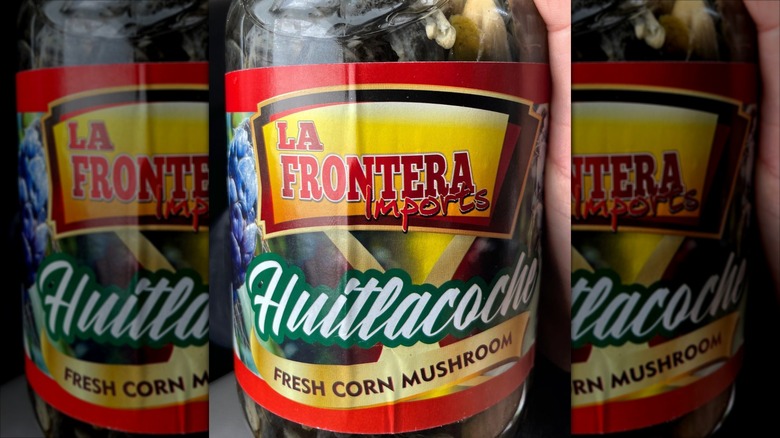
You can purchase huitlacoche outside of Mexico, and you don't even have to go to a Michelin-starred restaurant for it. Unless you're lucky enough to have a farmer's market where fresh huitlacoche is sold, however, you will probably have to settle for one of its various preserved forms. Canned huitlacoche is available throughout the U.S. from specialty stores and online. While it may be better than nothing, it pales in comparison to the fresh fungus. Some versions are pre-seasoned, and most contain corn as well as huitlacoche because they are cut from the same ear and not separated. Goya's, for example, contains safflower oil, onion, and salt in addition to regular corn kernels. This can be pretty disappointing considering that the stuff goes for nearly $1.50 per ounce on Amazon. Compare that to regular corn, which can go for as little as six cents an ounce.
Another option is to buy huitlacoche frozen, though this can be significantly pricier. One retailer sells it for a whopping $87.90 per pound. Ultimately, your best bet is to search for the fresh variety. More farmers in the U.S. are starting to sell it, and wholesalers import it from Mexico. If you are lucky enough to find it fresh, look for huitlacoche that is grey-blue and firm, which indicate freshness, and avoid the ones that have turned black are either dry or surrounded by dark liquid.
It needs to be stored carefully
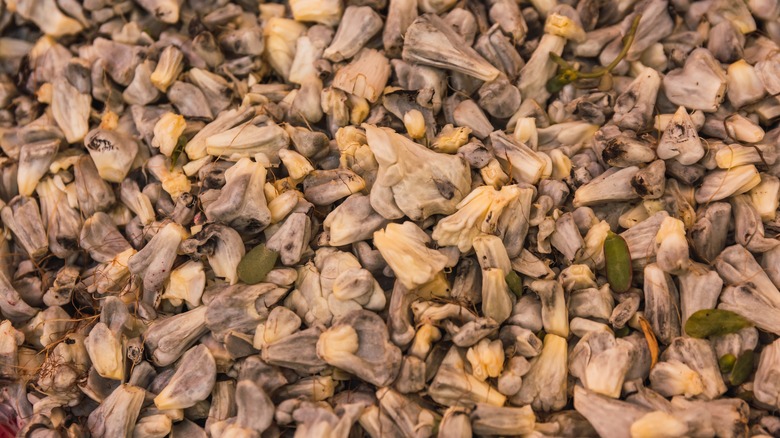
Fresh huitlacoche only has a shelf life of five to seven days, and that countdown starts when it's harvested, not when it's purchased. Because of this, you may need to figure out how to sustain its viability a little longer. You don't want to dash your excitement of finding a rare ear of fresh huitlacoche by letting it turn black and dry on your counter before you get the chance to use it. Of course, the best way to avoid this crushing scenario is to use it right away, but if you don't manage to use it all within a day or two of purchasing it, do not despair — there are options.
The best one is to put it in the refrigerator, the way you would with any other type of mushroom. A cool, dry environment can significantly extend its shelf life and give you more time to use it. Huitlacoche is, after all, an ingredient with a powerful taste, and unlike a pricey cut of meat, you probably won't want to eat it all at once. If you need even more time, you can freeze it. Using a vacuum seal bag will ensure that the flavor and texture remain intact when you're ready to thaw and cook it. Drying it is another option, though it's more time-consuming and not nearly as easy as throwing it in the freezer.