

Here's The Meaning And Origin Of Hellmann's Blue Ribbon Logo Design
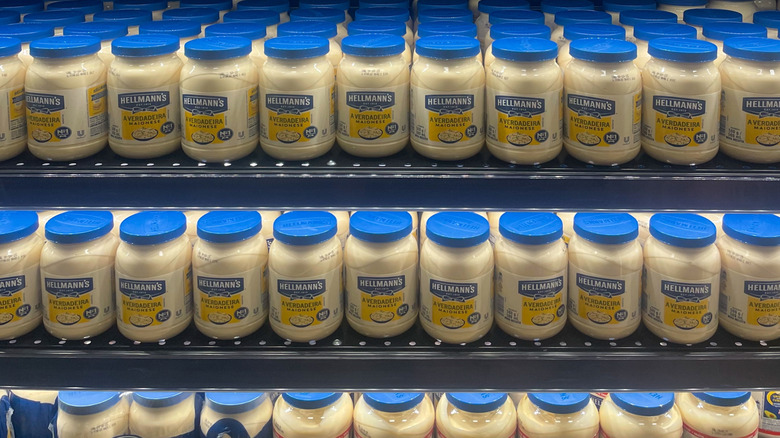
If you walked into a New York deli in the early 1900s for a sandwich, you might have seen a jar of mayonnaise sitting behind the counter, tied with a simple blue ribbon. In 1913, German immigrant Richard Hellmann opened a Manhattan deli on Columbus Avenue, serving a classic homemade mayo so popular that customers began buying it by the jar. Originally producing two versions, the literal blue ribbon signified the distinction.
Within a few years, demand outgrew the counter. Production moved from the deli to a small factory, and the Hellmann's Blue Ribbon Mayonnaise went into clear glass jars that showed exactly what you were buying. The blue ribbon followed suit as a printed mark customers could spot at a glance, becoming a visual shorthand for Hellmann's product identity, and a promise of quality to consumers. By 1925, the single-ribbon label was the standard on Hellmann's jars, a symbol that would carry the brand forward for generations.
A blue ribbon logo reads before the brand name does. In the U.S., it's a signal for top‑tier quality, reinforced anywhere people compete and get judged. County and state fair systems teach that a blue ribbon equals "excellent" in long‑running 4‑H judging guides, the tier you need to advance to bigger stages. Hellmann's leaned into that county fair literacy and became easily recognizable.
Reading the ribbon

Beyond the ribbon symbolism, blue tends to cue competence and trust in branding research; it's the hue people read as steady, reliable, almost procedural, which maps neatly to a pantry staple you want to behave the same way every time. The effect is not mystical; it's learned and culturally reinforced, and it shows up across studies of logo color and consumer perception. Peer‑reviewed studies have tied blue to trustworthiness and quality across categories.
Corporate history doesn't often preserve small marks, but the blue ribbon outlasted ownership changes and coast-to-coast branding. Postum Foods (later Best Foods) bought Hellmann's in 1927 and kept the symbol of identity that shoppers knew. East Coast jars kept the Hellmann's name, while the West Coast sold under Best Foods, but Best Foods took on the blue ribbon, so the package spoke the same visual language across the country. The formula stayed effectively the same region to region.
The brand's modern refreshes have kept the ribbon front and center precisely because it carries meaning on its own. When designers revisited the packaging in 2017, they retained the ribbon and pared back visual noise, linking the mark to its deli origin story while making it cleaner on the shelf. Put together, the effect is quiet but strong. A familiar ribbon and a calm palette sit in a label that reads clean and steady. You see the blue ribbon, and your brain supplies the rest; you know you're buying something dependable, the jar that works for tuna salad, potato salad, any deviled eggs recipe, lunchboxes, holiday leftovers. Hellmann's blue ribbon design is classic.