

The Unique Dish Garnish Gordon Ramsay Steers Clear Of Eating

Celebrity chef Gordon Ramsay has never been shy about voicing his opinions, regardless of who they might upset. From "Hell's Kitchen" to "MasterChef," Ramsay has been on TV yelling at chefs and home cooks alike with the goal of improving their skills for years. Also a successful restaurateur, he has always had his finger on the pulse of culinary trends. There are certain foods that Gordon Ramsay won't touch, including plane food and shark fin soup, and now we can add another to the growing list: Foams used to garnish dishes.
Ramsay participated in one of Reddit's famous AMA (Ask Me Anything) sessions, where he declared his hatred for foams as a garnish. One Redditor asked "What is the dumbest trend in food that you thought would not have lasted, but has?" to which he responded with sheer abhorrence for them. Mincing no words, the media personality opined, "I think foam should be used for shaving, not go on top of food."
In culinary terms, a foam is a flavored liquid that's been aerated, normally with a handheld tool called a whipping siphon that utilizes nitrous oxide, which is also commonly referred to in professional kitchens as an "ISI canister" based on the brand's popularity. The liquid usually needs a stabilizer added to it, to hold its shape after being transformed into a foam.
Foams have faded in popularity (but not enough for Gordon Ramsay's liking)
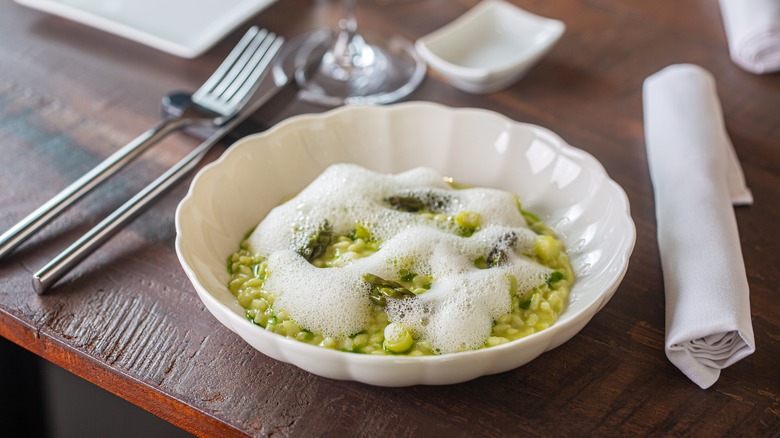
Furthering his disgust, Gordon Ramsay provided a valid reason why he detests the frothy garnish, via a rather grim visual: "When a foam hits a plate, unless you've eaten it within 3 or 4 seconds, at the end it looks like sort of toxic scum on a stagnant pool." Depending on the type and amount of stabilizer used, foam can easily deflate and pool around the food before it's served to a diner. This sometimes makes the food soggy, or even coats the entire plate in a thin layer of liquid. Ramsay also noted their antiquity in dining, acknowledging, "I started with foams in the 90s, and I'm still amazed that they're around now." What began as a fad with the early 2000s rise of molecular gastronomy has since waned in popularity, and the celebrity chef agrees, proclaiming simply, "We need to get rid of the foam."
As a line cook at a Michelin-starred restaurant in the mid-2010s, I concur. Not only are foams difficult to make and execute properly lest you tilt the canister wrong and liquid backfires into your face, but the ISIs used to make them were stressful to operate and the nitrous oxide refills are expensive. Pastry chefs commonly use them to produce whipped cream on the spot, which is an extremely practical use for the siphons. Other applications however, such as fancy foams or espumas, feel dated, and it usually doesn't enhance the food enough to merit the soggy texture often accompanied by dishes covered in foam.