

Costco's Kirkland Bottled Water Is Made By This Familiar Brand
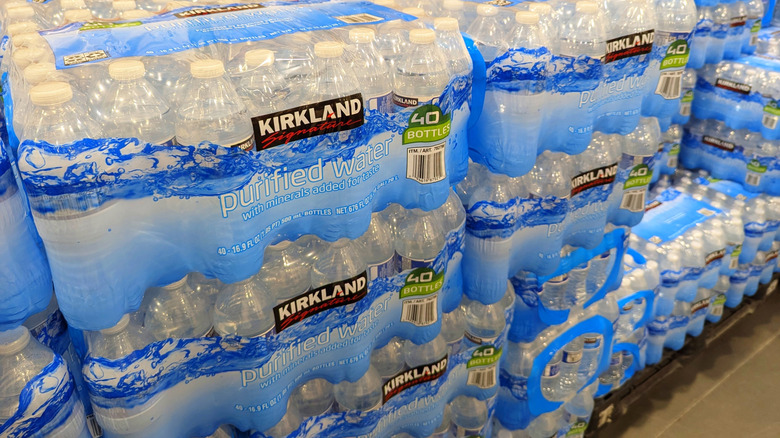
Have you ever wondered how Costco can manufacture and package so many products in countless categories while still keeping prices low and warehouses stocked? The company's secret is actually no secret at all. The vast majority of products in Costco's warehouses are made by outside companies, typically major players in each product category. Existing products are simply rebranded under Costco Kirkland labels, potentially tweaked to meet specific Costco requirements. This rebranding approach is evident throughout the Costco empire of popular products, including those multi-bottle cases of Kirkland Signature Purified Water.
There's something inherently mysterious about the Kirkland label, as Costco rarely comments on outsourcing methods. It sometimes takes a dedicated amateur sleuth to unveil one of their product's real origins. But it's widely known and revealed on the bottle itself that Kirkland purified water comes from the water giant Niagara Bottling. This family-owned company from Southern California, launched in 1963, now quietly reigns over the world of private‑label bottled water in the western part of the U.S. You've likely tasted their waters under many brand names, as Niagara Bottling started providing single-serve private-label bottled water as far back as the 1990s. They now supply the product to a wide variety of customers, spanning grocery, club store, convenience, and wholesale categories
So when you pick up that multipack of purified Kirkland water at Costco, you're actually purchasing renowned Niagara Bottling water at a considerably lower price point. That begs the questions: What exactly is in that water, and is it the best alternative for daily drinking?
What's inside that bottle of Kirkland Signature Purified Water
A closer look at the purified water from Niagara Bottling — which has the Kirkland Signature label at Costco — starts with a pretty rigorous purification process occurring in several stages. This begins with sourcing the water itself from vetted wells, springs, or municipal water systems. Then comes cleansing and enhancing, starting with micron filtration and progressing to reverse osmosis and ozone disinfection. The water is then remineralized with a small amount of food-grade minerals to deliver a clean taste.
But there's always going to be controversy when it comes to plastic bottles, especially in food packaging with direct human contact during consumption — like single-serve water bottles. Health experts have cautioned against nanoplastics in bottled water, and some testing has discovered such contaminants in Costco purified water. However, according to Niagara's water quality reports, their water is safe and healthy to drink, and their testing requirements exceed those set by the U.S. Food and Drug Administration. There's also no bisphenol A (BPA) in Costco water bottles, which are produced using food-grade plastics approved by the U.S. Department of Agriculture.
Niagara has worked steadily over 15 years to reduce their use of plastic; their current Eco-Air bottle uses 60% less plastic compared to their original bottles from 1998. Some customers complain that the Costco water bottles are too flimsy, but that seems to be the trade-off for more sustainability and fewer plastic particles floating through oceans and human bodies. With that in mind, though, you might want to consider drinking water sold in aluminum bottles, which are used by the great-tasting bottled water brand Proud Source. Alternatively, check out Costco's free reusable glass water bottles.