

Is The House Salad Worth It At A Restaurant? We Asked An Expert
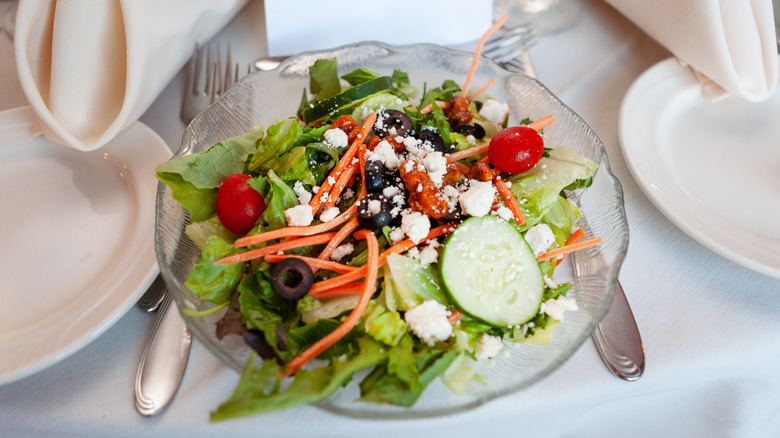
When dining in restaurants, a house salad is omnipresent on many menus. Usually presented as the eatery's "default" salad, it's most likely a reliable bowl of simple greens and a few vegetables. But not all house salads are created equal. Also known as side, dinner, or starter salads, they can be either crisp, fresh, and interesting or sadly disappointing, more an afterthought than an equal component of a well-orchestrated dinner. To explore whether this item is worth your time and appetite, we reached out to an expert in the field, Andrew "Kappy" Kaplan, founder of Culinary Advisors LLC and host of the "Beyond the Plate Podcast."
On reasons for being wary of house salads, Kaplan points to restaurant types and regional nuances. "The term 'house salad' really became popular in places like diners, steakhouses, and mom-and-pop spots," he explains, noting that these salads often consist of "just the basics," including lettuce, tomatoes, cucumbers, onions, carrots, and more. "But context matters, too," he reassures. For example, it's important to consider the environment and cuisine.
"It's not so much about being wary of the house salad as it is about knowing how to 'read the room' — or in this case, the restaurant," says Kaplan. "If I'm sitting down at an old-school greasy spoon diner off the highway, chances are the house salad isn't exactly the star of the menu." The expert notes that diners are known best for burgers or fried foods rather than house salad offerings. But there are two sides to that scenario.
Read the room for house salad cues
In contrast to the best old-school diners from across the country, Kaplan adds, "On the flip side, if I'm at a more modern spot — say a Sweetgreen-type restaurant with a chalkboard listing their local farm partners — I am likely more confident about the freshness of the ingredients." According to the expert, your location as well as the season matters as well. "If I'm eating in the Midwest in the dead of winter, the tomato probably isn't going to be that bright red, juicy, and flavorful," he adds.
Then, there's the dressing, which can be a dead giveaway. "Some restaurants will ladle it out of a gallon-sized jug, while others make it in-house (and can be quite delicious)," notes Kaplan. "If the restaurant is famous for chicken wings or shrimp and grits, the salad may not be the highlight." Unless a restaurant moves a lot of fresh produce, salads can be an expensive category, he points out, thus making them more of a culinary afterthought to many establishments.
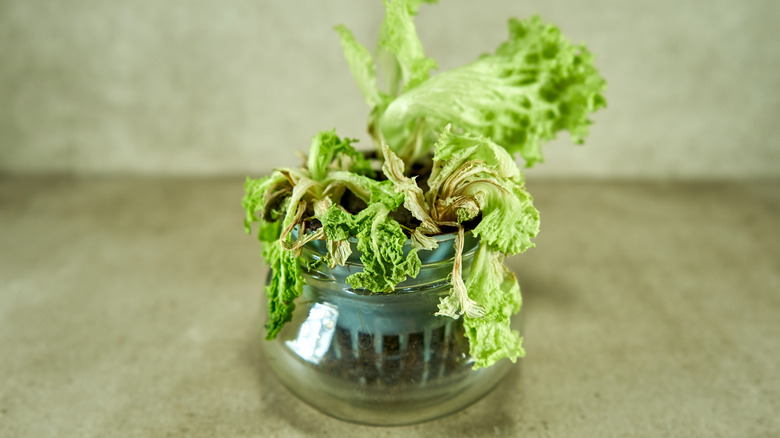
To gauge whether a house salad is up to par, Kaplan reveals some warning signs, the first of which is the obvious "sad, wilted lettuce." Additionally, be wary of a tomato that's "pale, rock-hard, and tastes like nothing." Lastly, Kaplan again emphasizes the dressing. "If the dressing shows up thick, gloopy, and clearly more preservatives than oil, vinegar, and seasoning," he explains. "That's a pretty good sign the salad isn't getting much love." For more pro-level salad advice, consider Bobby Flay's secret to great salad dressing or our 40 best salad recipes.