

The Detail You're Probably Missing On Tony's Chocolonely Chocolate Bars
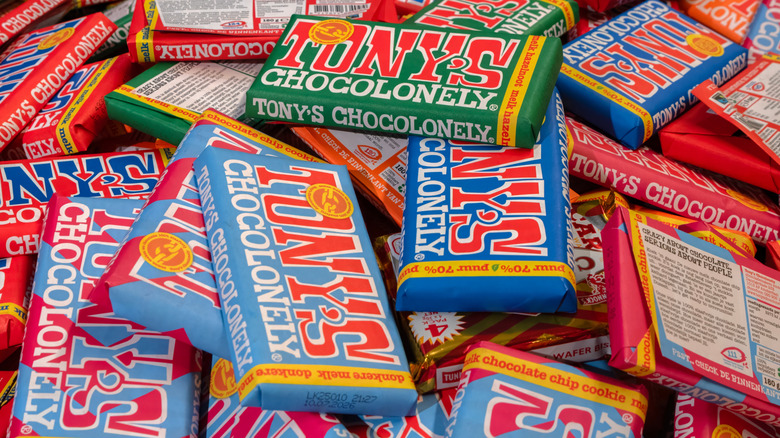
Tony's Chocolonely didn't just stumble into global fame. Its bold, paper wrappers and oversized, cartoony logo are instantly recognizable on any store shelf, enticing customers to take a bite through the company's meticulous approach to its design. And beyond the packaging, the Dutch brand boasts a subtle, often-overlooked detail within the chocolate itself. No, it's not just that it's delicious (and not even remotely overrated).
If you've ever had one of the company's signature chocolates, you've probably noticed that the pieces aren't like other candy bars. Instead of straight, even pieces that are perfectly snappable for easy sharing, Tony's Chocolonely features a jigsaw puzzle of uneven pieces, from minuscule to gargantuan. This isn't by accident, and it's not just a quirky arrangement. Instead, these uneven pieces take on a greater meaning, representing the massive profit inequalities in the global chocolate industry.
You see, a trio of journalists first created the company in 2005. Two years prior, these founders hosted a television exposé, showing off the dark side of some of our planet's mega chocolate companies. They found that these corporate giants routinely purchase cocoa from farms and plantations that utilize slaves and unethical child labor, and sought to change the industry altogether. So, since its founding, Tony's prides itself on being Fairtrade, ensuring that cocoa farmers and producers are paid a fair share. In addition, they work with cocoa co-ops and strive to meet strict environmental sustainability standards.
A secret chocolate atlas
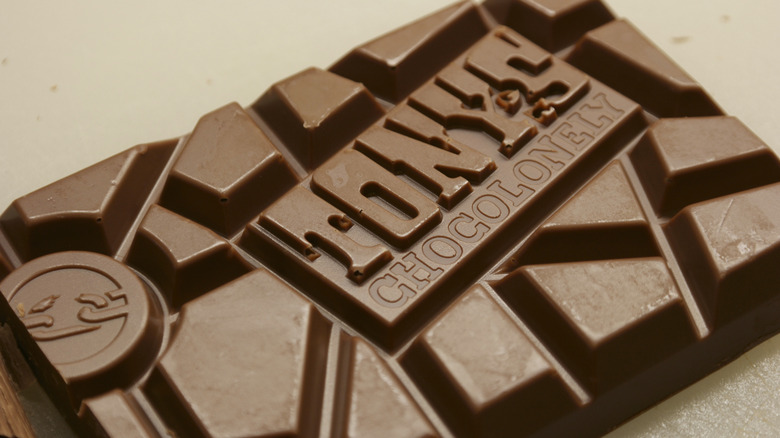
For the geographically inclined, the pieces found near the bottom-left of a Tony's Chocolonely bar might look a little familiar. While they still represent the inequalities of the global chocolate industry, they're also an artistic representation of the Gulf of Guinea. One long, skinny piece represents the coastline itself, and above that, you'll find six West African nations. In order from right to left, you'll find the western portion of Cameroon, Nigeria, Benin, Togo, Ghana, and Côte d'Ivoire (also known as the Ivory Coast). If you have a keen eye, you might notice that these six countries are represented by just five pieces of chocolate. That's because, in order to make enough space for a whole hazelnut in some of its flavors, the company has consolidated the two smallest countries (Togo and Benin) into one piece.
But why have a map of West Africa hidden inside every chocolate bar? Well, the funny thing about the cocoa found in every European chocolate bar out there (including Tony's Chocolonely) is that they're not European at all! While countries like Germany might produce the most chocolate, the cocoa beans themselves are grown throughout the world, mainly in the global South and near the equator. West African nations in particular grow roughly 70% of the world's cocoa beans. It's a staggering figure, especially when considering the amount of chocolate bars consumed each and every day around the world.