

How Bologna Is Made (And What You're Actually Eating)
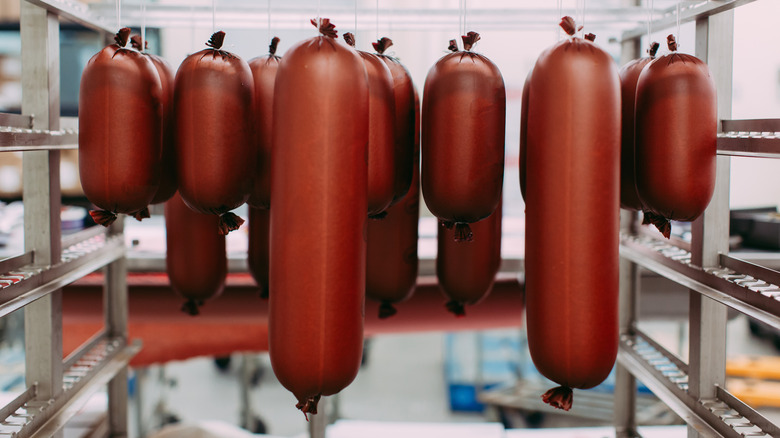
It's pink, pliable, and so uniformly unperturbed it seems as though it must have come from a single, endless sausage. In lunchboxes, it's folded into sandwiches with yellow mustard. In diners, bologna is fried until the edges curl. Bologna is so familiar that it's easy to forget it's a manufactured product with as much engineering behind it as cooking; everything from its color to its texture to the way it bends without breaking is the result of a deliberate process designed to turn assorted cuts of meat into a perfectly smooth slice.
To its core (or lack thereof), bologna is an emulsified sausage. The base is usually a mix of beef and pork, sometimes joined by chicken or turkey in less expensive versions. Fat content is carefully adjusted, typically about 25%, for flavor and mouthfeel. Trimmings and byproducts from various cuts are common, but these are not "mystery" in the literal sense; they're inspected meat, just not prime-grade steak cuts. In some brands, mechanically separated meat appears on the label. This is a paste made by forcing meat from bones under pressure, capturing more protein and calcium, but it changes the texture.
Seasoning is surprisingly subtle, almost tasteful: A proprietary blend of salt, sugar, white pepper, coriander, nutmeg, allspice, and celery seed, usually. Nitrites preserve color and flavor while protecting against bacterial growth. Non-meat binders, such as nonfat dry milk, soy protein, or modified food starch, may be used to help retain moisture and improve sliceability. Ice or ice water is added during processing, not as filler, but to keep the temperature low so proteins don't break down prematurely. By the time the seasoned paste is ready for the next step, it's as smooth as mousse and about as cohesive.
Bologna's backstory and manufacturing
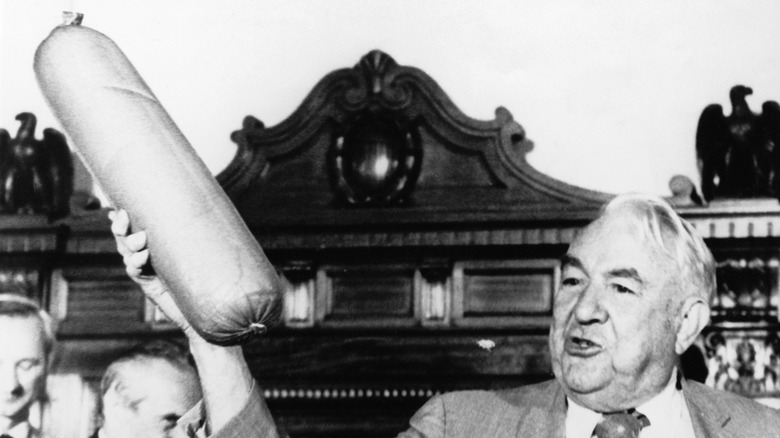
Here's a fact you didn't know about bologna: Its origins trace back to mortadella, a centuries-old Italian sausage made from finely ground pork studded with visible cubes of fat and, in some cases, pistachios. As it crossed the Atlantic and intermingled with German meat-curing traditions, the recipe got progressively smoother. The American palate favored a uniform texture, and industrial meat processing made that consistency possible. Instead of coarse speckling, U.S. bologna became a pale pink, perfectly smooth slice — essentially a mild-flavored hot dog in sheet form.
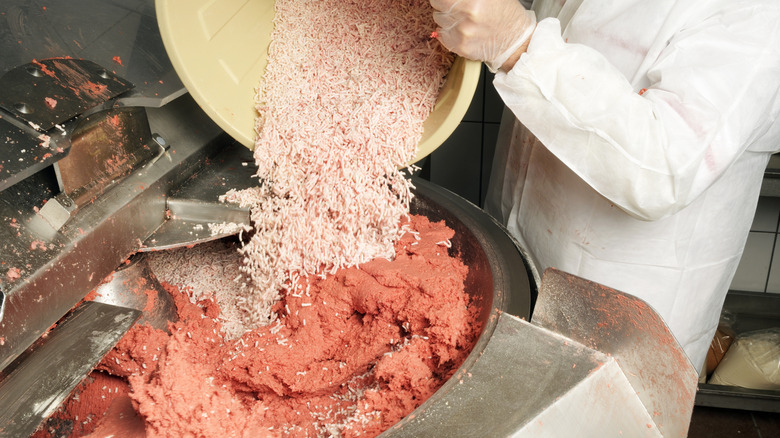
The making of bologna begins with a coarse grind. A slurry of meat and fat is run through industrial grinders, then pre-mixed to ensure the correct ratio. The mixture then heads to high-speed bowl choppers or emulsifiers, where spinning blades cut it down to a fine paste in seconds. This emulsification is what gives bologna its hot–dog–like uniformity. The ice or chilled water is added during chopping to keep the temperature below about 60 degrees Fahrenheit, which maintains protein structure and ensures a tight, springy texture after cooking.
Once the paste is uniform, spices and curing agents are added. The seasoned mixture is then pumped into large casings — sometimes natural but more often synthetic, especially for the oversized logs seen at delis. These casings hold the shape while the sausage cooks and help prevent moisture loss. Cooking is done gently in steam ovens or hot water baths, allowing the proteins to set without splitting the casing. The goal is a fully cooked interior with a uniform pink color from edge to center.
From pink slime to a packaged bite
After cooking, the bologna is quickly chilled to stop the cooking process and firm the texture. The casing is peeled away, and the surface may be smoothed for even slicing. Whole logs are either packaged intact or fed into slicing machines for retail packs. Slices are vacuum-sealed or packaged with modified-atmosphere gas to extend shelf life. Every step is designed to ensure each slice is identical in size, color, and texture.
Despite its "mystery meat" reputation, bologna's composition is tightly regulated. In the U.S., the USDA sets guidelines for minimum meat content, maximum fat limits, and requires any non-meat ingredients to be declared on the label. Mechanically separated meat, if used, must be labeled as such. Nitrites are permitted for curing and color; ascorbic acid or its derivatives may be added to stabilize that color. The smooth texture is the product of both mechanical processing and ingredient chemistry. Fat droplets are dispersed so finely that they're suspended within the protein gel formed during cooking. This structure locks in moisture and gives bologna its uniform bite. Binders, such as milk powder or soy protein, help keep the emulsion stable during heating, so the fat doesn't separate. The pink color comes from the reaction between nitrite and myoglobin in the meat, a process similar to what gives ham or hot dogs their hue.
Flavor-wise, bologna is intentionally mild; seasoned enough to be savory, but not so strongly that it overwhelms the sandwich it's in. Its low-acid, high-moisture composition means it's fully cooked and ready to eat, but should still be refrigerated to slow bacterial growth. Whether you see it as a lunchbox staple or a feat of processed-meat engineering, what's in that slice is less mystery than method: an old-world sausage reimagined for modern manufacturing.