

Is Your Homemade Broth Bitter? Here's How These Pro Chefs Avoid It

Making broth at home is an incredible way to save money, prevent food waste, and always have it on hand for recipes. Additionally, the beauty of making your own stocks and broths is that you know exactly what's gone into them, and you have complete control over the flavoring. Collecting and freezing vegetable, meat, and bone scraps in freezer-proof bags is the easiest way to quickly amass stock ingredients, but using them correctly is essential to avoid bitterness. We spoke with a few chefs to get the skinny on how to best avoid bitter notes when making broth at home. There is a difference between stock and broth, but when speaking with these various experts, their advice is generally applicable to either.
When asked about common pitfalls that can lead to bitter stock or broth, Derek Piva, the executive chef at The Restaurant at Tu Tu' Tun, informed us that "bitterness usually stems from over-roasting bones or vegetables — especially onions, garlic, or carrots — or from simmering herbs like bay leaves for too long." It's common to roast animal bones and vegetable scraps to acquire more depth of flavor in stock, but you need to be careful not to overdo it. "Roast bones to a deep golden hue but not burnt," Piva instructs, adding that you must "always maintain a gentle simmer, never a rolling boil, to prevent over-extraction of tannins and other bitter compounds."
Prepping bones and a gentle simmer are key components of a great stock
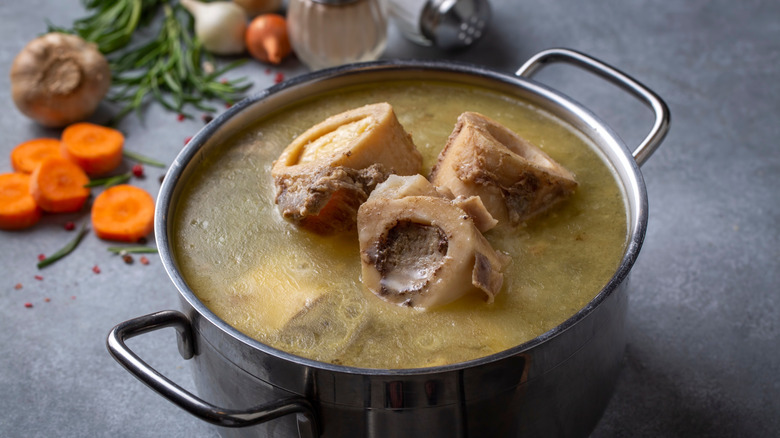
To avoid overcooking, it's important to prepare your animal bones properly to begin. "I rinse my bones carefully to remove any blood or scum," explains Ji Hye Kim, the chef and owner of Miss Kim. "Then I use the Asian method of blanching the [bones] first." The chef notes that blanching leaves fewer impurities to skim off later, and it also reduces the bitterness of stock. Rather than roasting vegetables and aromatics beforehand and then letting them simmer for hours on end, Kim offers another suggestion. "I just simmer the bones until [there's] about an hour left," she explains. "Then I add my aromatics like ginger, garlic, radishes, onions, or scallions." Chef Kim believes that raw aromatics lead to a cleaner stock flavor.
While bitterness doesn't have one single culprit, Lexi Stahr, chef at Lucky Charlie in Brooklyn, New York, says, "The biggest two to watch out for are high heat and overcooked vegetables." Stahr stresses the importance of simmering the stock gently and skimming the scum off frequently, particularly during the first half hour. While she's a fan of saving vegetable scraps like onion and garlic ends, Stahr stresses that "things like eggplant, for example, just do not belong — so be mindful of the veggies you're choosing and what they contribute." In contrast to Kim's advice for using raw aromatics, Stahr frequently roasts the vegetables to achieve caramelization before adding them to the pot. Similar to Kim, however, Stahr does "wait to add herbs and spices until the last 40 minutes."
Tasting and time are your best bets
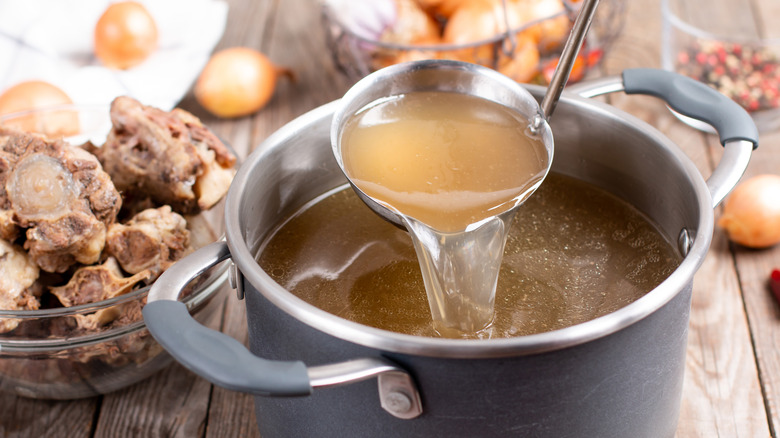
When it comes to seasoning, Grayson Altenberg, chef de cuisine at Craft, notes that many cooks forget to season their stock during the entire cooking process, leading to overcorrection. "Adding too much salt at the end can make a broth taste harsh or one-dimensional," says Altenberg. He advises that cooks "season gradually, taste often, and remember that reduction intensifies salt levels." Additionally, he recommends seasoning stock or broth with salt every time you add something to the pot, comparing it to "capturing a moment of each part of the cooking process."
While salt is a key component of seasoning, it's not the only thing to focus on. "Great broth has balance: acid, umami, and sometimes even a hint of sweetness are key," says Altenberg. To achieve that, the chef recommends "a few drops of vinegar, soy sauce, or mirin can transform a flat broth into something craveable." One way to put this into practice is with our umami vegetable stock recipe. "If you do over-season, dilution with water or unsalted stock is often the safest fix," Altenberg adds.
Of course, the key to knowing when stock is done is how it tastes, at least according to Emir Dupeyron, co-owner of Dolores in Brooklyn, New York. "Taste is everything here," Dupeyron explains. "Always taste the broth in different stages." While a light aromatic broth can come together quickly, the expert notes that deeply flavored stocks need to cook down much longer. "It could take up to 20 hours for some recipes," he reveals. Just be sure that, after you've put so much hard work into making a perfectly balanced stock, you store it properly to preserve its taste.