

Here's Why Your Ribs Are Chewy (And The Easy Fix)

Ribs may be one of the more primal eating experiences, but making sure they aren't chewy involves some of the most precise science demanded by any recipe. There aren't many things more disappointing than babysitting a rack of barbecue ribs for hours, only for them to come off the grill chewy anyway. Full of tough connective tissue and requiring a clean bite to easily tear off the bone, chewy ribs aren't just unpleasant, they are borderline inedible. So if you've suffered this tragic fate, know that there are usually two big culprits. Either you skipped removing the membrane under the ribs, or you just didn't cook them long enough.
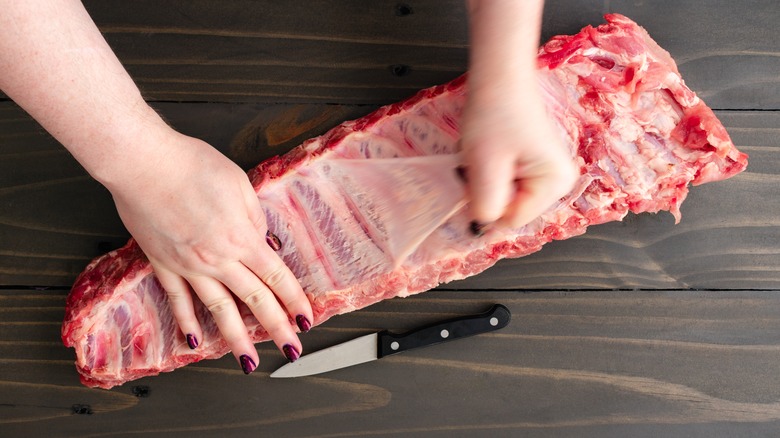
The membrane, also called the "silver skin" of the ribs, is the easier fix, as it only takes a minute and makes a big difference. First, you just need to loosen one end of the membrane to get a hold of it. This can be done with any flat, narrow piece of kitchen equipment, with a table knife being a good option. It's also easier to get under the membrane on the meat between the ribs. One you've jimmied under the membrane and it has started to release, it should be easy to peel off. The membrane won't take much meat with it even if you rip pretty strongly, so don't be shy. You may just need to use a paper towel or pair of gloves to help grip it, since the membrane can be slippery.
Make sure you remove the membrane and cook your ribs long enough to keep them from being chewy
The other key to avoiding tender ribs is breaking down collagen. This is the stuff that makes up the connective tissue running through meat, and ribs have a lot of it. However, when heated, collagen will break down into rich, liquid gelatin, which makes ribs both more flavorful and tender. This happens once the meat hits 160 degrees Fahrenheit, but it takes time for all that collagen to melt. This is why ribs are held at a low temperature, usually around 225 degrees Fahrenheit, for a long time. In that range, the collagen is given time to fully break down, while the meat itself doesn't overcook and dry out. For a rack of baby back ribs, this can take four to five hours, while for thicker St. Louis-cut ribs, it can take up to up seven hours. Experts don't say "low and slow" for no reason.
Thankfully, this means that if your ribs come out chewy, the solution is pretty easy. First, try and remove the membrane if you haven't, and if you have, just keep cooking the ribs. If you've been cooking the ribs for a while and don't want to dry them out, it helps to wrap them in foil and keep them moist with a thin mixture of vinegar and your favorite BBQ sauce brushed on. Then, back on the grill (or in the oven), they go until perfectly fork tender.