

The Common Kitchen Pest That You're Probably Mistaking For Fruit Flies

Most people know about fruit flies in the kitchen, and there's no love lost when eradicating them. But there's another winged pest with no interest in decaying fruit that is equally as irritating: the drain fly. This tiny, fuzzy creature from the Psychodidae family of insects is also known as the moth fly or filter fly. These insects like to inhabit drains in your kitchen, bathroom, utility room, or any other area with a sink.
Compared to fruit flies, they're about the same size, ranging anywhere from 1/8 to 1/5 of an inch long. But other than size, they have few similarities. Drain flies are fuzzy and grayish with hairy wings that breed in slimy organic buildup inside sink and shower drains, while those pesky fruit flies are smooth-bodied insects with red eyes, living and breeding in fermenting fruits and sugary liquids.
The wide, fuzzy wings on drain flies fold like a roof over their bodies (similar to a moth) as they hop and scoot across counters, floors, light fixtures, windows, and other surfaces, whether in your kitchen or elsewhere. They're generally harmless in standard indoor environments, but there's potential for exacerbating allergies or spreading unsanitary diseases. That's primarily a result of breeding in mucky, polluted water conditions such as septic tanks, pipe traps, air conditioner drip pans, rain barrels, toilet tanks, or even appliance drip pans and saucers beneath pet water bowls or indoor plants. Obviously, you want to do more than shoo away these pesky winged wonders; total removal is more the ideal.
How to send drain flies packing
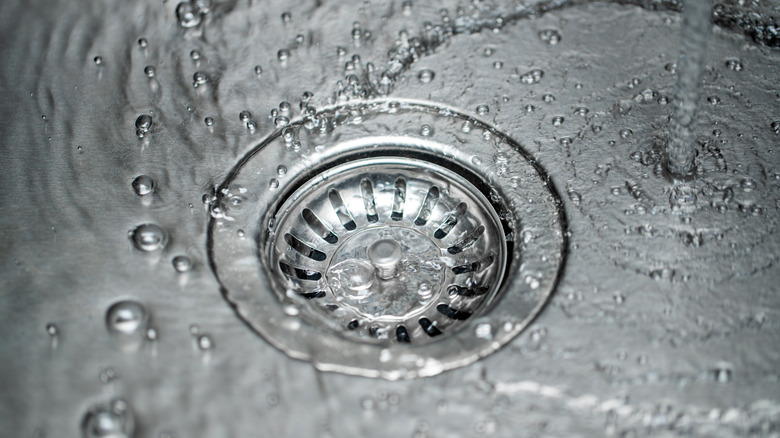
As with any pesky guest, particularly one that hangs around the kitchen, you want to see drain flies disappear — and fast. But when there's an infestation, it takes persistence to eradicate it. Females lay up to 200 eggs onto slimy surfaces, resulting in wormy larvae that feed for eight to 24 days, creating the adults you see flying around your home. Adults only live for about two weeks, but here's the rub: they mate very quickly, potentially giving you a fresh batch every few weeks.
Fortunately, it's fairly easy to send drain flies on their merry little way. The first step is figuring out which drain is breeding them, which could be more than one. Try coating a clear plastic cup with vegetable oil, petroleum jelly, or sticky tape, and then use it to cover the suspected drain. Leave it overnight, when these flies are most active, which will trap any flies entering from that drain. Voilà! There's your source.
Now, it's time to tackle that problem. You essentially need to scrub and remove all the organic buildup in the area where breeding is occurring. Start by unclogging built-up food, grease, or other debris using a plumber's snake or hot water, and then scrub several inches deep with a stiff drain or pipe brush. Remembering the drain fly life cycle, repeat this process for up to three weeks. For insights on other related issues, check out our articles on common kitchen sink problems and more ways to keep kitchen pests away.