

The Caribbean Origins Of The Word 'Barbecue'
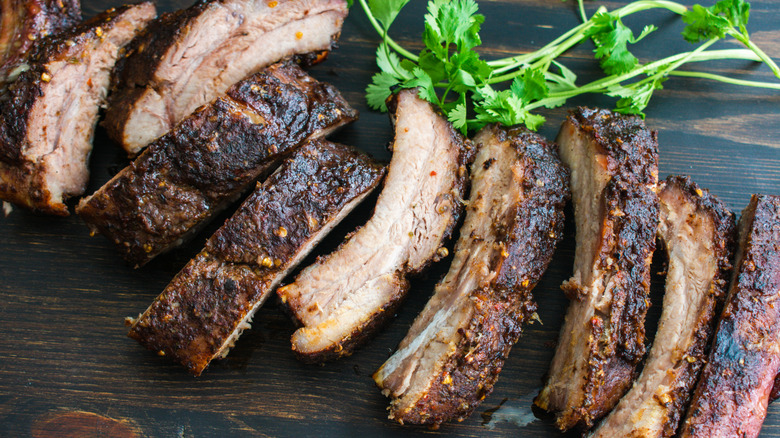
Barbecue is entrenched in American history and culture from its alleged roots in the Eastern and Southeastern colonies pre-Revolutionary War. There are many types of barbecue — such as Carolina, Memphis, Texas, and Kansas City — that are believed to have originated in the U.S., the unique flavors and styles of which can be attributed to the influx of immigrants who helped shape the new nation. But the derivation of the word "barbecue" and the method of slow-cooking meats over fire dates back hundreds of years to the Caribbean island that Christopher Columbus dubbed La Isla Española, or Hispaniola, in 1492. Today, Hispaniola is divided into the Republic of Haiti and the Dominican Republic, but when Columbus landed, the Caribbean islands were populated by the indigenous Tainos, whose ancestors immigrated there from South America two thousand years earlier.
Columbus noted the Tainos method of cooking meats over wooden frames called "barabicu" and later renamed "barbacoa" by the Spanish conquistadores. Present-day barbacoa, often eaten in tacos, is vastly different, however, since barbacoa meat is cooked in a pit and not over an open fire, as the Tainos did. The word "barbacoa" then began to appear in different languages, and in 1661, British captain Edmund Hickeringill used it as a verb, 'barbecu'd,' in his book "Jamaica Viewed," which is the first time it appeared in print. Its present-day spelling was defined in 1775 by British author Samuel Johnson in his influential "A Dictionary of the English Language" as "a hog drest whole, in the West-Indian fashion."
Some pirates were expert barbecuers
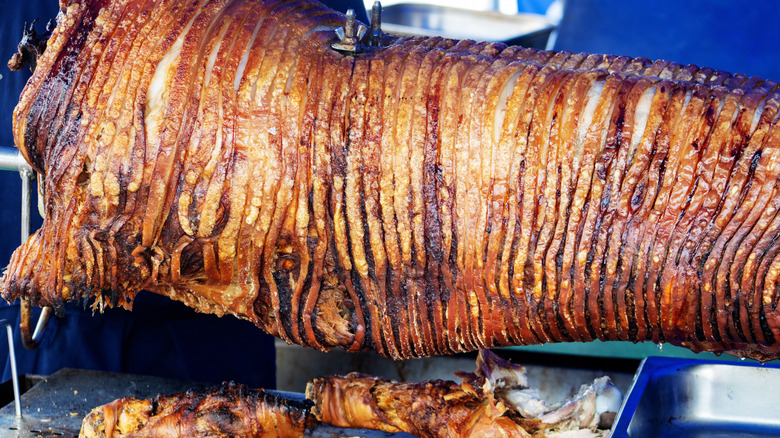
Perhaps one of the most amusing derivations of the word "barbecue" has to do with piracy and how the pirate term 'buccaneer' came to be used. French traders made it to the West Indies in the 17th century and encountered another indigenous people, the Tupi, who cooked meat in the same manner as the Taino. In the Tupi language, the wooden frame for barbecuing was called "mukem," which the French translated to "boucan," and thus, the men who barbecued were known as "boucaniers." The Spanish drove out the French traders, and those who chose the pirate's life became known as 'buccaneers." Presumably, the pirates ate very well.
Another variation of barbecue's etymology is also a French derivation. "De la barbe a la queue" — from beard to tail — implies that barbecuing a whole hog is more authentic than barbecuing other meats. Although this tale is anecdotal, it may explain the disdain that Southeastern barbecuers have for Texas barbecue, which is predominantly beef.
Another theory is that American barbecue actually has African roots. In the Hausa language in West Africa, 'babbake' refers to roasting meats over an open fire, and when enslaved Africans were transported to the American South, they brought their traditional cooking method — and its name — with them. By the 18th century, barbecue had become a popular feast for merriment throughout the South, and George Washington was an avid barbecue fan.