

What, Exactly, Is Crème Anglaise And How Does It Differ From Custard?

Alexander Pope once famously observed, "You eat, in dreams, the custard of the day." Here, custard is touted as the proverbial crème de la crème (pun intended), the best thing life has to offer. However, it seems likely that the English poet would've also sung the praise of crème anglaise (French for "English cream").
Both custard and crème anglaise are made from a basic foundation of four ingredients — egg yolks, sugar, vanilla, and milk or heavy cream — which get cooked together on the stovetop. Vanilla is the standard flavor, which can be achieved by adding a splash of vanilla extract or by infusing a whole vanilla bean into the milk or cream via simmering. Yet, on the flip side, making either is an infamously finicky process. Over the heat, the cream is liable to curdle, and the eggs tend to lightly scramble.
The main thing that separates thick custard from velvety crème anglaise is that crème anglaise is a custard-style cream sauce, whereas custard is (you guessed it) simply custard. It's all about the way the egg proteins coagulate over heat. Texturally, crème anglaise is silky, thin, and pourable due to its minimal egg yolk thickening agent. Custard, on the other hand, is made from both egg yolks and egg whites, is substantially thicker, and can be baked in the oven for firmer custard-based desserts; spoonable crème anglaise stays on the stovetop.
What is crème anglaise?
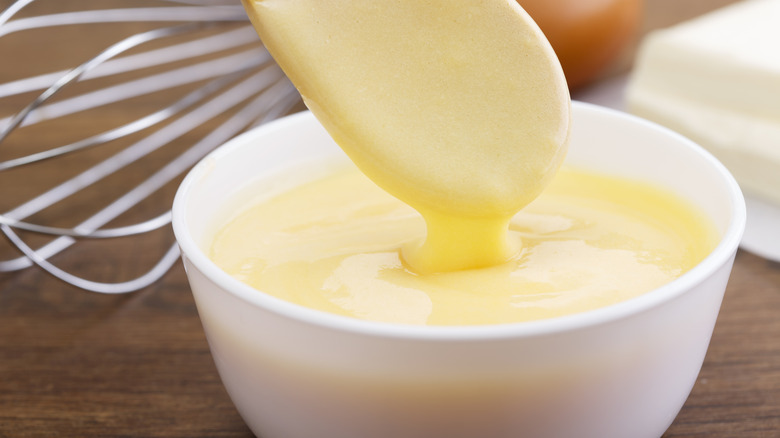
Crème anglaise is a versatile dessert base. It's also used to make some of the best ice cream brands by vigorously churning and chilling. It's also the pool for bobbing meringues in the whimsical floating islands dessert. But, where this pourable, spoonable, custard-style cream sauce is best-known is as a moist, vanilla bean topping over other desserts like apple strudel, pies, tarts, muffins, or fresh berries.
To make crème anglaise, heavy cream gets simmered on the stovetop and infused with a flavoring agent like vanilla bean, chocolate, or raspberry, if desired. Then, the simmered cream gets slowly tempered into a paste-like mixture of sugar and egg yolks. Tempering helps prevent too-large clumps of egg yolk proteins from cooking too quickly and accidentally scrambling. On a scientific level, crème anglaise's signature richness is thanks to lecithin, a lipid and natural emulsifier found in egg yolks. In order to activate those protein strands evenly, constant stirring over low heat is crucial.
From there, the whole thing gets simmered once more, stirring continually to combine. A temperature of 165 to 185 degrees Fahrenheit is ideal (the hotter, the thicker). Or, referring to the classic French nappé method, once your crème anglaise has thickened enough to coat a wooden spoon without running, dripping, or budging, it's finished. For the silkiest mouthfeel, crème anglaise gets strained through a wire sieve and transferred to the fridge to chill.
What is custard?
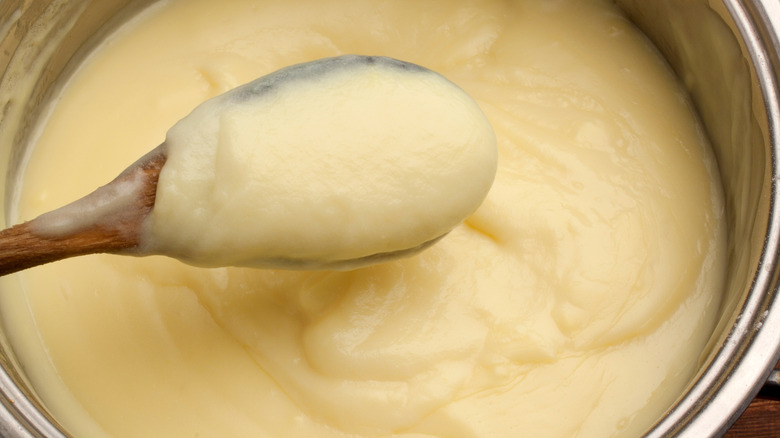
Custard's preparation is nearly identical to the assembly of crème anglaise. To make it, milk and sugar get simmered together in a saucepan on the stove, stirring constantly and avoiding a boil. Some bakers also add a pinch of nutmeg and salt for flavor. Then, whole beaten eggs get slowly added into the mixture, simmered once more (without ceasing stirring), strained, and chilled.
One of the main deviations here is that, unlike crème anglaise, custard can also be baked. If preparing a baked custard, rather than chilling, the strained custard gets transferred to the oven at 350 degrees Fahrenheit and baked for roughly an hour. To avoid scorching the delicate custard, whip out a DIY bain-marie by placing the baking dish inside a deep pan of water. In the oven, those egg proteins solidify into a gel, giving custard its signature luscious mouthfeel. Chill to serve.
Some custard preparations also incorporate thickening agents like gelatin, flour, or cornstarch for a richer texture. These preparations are less tricky to execute and can be brought to a full boil, as the thickeners protect those delicate egg proteins from prematurely scrambling. (Important note: Puddings are thickened with starch, whereas custards are thickened with eggs, so don't overdo it.) Custard-centric desserts include caramel flan, French éclairs, crème brûlée, egg tarts, Bavarian cream, Italian zabaglione, and more. Also, compared to crème anglaise, custard has a much wider range of savory-leaning applications, like custard-based quiches and frittatas.