

10 Vintage Kitchen Tools That Can Be Worth A Fortune Today
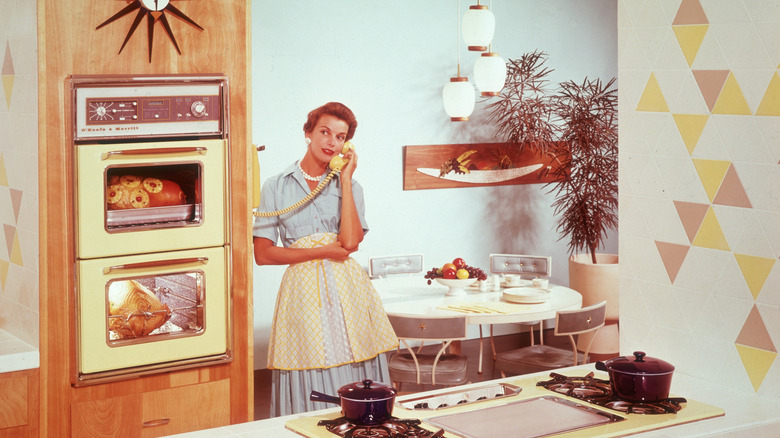
Believe it or not, your grandma's kitchen cupboards might be housing a small fortune. From timeless cast iron pans to vibrant mid-century casserole dishes, vintage kitchenware is still loved by many and can be surprisingly valuable today. A dish you find at a thrift store for a few bucks might fetch a hundred dollars on eBay, as long as you know what to look for.
Why buy vintage? For starters, it's true when people say, "They don't make 'em like they used to". Many older kitchen tools were built to last for generations and have successfully done so. Before plastic Tupperware and nonstick pans were kitchen mainstays, cookware was crafted from durable, high-quality materials like iron, copper, and enamel. Manufacturers took pride in their craftsmanship, and many of these wonderfully crafted items were made in the U.S.A.
There's also something special about collecting beautiful pieces with a bit of history. Vintage pots and pans were often designed to be just as eye-catching as they were functional, and for modern collectors, searching for matching sets can be a never-ending treasure hunt. Many vintage kitchen tools are still fully usable today; some pieces, like carbon steel knives and cast iron pans, even get better with age. Read on to discover vintage kitchen tools that are as beloved and practical as they are valuable.
Cast iron skillet
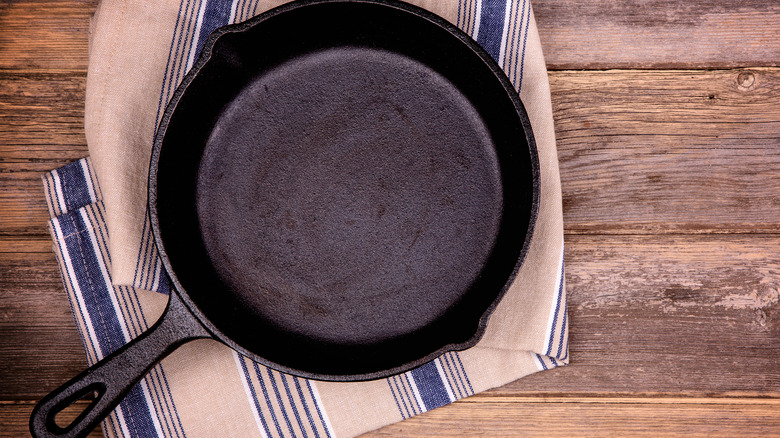
Cast iron skillets (see common usage problems) are one of the few kitchen tools that get better the more you use them. Thanks to the natural seasoning that builds up over time, a well-used skillet becomes smoother and more non-stick with every cooking session. Even if you find a vintage cast iron that's rusty or crusted over, it can usually be cleaned and restored to full working condition. Among cooks and collectors, two brands stand out as the cream of the crop: Griswold and Wagner.
Griswold Manufacturing was founded in 1865 in Erie, Pennsylvania. The company originally produced hardware like hinges before moving into cast iron cookware. What made its skillets special was the exceptional quality: they're far lighter than modern cast iron and have a silky-smooth surface that can fry an egg with no sticking at all.
Today, these skillets can fetch thousands of dollars. Pieces marked "ERIE, PA" were made before 1957 at the company's original factory and are especially valuable. Larger logos also typically mean higher prices, and a rare #2 skillet with a slanted logo recently sold for $1,200 on eBay. The most coveted Griswold piece is a skillet with a spider emblem on the bottom; one of these "spider skillets" was listed on eBay for $8,000.
Wagner, founded in 1891 in Sidney, Ohio, is a close second to Griswold but just as valuable. Their cast iron was also known for its high quality and craftsmanship, and the company produced cookware well into the 1950s. A vintage Wagner skillet recently sold on eBay for $999.
French copper cookware
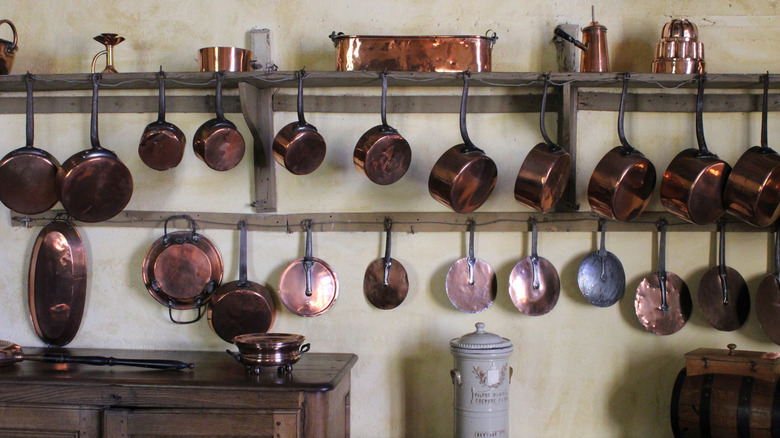
Even if you've never cooked with French copper cookware, you've probably seen it featured in picture-perfect farmhouse kitchens on Pinterest. Often displayed prominently on hanging racks, these shining copper pots are undeniably beautiful while also being functional. Copper is prized for its excellent heat conductivity, making it great for cooking sauces and searing meats.
Vintage French copper stands out for a few reasons. The earliest examples of French copper cookware were handcrafted in the 1800s up until the Second World War. These were made with extra-thick copper and often featured ornate brass or cast iron handles. A second wave of high-quality French copper emerged after World War II, when Julia Child introduced French cooking to American home kitchens.
Vintage pieces are renowned for their thickness. While most modern copper pots are less than 2.5 millimeters thick, vintage French copper cookware is often 3 to 5 millimeters thick, which means that temperature changes more slowly and holds onto heat longer. These older pots require a bit of care, as their tin linings can wear down over time, but they can be relined by professionals for continued use.
Prices can vary widely depending on age, thickness of the copper, and the condition of the tin lining. Some old copper pieces are decorative at best, while others can be extremely valuable if they've been relined and taken good care of. On Normandy Kitchen Copper, a 5-piece set from 1899 currently sells for about $1,200.
Pyrex dishes
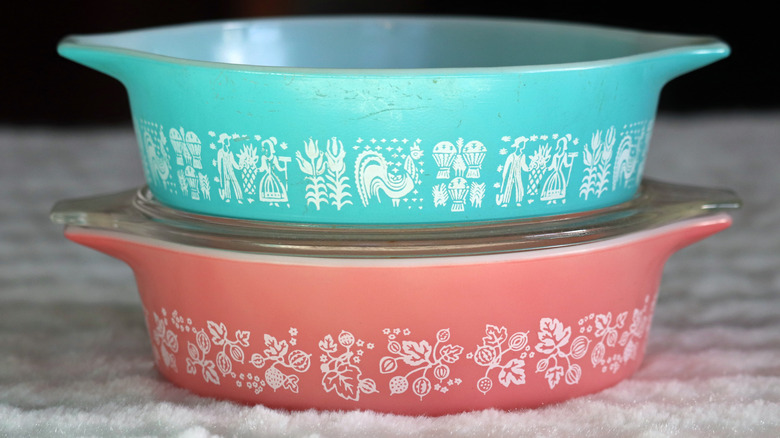
Vintage Pyrex has made a major comeback in recent years, especially among millennials and Gen Z collectors on TikTok, and it's easy to see why: Pyrex is beautiful and practical. With its cheery colors, whimsical patterns, and durable designs (as long as you keep it far away from the dishwasher), it's the kind of vintage item that looks great on a shelf and still works perfectly in the kitchen.
Pyrex began in 1915 when Corning Glass Works launched a 12-piece ovenware collection featuring casserole dishes, pie plates, and baking pans. At the time, most people used metal bakeware, so heat-resistant glass was a revelation. Pyrex pieces didn't stick and hold on to odors and flavors, and were easy to clean. While early versions were clear and simple, Pyrex became truly iconic in 1945 with the release of its Color Ware line.
Over the next 40 years, Pyrex introduced more than 150 patterns. The Cinderella mixing bowls are probably the most famous, but Pyrex also made everything from baby bottles to percolators. The sheer range of colors, designs, and collections is what makes it such a popular collector's item today.
Prices vary widely depending on the pattern, condition, and piece type. A single rare item might fetch around $100, while full sets can go for several hundred. The holy grail is the "Lucky in Love" pattern from 1959, which features a design of shamrocks and hearts. One casserole dish with this pattern was sold for $5,994 in a Goodwill auction.
Ball Mason jars
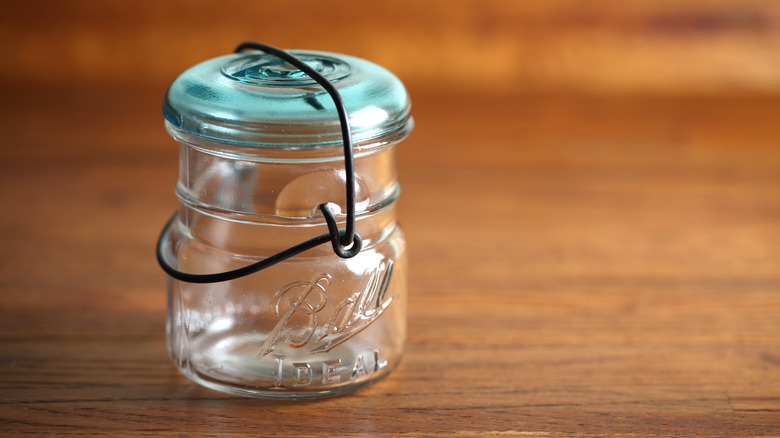
They may seem like humble kitchen staples, but Mason jars have a long and fascinating history that's turned them into prized collectibles. The original Mason jar was invented in 1859 by John Landis Mason, a New Jersey tinsmith. Although he failed to secure his patent rights and died in poverty, his name lives on in pantries and kitchens around the world.
The Ball Corporation, the most famous producer of Mason jars, got its start in 1880 when brothers Frank and Edmund Ball borrowed $200 from their uncle to buy a small tin can company in Buffalo, New York. When the cans started corroding, the brothers turned to glass instead and quickly found success. By 1900, their new factory in Indiana was the largest fruit jar producer in the world.
For collectors, the value of a Ball Mason jar depends on its age, color, size, and imperfections. Rare colors like dark green and purple can fetch high prices online and in antique stores. A single jar can easily sell for over $100, and rare examples have been listed for up to $2,000. Misprints or production flaws often make the jars even more valuable.
The most sought-after version is the blue Ball jar, introduced in the 1890s. Its distinctive blue shade was believed to block sunlight and preserve food longer; the color Ball blue is named after the distinct glass. The production of this glass stopped in 1937, but these jars remain a favorite among collectors.
Le Creuset Dutch ovens
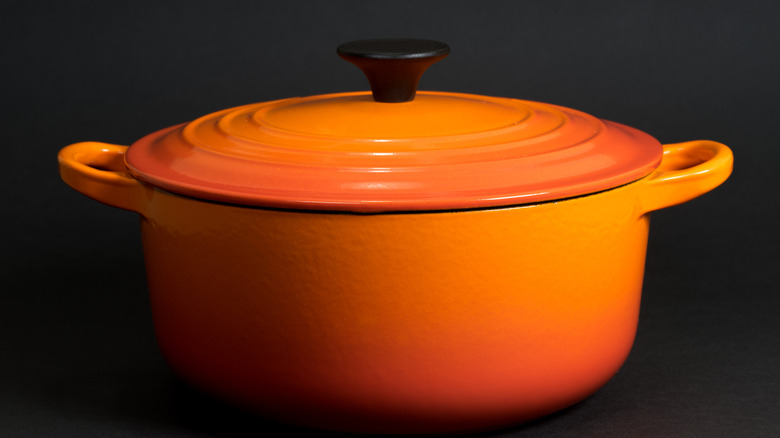
The enamel Dutch oven, also known as a cocotte, is a true kitchen classic. It's often given as a wedding gift and passed down through generations for good reason. These heavy-duty pots are distinctive, durable, and endlessly versatile, perfect for everything from braises and stews to homemade bread.
The most iconic brand of them all is Le Creuset. The company was founded in 1925 when two Belgian craftsmen, one specializing in casting and the other in enameling, set up a foundry in Northern France. Nearly 100 years later, Le Creuset is still making cookware in the same region. Its signature red-orange color, originally called Volcanique, was inspired by the glow of molten cast iron.
New Le Creuset Dutch ovens can run anywhere from $200 to $900, but vintage pieces frequently offer better value without sacrificing quality. Older Le Creuset items are beloved for their smooth, slightly matte enamel finish and softer, worn edges that come with years of use. You'll also find discontinued colors and designs that aren't available in stores anymore. When shopping for Le Creuset secondhand, you'll want to check for cracks or chips in the interior enamel, which can affect its cooking performance. But if the inside is in good shape, a vintage Le Creuset can last a lifetime.
The most valuable pieces tend to be discontinued styles and designer collaborations. The rare Bean Pot model sells for around $300, while a Dutch oven in the discontinued petite fruits pattern recently fetched $400. Collaborations with designers like Raymond Loewy and Enzo Mari are especially collectible. One pink Loewy pot was listed at $800, and a brown Enzo Mari "La Mama" is also on sale at $550.
KitchenAid stand mixer
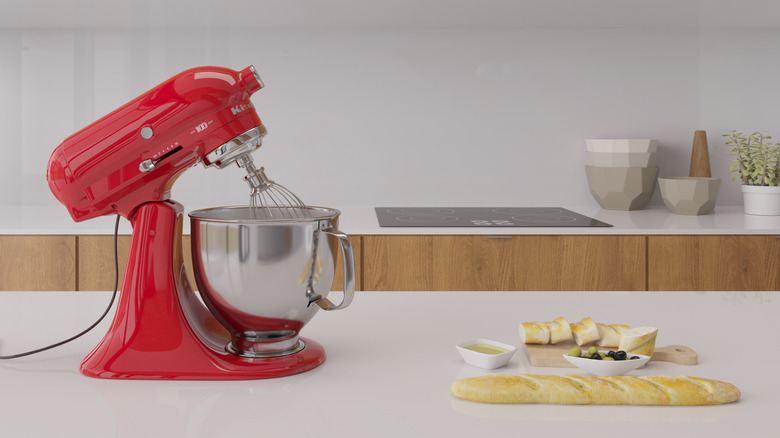
The KitchenAid stand mixer is an iconic and beloved kitchen appliance. With its instantly recognizable silhouette and rainbow of color options, it's a staple on wedding registries and a must-have for retro-style kitchens. Whether vintage or new, once you've used a KitchenAid, it's hard to imagine whipping egg whites by hand ever again.
Long before it became a household name, KitchenAid got its start in industrial settings. In 1908, the Hobart Manufacturing Company created the Model H, a massive 80-quart mixer used in commercial bakeries, restaurants, and even aboard naval ships. A decade later, in 1919, Hobart introduced the Model H-5, a smaller version designed for home cooks. Though it looked more like lab equipment than a countertop appliance, it was a game-changer for cooking and baking.
In 1937, KitchenAid debuted the Model K, the first to feature the iconic shape we know today. Despite launching in the middle of the Great Depression, its innovative form and function made it stand out. By 1955, a variety of colors were introduced, adding a cheerful, customizable touch that made it stand out on any kitchen counter.
Today, vintage KitchenAids can fetch high prices depending on the model. A green K5-A — considered one of the best models KitchenAid ever made — is currently listed on eBay for nearly $800. Older units stamped with the Hobart name are especially sought after.
Carbon steel knives
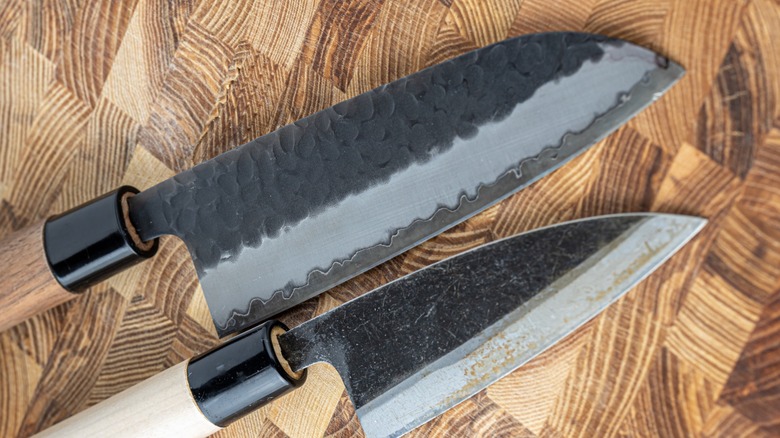
Carbon steel is a special material for knives: it sharpens easily and holds its edge for a long time. However, one big tradeoff is that it will rust if it's neglected. That's why a crusty old knife in an antique store could actually be a high-quality carbon steel blade left to the elements. Although severe rust can thin the metal and affect performance, many rusted knives can be restored to their former glory with a bit of effort.
For much of the 20th century, carbon steel was considered the superior material for kitchen knives in comparison to stainless steel. For vintage collectors, carbon steel remains the gold standard, particularly if you're willing to put in a little maintenance into them. As expert Nathan Gareau wrote on knifewear.com, "If you like cast iron pans, vinyl records, or any other hobby requiring a little extra work on your end, you will LOVE carbon steel knives."
These blades also develop a unique patina over time that chefs and collectors adore. When slicing fruit or vegetables, the steel reacts with each ingredient, gradually tinting the surface with a range of colors from grey and blue to brown and orange. Each patina is one-of-a-kind, showing the history of all the meals prepared with the knife.
Some of the best vintage brands include Sabatier from France and F. Dick from Germany. A 9-piece F. Dick set is currently listed at nearly $4,000. Individual knives can be valuable too — one chef's knife from F. Dick is going for $550, while a vintage Sabatier model is listed at $500.
Peugeot pepper mill
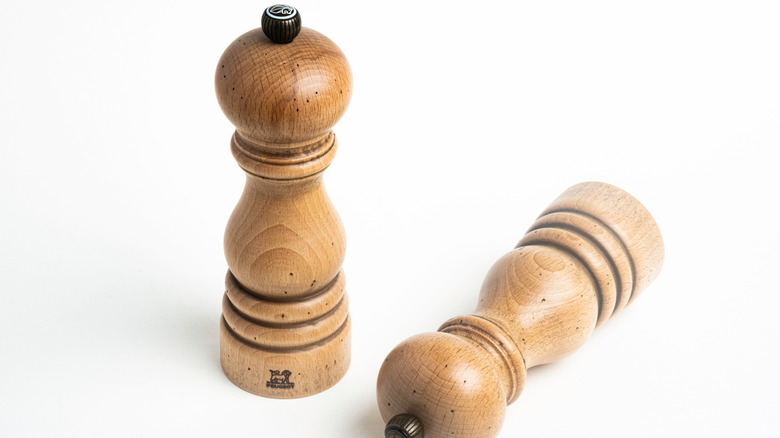
It's always a bit surprising to learn that Peugeot, the company best known for its cars, also makes some of the world's best pepper mills. The connection lies in the company's roots. In 1810, the Peugeot brothers converted their family's flour mill into a steel mill and went on to produce everything from tools and sewing machines to corset stays and watch parts. In 1874, they introduced their iconic pepper mill, often considered the best in the world due to its grinding mechanism. The adjustable top knob allows for custom grinding, from coarse cracks for steak to fine dustings for sauces. At one point, the Peugeot company actually split in two: Les Fils de Peugeot Frères was responsible for kitchen tools and bicycles, while La Société des Automobiles Peugeot made cars. The two branches eventually rejoined in 1910.
While Peugeot cars are iconic in their own right, the pepper mills have a global following as well. According to legend shared on its website, during a 1930s banquet for automobile manufacturers, someone told Jean-Pierre Peugeot that everything in the room was American-made. He reportedly picked up a pepper grinder and replied, "Almost all, except this, which is French. And what is more it's Peugeot." Today, vintage Peugeot pepper mills can fetch high prices, with some selling for $250 or more each.
Napier cocktail shaker
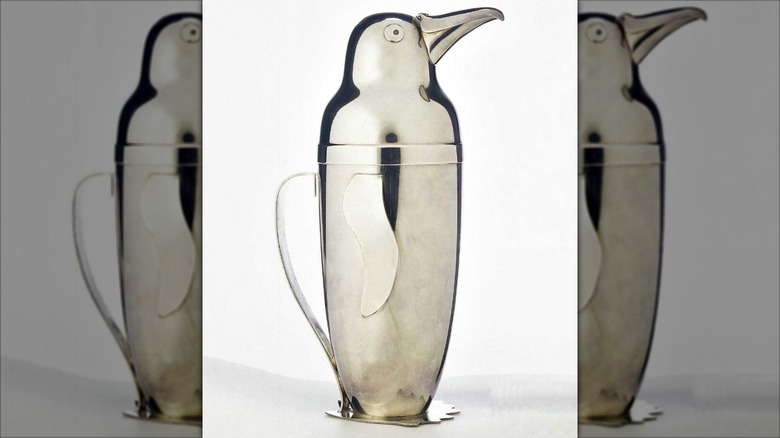
The cocktail shakers made by The Napier Company are so well-designed and collectible that they've been featured in museums. Founded in 1875, Napier is best known today as a jewelry company, but in the 1920s, it briefly pivoted toward crafting high-quality barware. Inspired by sleek European styles seen at the 1925 Paris World's Fair, Napier's creations blended modernist design with a sense of fun and practicality.
One of its most famous creations is the "Dial-a-Drink" shaker, a cleverly designed tool that shows different cocktail recipes as you twist the outer sleeve. These regularly sell for $600 or more on eBay, depending on the condition. Even more sought-after are Napier's penguin-shaped cocktail shakers; these whimsical Art Deco pieces routinely fetch $750 to $1,400, with rare examples climbing even higher. One recently sold for $4,375, while another brought in about $7,000 at a Christie's auction in 2013.
Other Napier barware, like their mouse-shaped jiggers, reflects the same mix of playfulness and utility. But be warned —many reproductions exist, especially of the penguin. Authentic Napier pieces are marked, feel solid in the hand, and are fully functional as bar tools.
Syroco corkscrews

Among the quirkiest and most collectible vintage tools are the decorative corkscrews made by Syroco, short for Syracuse Ornamental Company. Based in Syracuse, New York, the company was founded in 1890 by Adolph Holstein and became known for decorative molded wood-pulp items that mimicked the look of intricate hand-carving. Originally, they made fireplace mantels and interior décor for Victorian homes, but by the mid-20th century, they were crafting novelty items like corkscrews.
Syroco corkscrews from the 1940s and '50s feature whimsical and somewhat creepy characters like butlers, clowns, and monks. Many of these figurines have detachable heads that reveal the hidden corkscrew inside. Collectors should watch for mismatched or replacement parts, as original heads and bodies add to the value. While the designs are undeniably old-fashioned looking, there are many dedicated Syroco collectors out there who particularly love these quirky corkscrew designs. Highly collectible today, certain rare models (especially the older or elaborate ones) can fetch serious money. One Syroco corkscrew shaped as an "Old Codger" recently sold on eBay for $800.