

Avoid This Mistake When Paying For Tapas In Spain

Ordering tapas in Spain means embracing joyful disorder. Tiny plates arrive stacked with boquerones en vinagre, dense wedges of tortilla, and paper-thin jamón that melts in your mouth. Servers weave effortlessly between tables as friends lean in to share bites and pour another splash of vino tinto. There's no formal seating, no individual orders. Traditional Spanish tapas exist to be shared: a casual, messy, and social ritual. If your first impulse when the check arrives is to pull out a calculator or divide the bill precisely, you've missed the point entirely.
Historically, the word "tapas" referred to bread placed over drinks to keep flies away, the establishment's act of hospitality. Over time, it evolved into something more broad and culturally meaningful: a casual way to be together in public, without the structured and intricate formalities of a full-course dinner. Plates appear and vanish throughout the night at random intervals, but conversation, red wine, and generosity keep flowing.
When the check arrives, visitors to Spain often freeze, unsure how to navigate payment in this uniquely communal setting. But tallying green olive consumption percentages and counting coins isn't just awkward and inconvenient, it goes against the grain of the entire experience. Letting go of familiar payment routines when traveling can feel uncomfortable at first, but it transforms your experience. Engaging with local customs demonstrates respect, deepens interactions, and opens authentic moments of connection.
Splitting the bill misses the mark in Spain
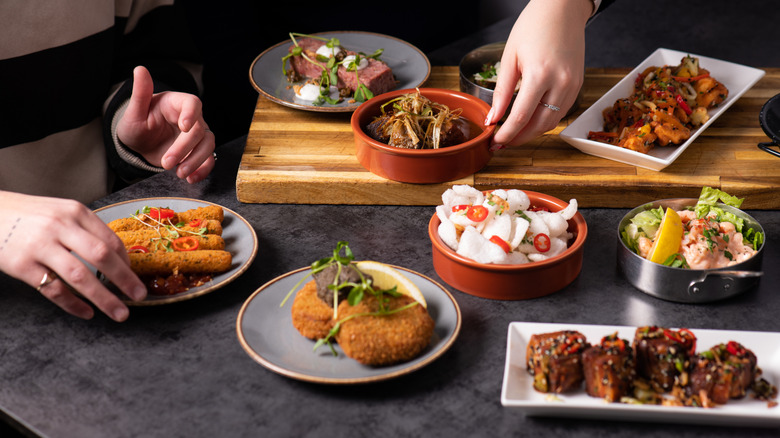
The impulse to neatly split a tapas bill isn't just unusual in Spain, it actively disrupts the social rhythm. Servers in loud, crowded bars move quickly. They're juggling plates and pouring drinks, accustomed to glancing at a handful of cash or running a card and moving on. Handing over multiple cards, explaining over the din who had what, or pulling out calculators to split the bill one too many ways grinds this dance to a halt. Some places may straight up refuse to split the bill, or act like they don't understand what you're asking.
But beyond practicality, there's a deeper cultural layer: Paying individually goes against the grain of sharing which is at the heart of tapas, implying distance or formality and suggesting diners aren't truly connected. Tapas culture rests on subtle exchanges of hospitality, a "vuelta" (turn), one friend casually covers today's drinks; someone else will pick up dinner tomorrow. The Spanish have a phrase for this fluid reciprocity: "Hoy por ti, mañana por mí" ("Today for you, tomorrow for me"). This tradition reinforces friendships, building trust without ever explicitly tallying debts.
Someone might step in to say, "invito yo" ("I've got it"). But the usual practice is to create a collective bote, or a kitty, for the night. A pool of euros is dropped casually from the bote at the center of the table. The bartender takes what's needed, and if there's extra, it goes toward the next round or into someone's pocket for coffee tomorrow. It's informal and very Spanish. Everyone chips in a little and no one feels shortchanged.
How to pay for tapas like a local

When tourists insist on dividing bills precisely, the gesture seems out of place because it imposes a kind of transactional logic on an experience intentionally designed to resist it. Spaniards aren't bothered by occasional imbalance because their hospitality naturally cycles through, it's part of the give and take of their social economy. It's understood that generosity evens itself out over time, making detailed accounting both unnecessary and oddly inappropriate.
Consider joining in on the local customs of generosity. If your friend covers one meal, pick up the next round of drinks. Or propose making a bote right away. Letting go of the urge to track every euro creates a relaxed atmosphere, allowing you to truly focus on the important, Spanish stuff: the food, the conversation, and the ambiance.
When you're traveling, it's easy to cling to familiar routines. But traveling isn't just sampling and seeing, it can be stepping into the ways locals live, eat, and interact. So when you see that tapas bill heading toward your table, resist the impulse to dissect it. Trust the local rhythm, embrace the generous spirit at the heart of Spanish dining, and allow your evening to unfold naturally.