

Why Is Cow Milk White?

If you've ever stared into a glass of milk and wondered, "Why is this stuff so bright white?" you're asking a question that bridges both kitchen science and weird, cookie-induced late-night curiosity. The answer is actually about physics, not just biology. Cow's milk looks white because it's packed with tiny round particles. It's basically a complex suspension. Milk is made up of billions of tiny fat droplets and protein clusters (mainly casein), all floating together in water. When light shines on the liquid, those tiny particles scatter the light in every direction, a phenomenon scientists call the Tyndall effect.
Unlike clear liquids, where light just passes through, or colored ones, where pigments absorb certain wavelengths, the structure of milk means almost all visible light gets bounced back to your eyes. That creates the opaque, almost glowing whiteness you see — the same reason clouds look white. But why don't you see green or yellow, even though cows mostly eat grass and hay? Because chlorophyll and other plant pigments are digested by the cow and broken down before they ever make it to the udder. Instead, the nutrients from grass are reassembled in the cow's body into things like fat, protein, and sugar. None of those, in their pure form, are green.
Goats and sheep break this pigment down more efficiently, so milk from these bovids can look even brighter white because they have slightly different fat and protein makeups (and less of a yellow pigment called beta-carotene). Cow milk sometimes looks a little creamy or yellowish, especially if it's whole milk, thanks to leftover beta-carotene from grass. Skim milk looks bluish because removing fat lets more light pass through, and what bounces back is mostly blue wavelengths. This faint tint is usually only noticeable if you pour skim milk into a clear glass and squint.
The colorful world of cheese
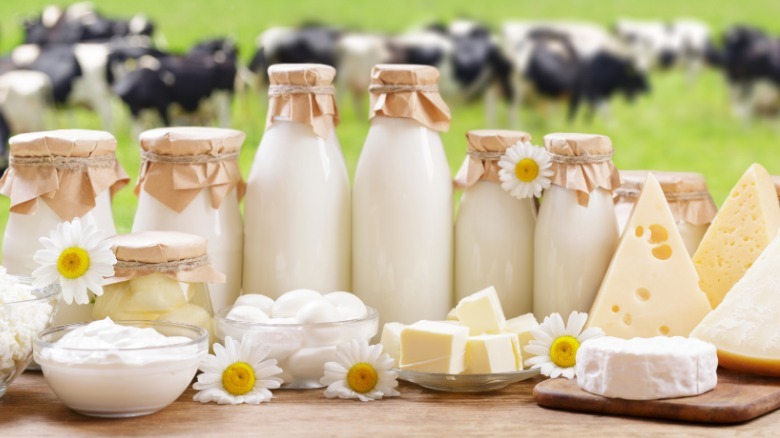
Okay, so if milk is so white, then why is cheese sometimes yellow, orange, or even blue? First, some cheeses are actually still white — think mozzarella, feta, or goat cheese. That's because not much changes in the color department if you keep the process simple. But for cheeses like cheddar, the color can shift. Part of it is concentration: When you make cheese, you remove water and some proteins, so the fats and whatever tiny pigments are left become more obvious. This is also why cheese has more protein than milk.
Cows that eat a lot of fresh grass produce milk with a little extra beta-carotene (the same yellow pigment that makes carrots orange), making their milk (sometimes called grass milk or grass-fed milk) and cheese a more deeply saturated cream-color, rather than pale, eggshell white. When cheese is made, that pigment can build up, giving the cheese a yellow or golden hue. Some cheeses, especially American or British cheddar, have even had annatto (a natural, plant-based coloring) added for centuries, just to make them look more "cheddary." In fact, this color can tell you where the cheddar was made.
If you see a cheese that's a wild color, it's often because the makers added something to make it stand out. And about those blue cheeses? That's a whole different color story, with edible molds doing the heavy lifting – nothing to do with milk color, but everything to do with fermentation. Cheese and butter go off on their own color adventures, but every dairy snack starts with that same blank, milky canvas. And it all comes down to the way light bounces off those microscopic fat and protein particles like a delicious disco, leaving you with a glass of pure, opaque white. Science is everywhere, man.