

The Breakfast Staple That Was Sold Mostly In Cans Before Its Iconic Bottles
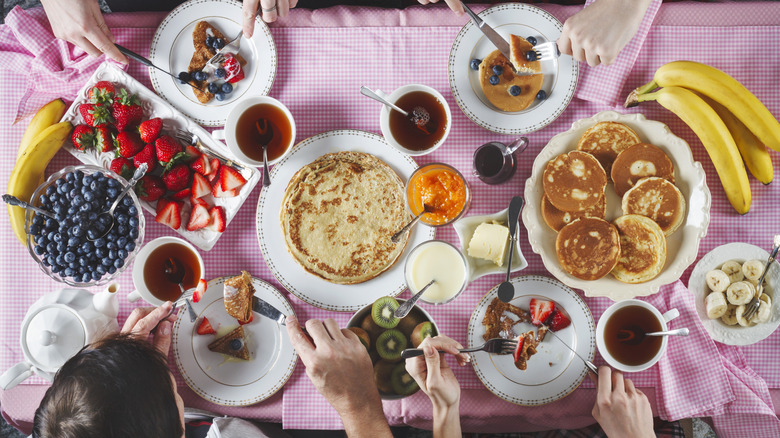
Sit down at a breakfast table in the U.S. or Canada, and odds are pretty good that you'll find a plastic or glass bottle of maple syrup there to greet you. While these days it is expected that your pancakes and waffles can easily be topped with a squeeze or a pour of that iconic amber sweetener from a translucent bottle, this was not always the case. In fact, as strange as it sounds, there was once a time when maple syrup was sold primarily in metal cans — often measuring as much as an entire gallon. Yet, perhaps even more surprising than the packaging is the fact that, prior to these metal cans, maple syrup was not a common breakfast product at all.
Maple sugaring — the process by which sap is harvested from maple trees and boiled down to concentrate its sugars — is a tradition with a long history. Explorers as early as 1609 recorded Native Americans making use of maple sap for its sweetness, both with simple techniques (like boiling meat in the sap) and more complex early sugaring procedures. Early settlers from Europe learned the practice of sugaring from the native populations, and it became a part of the agriculture of the American colonists as well. But this springtime tradition was not a process for making syrup as we typically consume it today. No, the original product of these endeavors was something quite a bit more shelf-stable: maple sugar — one of the best non-syrup maple products.
From maple sugar to maple syrup

The process of turning maple sap into maple sugar requires boiling large amounts of sap down, which steams off the water and concentrates the sugars. After enough water is removed, the syrup begins to crystallize and can be poured into molds to harden. Once hardened, the sugar is easily stored as is or grated into bits to be used in cooking and baking. While it is not nearly as common in the kitchen anymore, you can still buy maple sugar, and it is still used as an alternative to other refined sugars, particularly in places where maple products are especially popular — like Canada, the country where the most maple syrup is made.
As the sap boils down in the sugaring process, the syrup gets steadily thicker. The way it was traditionally done, in large batches in sugar shacks, it took hours or even days of boiling to reach the final product. Throughout the process, the pot let off fragrant, maple-scented steam. It is no wonder that the workers steeped in this intoxicating scent would also make use of what might otherwise be considered a mid-process product: the maple syrup.
One way that this syrup was enjoyed was in the form of a must-try winter treat that is still popular to this day called wax sugar, maple taffy, or tire sur la neige (which translates to "draw on the snow"). Thick maple syrup is poured over snow, thickening it into a taffy-like treat. The trouble was, despite how delicious maple syrup is, until the advent of canning, there was not a good way to get it to market.
How cans brought maple syrup to the breakfast masses
Clearly, pure maple syrup has long been enjoyed, but the difficulty came in the storage process. While maple sugar could easily be popped on a shelf for later use, liquids like maple syrup were both hard to transport and at risk of spoiling. It wasn't until the invention of canning that the mass consumption of maple syrup became a real possibility.
Canned food first came about when a Frenchman by the name of Nicolas Appert first developed the process in 1809, but it didn't properly take off for a few more decades. The process began gaining popularity in the U.S. in the 1820s, but the canned rations of Civil War soldiers greatly expanded the industry in the 1860s. By the 1870s, canned maple syrup was a market on the rise.
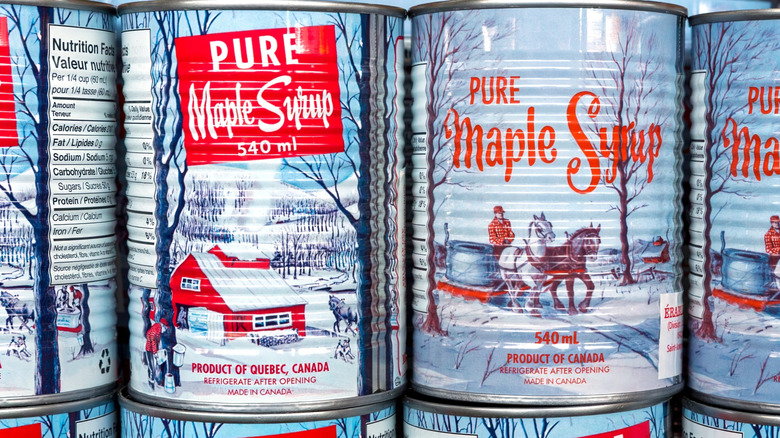
Cans of maple syrup, of course, gave way to bottles, so it could perhaps be added to the list of vintage canned foods that no one remembers anymore. However, the legacy has persisted. While no longer common, you can still buy maple syrup in metal cans today, such as this Canadian-made Pure Maple Syrup from Decacer. Whether you're making a batch of maple biscuits and gravy, whipping up some maple bourbon steak tips, or just pouring it over a tall stack of pancakes, the classic can does have a nostalgic feel, giving a nod to the origins of this favorite ingredient.