

How Pitmasters Control Smoke To Make The Perfect Barbecue

We may receive a commission on purchases made from links.
When it comes to really good barbecue — the kind you get from the absolute best barbecue restaurants in the U.S., where people start lining up at dawn — the careful use of smoke is crucial. The taste of smoke is an essential component — a key ingredient, really — but it can also easily be overdone. Too much, and your barbecue goes from deliciously smoky to ashy or burnt. For a little insight into how pitmasters achieve this perfect balance, Tasting Table spoke with Brandon Hurtado, chef and author of "Barbacoa: The Heart of Tex-Mex Barbecue."
Straight out of the gate, Hurtado has an answer for us as well as a technique. "When smoking meats, I try to introduce more smoke at the very beginning of the cook, then run a cleaner fire with the smoke stack more open throughout the duration of the cook," he says, adding that this method prevents "an overly smoky or 'dirty' acrid taste." But what exactly does it mean to burn a "clean" fire?
A clean fire, as Hurtado explains, simply means that the wood is burning well. And the best tool to judge the cleanliness of the burn is the color of the smoke. Hurtado elaborates that a clean-burning fire will create a light blue smoke that doesn't carry too much unwanted flavor. Heavy, dark smoke with a strong, acrid smell is what you want to avoid. And the trick to that, it turns out, is also the key to all smoking: fire management.
Harnessing the power of smoke in your backyard
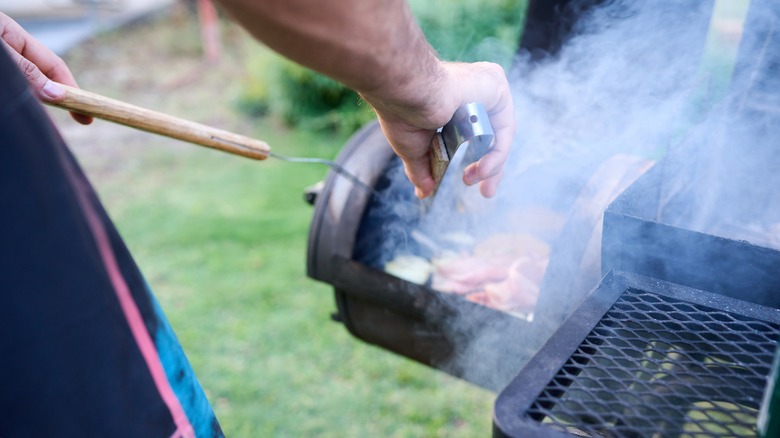
As Hurtado puts it, "Fire management is the most important part of becoming a pitmaster." His top advice for home cooks and aspiring pitmasters alike is to learn the ins and outs of whatever smoker you are working with, as well as the different fuels and conditions. Ensuring your fire gets enough ventilation is also key. "Everything affects how you manage a fire (and barbecue smoke)," he says, "from the environment you're cooking in, to the type of wood or charcoal you're cooking with."
It is no mean feat to master your smoker, and Hurtado pulls no punches in his explanation of the difficulty. "At the end of the day," he says, "it can take months, or even years of practice and cooking with different variables, to produce a consistent product that your friends and family enjoy." But we all knew that the art of smoking was not one that would come easily. Whatever your preferred regional barbecue style, there is a certain amount of hard-won finesse required to do it just right.
The good news here is that the arc of learning on your way to pitmaster status is filled with delicious — if not quite perfect — smoked meats. If your smoked pineapple ham comes out a little light on smokiness, no problem, it's still delicious. Likewise, smoked country-style ribs that are a touch heavy on the smoke might just need a little extra sauce. Once you get it dialed in, you can even try your hand at adding a taste of smoke to chocolate ganache.