

If You're Missing Kernels When Growing Corn In Your Backyard, Try Doing This
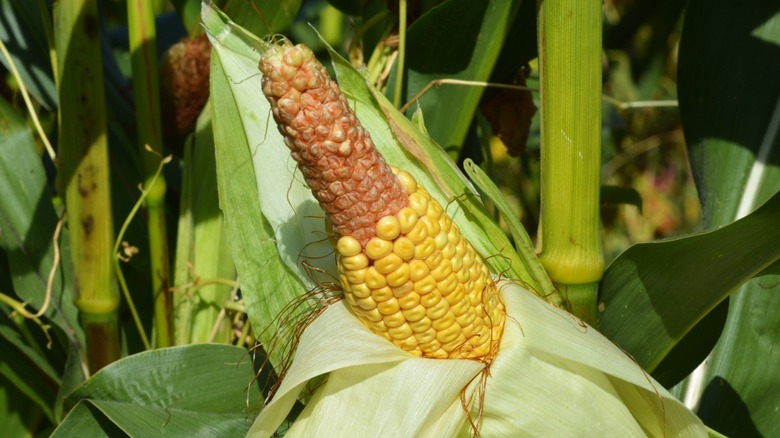
If you're a new gardener and your corn is missing kernels when you harvest it, it's because the ears weren't fully pollinated. Thankfully, you can fix that on your next attempt to grow a crop. You need to hand-pollinate your corn. Typically, corn is grown in squares or in massive fields filled with plants, and this plays a huge part in the pollination process. When there are rows and rows of corn all growing together in a big field, all it takes is a gentle wind to blow the pollen around and pollinate every plant. That's why it is recommended that you grow at least 18 corn plants together in a block for them to pollinate properly on their own.
Sometimes, that isn't possible due to space constraints. But even if you're growing the minimum number of plants and not a whole field, you should still hand-pollinate them to ensure that all the kernels develop. How much space you have is something to consider before planting a garden. But if you're a backyard or container gardener with limited room to work with, you can still successfully grow corn — even if it's just a handful of plants. You'll just have to take a couple of extra steps to ensure you have cobs with whole rows of corn kernels.
Here's how to hand pollinate your corn
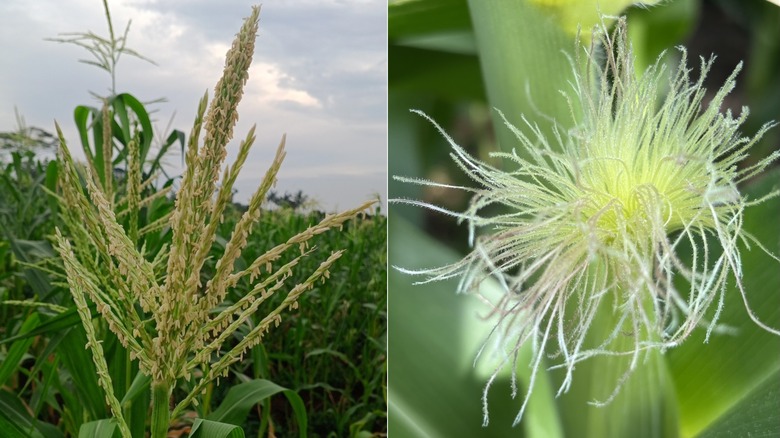
If you're growing a small number of plants, there are two different steps to take in order to ensure your corn is fully pollinated. The first is to cut one of the tassels with a bit of pollen on it (pictured left) and rub it all over the sticky silks sticking out of the lower parts of the plant (pictured right), making sure to touch the pollen to every single silk. Each silk on a corn cob is connected to where the kernel should develop, so a kernel won't grow there if that individual silk isn't pollinated. This is why the corn silk can help you pick out the best ears of corn at the store. The next step to ensure proper pollination is to gently shake the corn stalks, knocking the pollen loose and spreading it among the silks sticking out of each cob below. This mimics nature, as the wind typically shakes and moves pollen from the tassels to the silks.
The best time to do this is within the first 10 days that the silks start sticking out. Hand pollinate your corn in the morning after the dew has dried off, but don't wait until it's too hot, excessively dry, or pouring rain, as that can negatively affect pollination. In a normal cornfield, there's so much pollen moving among rows and rows of corn and from field to field that it would be rare for the cobs to have missing kernels – and if they did, it wouldn't be many. But when you've got just a handful of plants in a backyard, that's when pollination gets tricky and you have to take matters into your own hands. Corn can be a little bit complicated, but after you master how to grow it, it'll be worth the hard work when you can throw fresh husks of corn on the barbecue. To enjoy all of your hard work, here's the best way to grill corn.