

The Special Spice Jamie Oliver Always Keeps In His Pantry

We may receive a commission on purchases made from links.
It would be nearly impossible to talk about Basque cuisine without mentioning the Espelette pepper. Espelettes hail from Basque Country near Spain, the home of heralded culinary triumphs like Rioja wine and Basque cheesecake. But, make no mistake that piment d'Espelette is a uniquely French pepper that brings smoky, spicy, robust flavor with a subtly citrusy undertone. It's attractive, yet difficult to source. Still, thanks to its dimensional, distinctive flavor and gentle touch of heat, Espelette pepper has earned its place as a permanent fixture in Jamie Oliver's kitchen.
As Oliver shared in an interview with The Times last year, "It's my favourite ingredient of the past decade. It's my new craze. It's phenomenal. I have at least three jars at home because I use it so passionately." Espelette is such a staple in Oliver's kitchen that he considers it "a third seasoning," claiming, "It's the most versatile spice in my cupboard." In fact, even fellow celebrity chef Bobby Flay is an outspoken fan of fiery Espelette pepper.
On the palate, Espelette pepper is slightly sweet, yet with unmistakable umami depth. Reaching up to 4,000 Scoville Heat Units, Espelette peppers clock in at mildly hot, offering roughly the same heat intensity as a mild jalapeño or poblano pepper. It won't sear foodies' taste buds with heat, rather bring an impressively zesty flavor to dishes.
How to use Espelette pepper and where to buy it
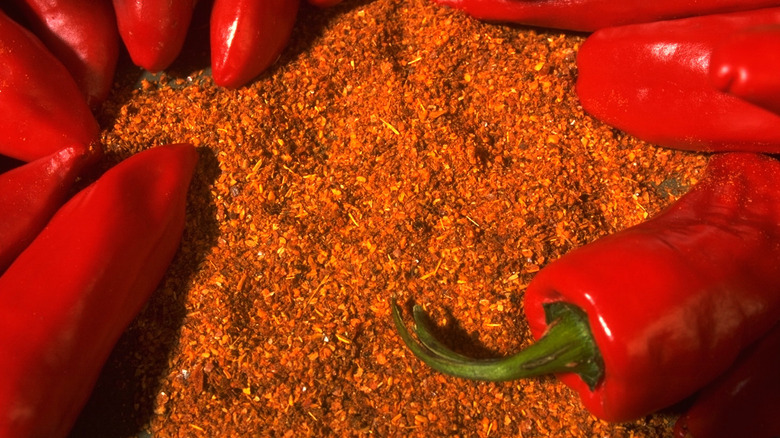
"Espelette is slightly flaky so it's great for sprinkling; it's easy to distribute," Oliver tells the U.K. outlet. He explains, "Vegetables, meat, fish, salad, dusted over soup — it goes with almost everything." A pinch can be added to anything from dressed salads to grilled cheese toasties to stuffing. Oliver even recommends using it in an arrabiata pasta sauce. Espelette is also a common ingredient in many Basque recipes like our comforting chicken stew with French and Spanish influences. The spice can be added into French quiche or Spanish paella, and a variety of cream sauces, too.
The Espelette pepper is such a staple of Basque culinary style that it earned AOC (Appellation d'origine contrôlée) status in 2000 as a product with protected origin. Authentic piment d'Espelette must be grown in the French region of Espelette and processed according to strict standards. Fresh peppers tote a bright red hue at maturation, growing to about six inches long and sporting a chili pepper curve. Ripe Espelettes are often strung together and hung to dry.
Beyond Basque Country, the pepper is typically found in its dried, flaky form, with an orange-brown color and an aromatic profile of hay and charred, grilled fruit. For foodies located outside of France, the best way to track down ground Espelette pepper is to purchase it from an online retailer – a 1.41-ounce jar like Biperduna's Piment d'Espelette will set you back about $9.