

What To Know About Scallions Vs Shallots Before You Swap Them
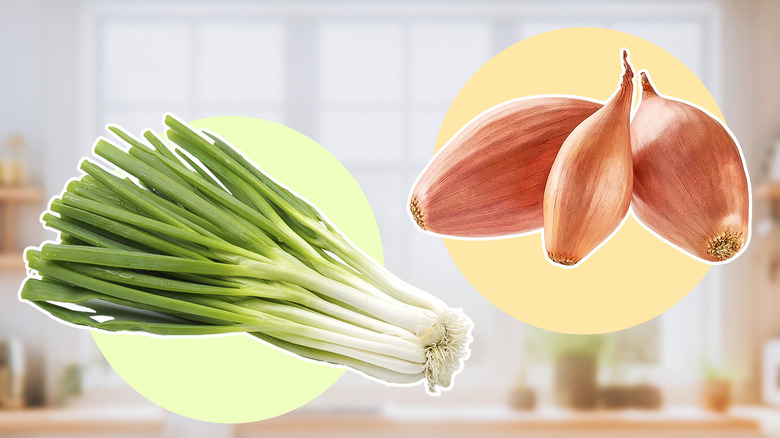
Scallions and shallots are both mild, oniony vegetables that lend a zing to salads and help build the base of many recipes when cooked, but there are some key differences in their flavor that you should consider before swapping them. Let's take a closer look at both alliums. Scallions, which are also called green onions, depending on where in the United States you're based, are whole onions that are harvested very young. Scallions have a green stalk and no discernible bulb. They are not the same as spring onions, which are also whole young onions, just harvested later so they sport a small bulb. Unless you're in the United Kingdom, that is, where spring onions and scallions are the same thing. Confused? It seems like everyone is.
For the purposes of this article, though, when we say "scallion," we're talking about the bulb-free, immature onions that look a little like skinny leeks. They have a distinctly oniony flavor but are milder than fully grown white or brown onions. The white ends of scallions contain the most flavor, but the whole plant is edible and can be eaten raw or cooked. Although discarded by many, the grassy, fresh green tops are often used in Asian cooking. Shallots, on the other hand, are not onions at all. They're just a close relative. Shallots are smaller and less uniformly round than onions, but they have a similar papery skin that's a beautiful bronze color. Their delicate flesh ranges from a warm gray to magenta. Shallots are sweeter than onions and scallions and are sometimes described as tasting like onion and garlic combined. This cousin of the onion is closely associated with French cooking, including in dressings and sauces (like this flavorful red wine sauce).
How and when to swap scallions and shallots
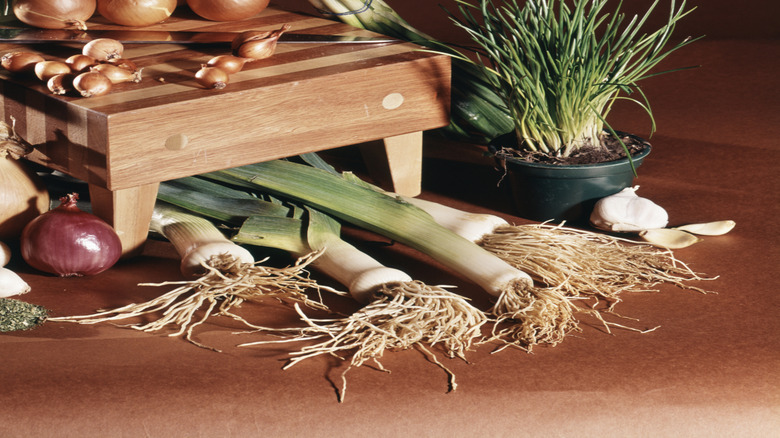
Shallots are not only sweeter than scallions, but they also have a deeper flavor than scallions when cooked. Although scallions will caramelize, shallots are usually a better choice in sauces and stews, with yellow onions a close second. If all you have is scallions, their white flesh also work as part of the aromatic base of recipes like this, but the green ends should be saved for salads, a garnish, or Asian-inspired dishes. Cooked, the green tops behave a little like leeks, so keep this in mind when making substitutions.
If you're making fried rice or a noodle dish and you do not have scallions to hand, you can usually sub in shallots. Since they're sweeter, you might want to use a little less shallot than you would scallion. Garnishing noodle dishes, salads, or soups and stews with shallots is delicious, too. Just remember that you won't get the vegetal tang or visual excitement scallion greens provide. Both scallions and shallots can also be used in dressings, dips, and spreads. The sweetness and mild onion flavor of both can be complemented by fresh herbs, while their onion zing is softened by fats like olive oil or cream cheese. As with all substitutions, there may be a little trial and error involved in swapping shallots and scallions, but they are similar enough that you are very unlikely to ruin a recipe if you go a little off-piste with your alliums.