

How To Make Charcuterie Fancy Without A Wooden Board In Sight
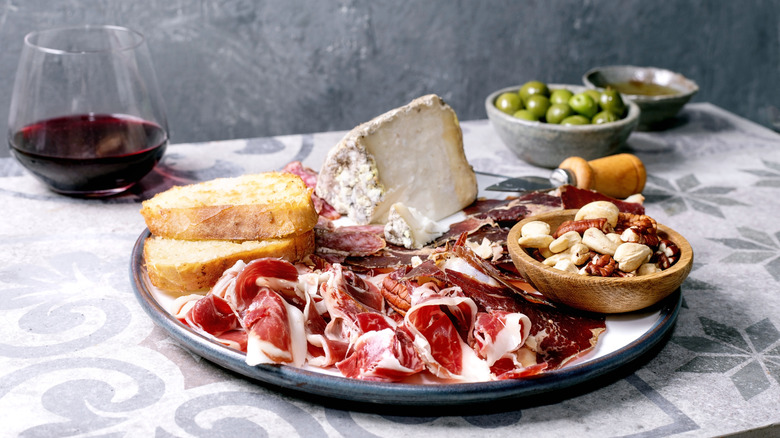
Wooden boards may be all the rage for charcuterie spreads, but it's really the contents of the board and their presentation that are most important when assembling an impressive charcuterie spread. While wooden boards, marble platters, and ceramic trays may look gorgeous on their own, most of that charm gets covered up with meats, cheeses, and other accoutrements, rendering the pretty vessel practically moot. We're here to shatter the illusion that wooden boards are a must-use for charcuterie boards and encourage you to use an alternative that's likely already well-loved in your kitchen.
One of our favorite alternative uses for sheet pans is to swap them for heavy wood or marble boards. Rimmed baking sheets are dramatically lighter than a thick wooden board, making them much easier to handle and transport, and the rim along the edges actually helps to keep the contents tucked in and prevent spillage. Using your cleanest baking sheet is ideal, but it doesn't have to be perfect. The best way to build a charcuterie board on a metal baking sheet is to lay down a couple of sheets of parchment paper so the edges of the paper come up just above the rim of the sheet; you can angle them slightly to make the overlapping edges look a bit more rustic. If you happen to have them, overlapping paper doilies also make for a great, fancy base on top of the parchment.
A fancy charcuterie board is all about visual intrigue
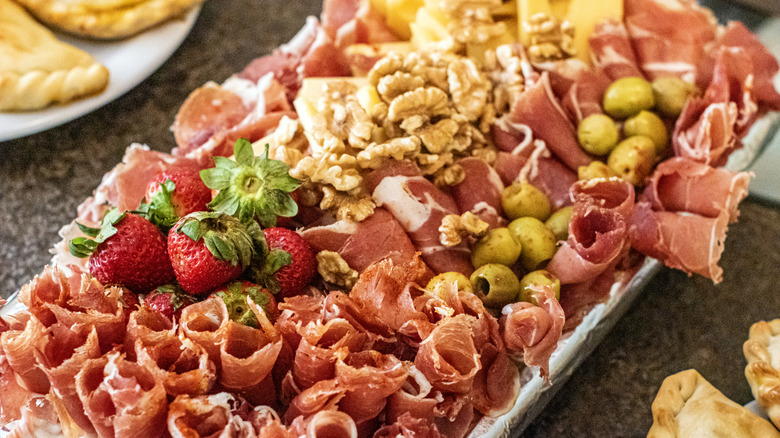
With the metal tray below mostly invisible, you're starting with a blank slate, and it's all about making the most of what you have on hand. Other than the colors and diversity of the meats and cheeses you'll use, think of ways you can add more visual interest using what you already own. Use small, decorative bowls of varying sizes to give your board some dimension and character, as well as a variety of small serving spoons, cheese knives, and tiny forks for spearing meat. Select different fruits, nuts, olives, pickles, and jams to create a vibrant platter filled with different tones and textures.
Once you have your ingredients ready, you can prepare and display them in visually intriguing ways. Slice and neatly arrange harder cheeses, but leave softer cheeses whole or simply slice in half for contrast to the hard cheeses. Pile thinly sliced meats like prosciutto in a tall, airy stack to create height, and fold other sliced meats like salami in creative ways, like a Valentine's Day-inspired salami rose or into triangles that overlap and form a sort of river through the other ingredients. Some of those smaller items, like pickles, olives, jams, etc., can be placed in the small bowls, while less messy items like nuts and fruit can be strewn about the board, filling in the gaps between the meats and cheeses. The goal is to fill the board so that there are no negative spaces. Garnish everything with a few sprigs of whole herbs, or even small flowers.