

You Can Eat Saffron Flowers, But Only From This Variety
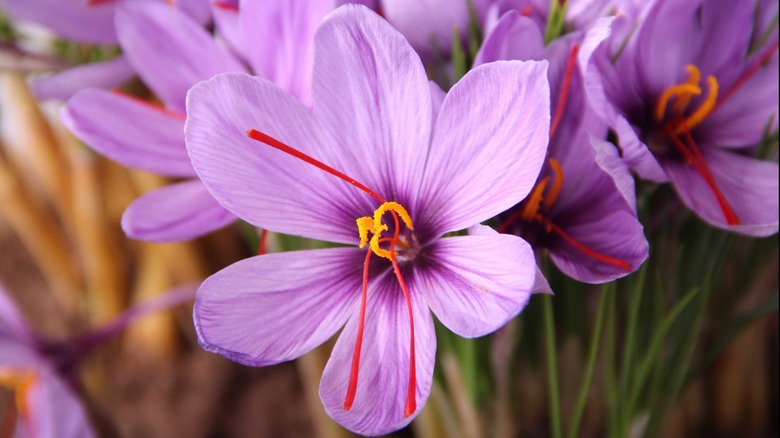
Not every purple crocus is your friend. The part of the plant you actually eat — the vivid crimson stigmas — produce saffron, the world's most coveted and expensive spice, and they come from just one plant: Crocus sativus. These stigmas are the powerful but fragile filaments that color Spanish paella, perfume Persian rice, and give countless dishes, from desserts to broths, their distinct golden tint and earthy-sweet complexity. Yet for all their fame, most of us have never seen a saffron crocus up close, and few realize how risky it can be to mix up crocus species in the garden or kitchen.
Despite their resemblance, most crocus species and lookalikes are inedible or outright dangerous. More than 80 different crocuses grow worldwide, many blooming in lawns or woodlands each spring and fall, harbingers of seasonal change. Some, like the so-called autumn crocus (Colchicum autumnale), carry toxic alkaloids that can cause severe poisoning. The visual similarities can fool even seasoned gardeners, and accidental poisonings have been recorded, with reports describing cases where foragers or cooks fell ill after confusing toxic autumn crocus with their edible cousin, or even used it intentionally as a poison.
In regions where saffron is cultivated, generations of local knowledge help distinguish the safe from the risky, but the margin for error is slim. Each fall, in places such as Kashmir, Iran, Greece, and Spain, fields erupt in streaks of violet as saffron crocus flowers bloom for just a short window. Harvesters move quickly, picking three red stigmas from each blossom by hand — a painstaking process, especially considering that tens of thousands of flowers are needed for a single pound of saffron. This careful work and small yield explains why saffron is so expensive. These threads are the only part of the plant that's widely used as food, and even then, in tiny doses.
How to identify real saffron

Spotting genuine saffron, whether in a market or the garden, calls for careful attention to detail. The true saffron crocus blooms in autumn, and its flowers are sterile, with six purple petals, three bright red stigmas, and three yellow stamens. Unlike many spring-blooming crocuses that may be paler in color or lack the distinct thread-like stigmas, Crocus sativus always appears in the fall and never grows wild from seed. Reliable growers and specialty spice suppliers source their saffron from bulb-like corms, not packets of mixed crocus seeds, a detail that can make all the difference between a safe culinary experience and a risky experiment.
In the spice market, real saffron is always sold as dried, thread-like stigmas, never as whole flowers or ground powders mixed with other botanicals. The cost is high, but so is the risk of adulteration or substitution: Throughout history, everything from marigold petals to dyed corn silk has been used to fake saffron's appearance and stretch profits. Buyers are advised to look for vivid color, a faint metallic scent, and threads that stain water golden without dissolving instantly to discern real from fake saffron.
The significance of saffron extends well beyond the kitchen. In antiquity, the spice was used as a dye, a perfume, and a ceremonial offering in rituals from Greece to Persia. Saffron's association with royalty and the sacred endures, driven in part by the knowledge and labor required to produce it safely. Its history is dotted with stories of wars fought over crocus fields, laws written to prevent fraud, and myths claiming the plant sprang from the blood of ancient lovers. Today, the value of saffron is inseparable from its authenticity.
Botany and history of a singular spice
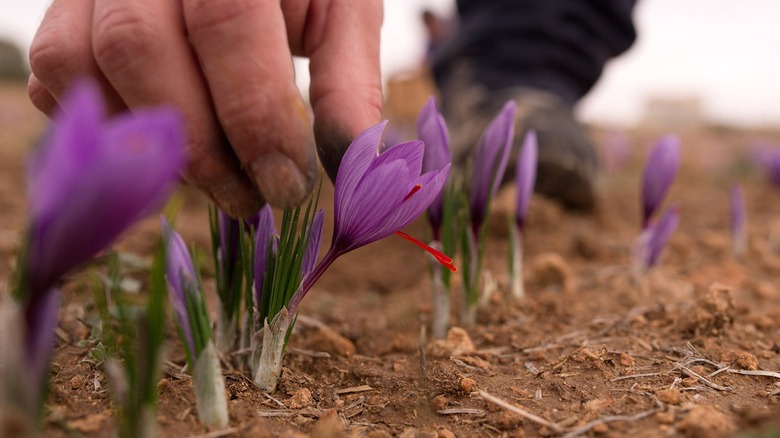
Botanically, Crocus sativus is a case of a plant depending on human intervention for survival. The flower's inability to reproduce by seed means all plants are propagated by carefully dividing underground corms, a process passed down for centuries in regions such as Kashmir and Iran (the country that produces most of the world's saffron), where growing the prized spice is both a livelihood and a tradition. This dependency on cultivation has driven selective breeding, gradually amplifying the intensity and safety of the spice's chemical makeup. What sets Crocus sativus apart from other crocus species is the chemical profile of its stigmas.
The red threads contain high concentrations of specialized compounds: crocin (which imparts the unmistakable golden color to food), picrocrocin (responsible for saffron's slightly bitter, earthy flavor), and safranal (the source of its floral, hay-like aroma). Other crocus species lack these desirable characteristics entirely, and several produce toxins that can cause anything from stomach upset to organ damage. Culinary saffron has been cultivated for over 3,500 years, and is prized not just for its color and aroma, but also for its trace minerals and antioxidant content.
Modern analysis has confirmed what ancient doctors have claimed: The stigmas contain antioxidants, carotenoids, and even neuro-influencing phytochemicals, which have contributed to saffron's long-standing use in both medicine and ritual. Contrastingly, wild and ornamental crocuses have evolved defenses, bitter flavors, and alkaloids that are acutely toxic to humans and animals. This chemical divergence is what makes proper identification so critical, and why centuries of tradition, science, and careful cultivation have all focused on Crocus sativus alone to produce saffron.